

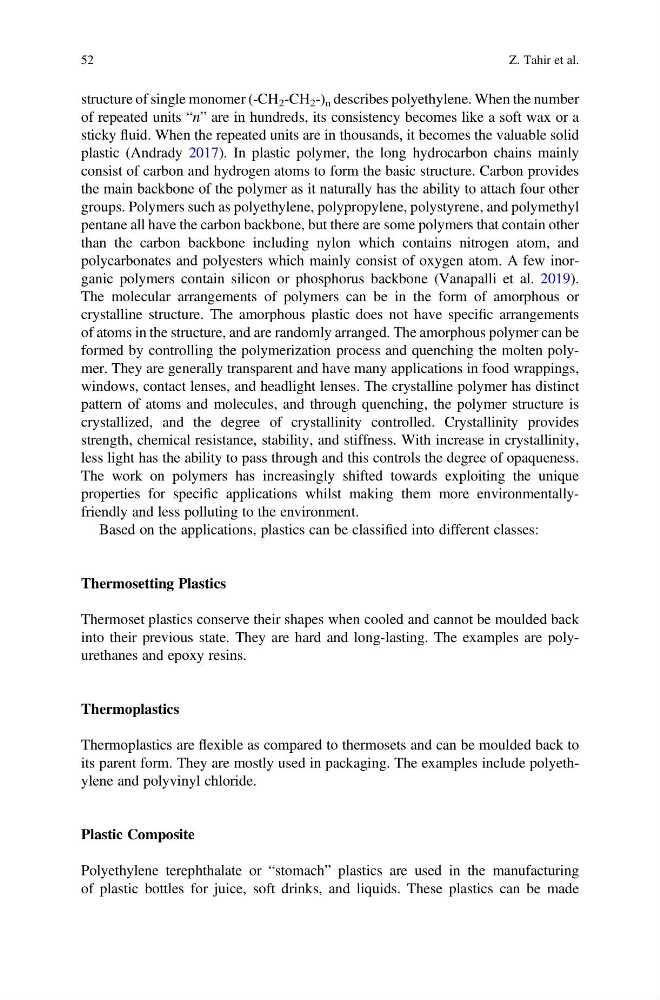
structure of single monomer (-CH 2 -CH 2 -) n describes polyethylene. When the number
of repeated units “n” are in hundreds, its consistency becomes like a soft wax or a
sticky fluid. When the repeated units are in thousands, it becomes the valuable solid
plastic (Andrady 2017). In plastic polymer, the long hydrocarbon chains mainly
consist of carbon and hydrogen atoms to form the basic structure. Carbon provides
the main backbone of the polymer as it naturally has the ability to attach four other
groups. Polymers such as polyethylene, polypropylene, polystyrene, and polymethyl
pentane all have the carbon backbone, but there are some polymers that contain other
than the carbon backbone including nylon which contains nitrogen atom, and
polycarbonates and polyesters which mainly consist of oxygen atom. A few inorganic polymers contain silicon or phosphorus backbone (Vanapalli et al. 2019).
The molecular arrangements of polymers can be in the form of amorphous or
crystalline structure. The amorphous plastic does not have specific arrangements
of atoms in the structure, and are randomly arranged. The amorphous polymer can be
formed by controlling the polymerization process and quenching the molten polymer. They are generally transparent and have many applications in food wrappings,
windows, contact lenses, and headlight lenses. The crystalline polymer has distinct
pattern of atoms and molecules, and through quenching, the polymer structure is
crystallized, and the degree of crystallinity controlled. Crystallinity provides
strength, chemical resistance, stability, and stiffness. With increase in crystallinity,
less light has the ability to pass through and this controls the degree of opaqueness.
The work on polymers has increasingly shifted towards exploiting the unique
properties for specific applications whilst making them more environmentallyfriendly and less polluting to the environment.
Based on the applications, plastics can be classified into different classes:
Thermosetting Plastics
Thermoset plastics conserve their shapes when cooled and cannot be moulded back
into their previous state. They are hard and long-lasting. The examples are polyurethanes and epoxy resins.
Thermoplastics
Thermoplastics are flexible as compared to thermosets and can be moulded back to
its parent form. They are mostly used in packaging. The examples include polyethylene and polyvinyl chloride.
Plastic Composite
Polyethylene terephthalate or “stomach” plastics are used in the manufacturing
of plastic bottles for juice, soft drinks, and liquids. These plastics can be made
52
Z. Tahir et al.
of repeated units “n” are in hundreds, its consistency becomes like a soft wax or a
sticky fluid. When the repeated units are in thousands, it becomes the valuable solid
plastic (Andrady 2017). In plastic polymer, the long hydrocarbon chains mainly
consist of carbon and hydrogen atoms to form the basic structure. Carbon provides
the main backbone of the polymer as it naturally has the ability to attach four other
groups. Polymers such as polyethylene, polypropylene, polystyrene, and polymethyl
pentane all have the carbon backbone, but there are some polymers that contain other
than the carbon backbone including nylon which contains nitrogen atom, and
polycarbonates and polyesters which mainly consist of oxygen atom. A few inorganic polymers contain silicon or phosphorus backbone (Vanapalli et al. 2019).
The molecular arrangements of polymers can be in the form of amorphous or
crystalline structure. The amorphous plastic does not have specific arrangements
of atoms in the structure, and are randomly arranged. The amorphous polymer can be
formed by controlling the polymerization process and quenching the molten polymer. They are generally transparent and have many applications in food wrappings,
windows, contact lenses, and headlight lenses. The crystalline polymer has distinct
pattern of atoms and molecules, and through quenching, the polymer structure is
crystallized, and the degree of crystallinity controlled. Crystallinity provides
strength, chemical resistance, stability, and stiffness. With increase in crystallinity,
less light has the ability to pass through and this controls the degree of opaqueness.
The work on polymers has increasingly shifted towards exploiting the unique
properties for specific applications whilst making them more environmentallyfriendly and less polluting to the environment.
Based on the applications, plastics can be classified into different classes:
Thermosetting Plastics
Thermoset plastics conserve their shapes when cooled and cannot be moulded back
into their previous state. They are hard and long-lasting. The examples are polyurethanes and epoxy resins.
Thermoplastics
Thermoplastics are flexible as compared to thermosets and can be moulded back to
its parent form. They are mostly used in packaging. The examples include polyethylene and polyvinyl chloride.
Plastic Composite
Polyethylene terephthalate or “stomach” plastics are used in the manufacturing
of plastic bottles for juice, soft drinks, and liquids. These plastics can be made
52
Z. Tahir et al.