

18.2.1 Silica Nanoparticles
A material should have an ordered porous structure and large surface area in order to
be a good absorbent. Accessible adsorption sites with excellent stability under
adsorption and regeneration conditions endowed the material with good adsorption
features. Porous silica has proven to be an excellent sorbent for wastewater treatment. Since their discovery in the early 1990s, their use is greatly extended for
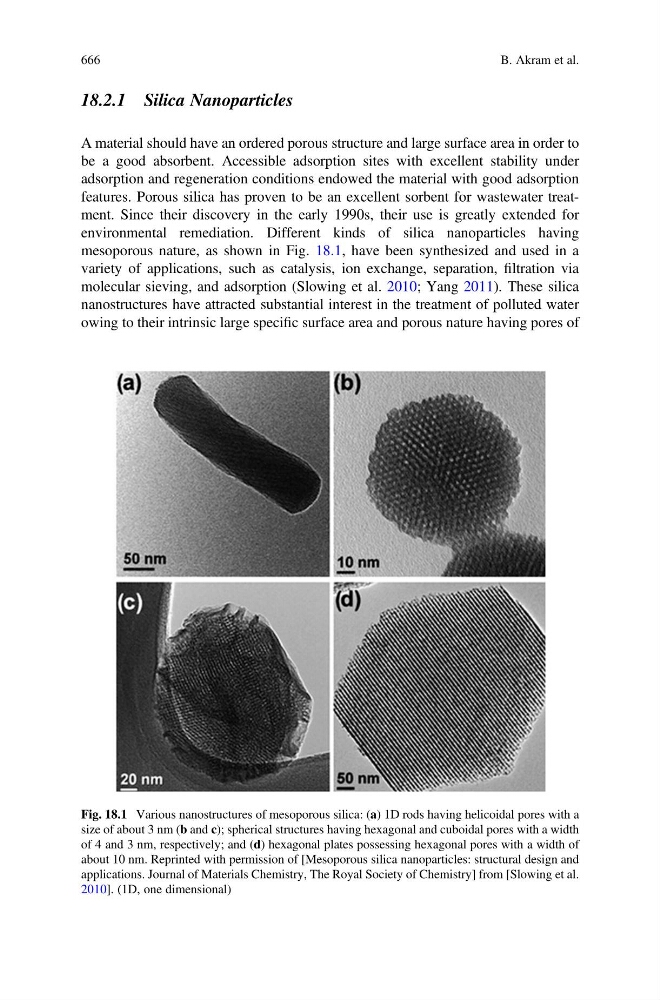
environmental remediation. Different kinds of silica nanoparticles having
mesoporous nature, as shown in Fig. 18.1, have been synthesized and used in a
variety of applications, such as catalysis, ion exchange, separation, filtration via
molecular sieving, and adsorption (Slowing et al. 2010; Yang 2011). These silica
nanostructures have attracted substantial interest in the treatment of polluted water
owing to their intrinsic large specific surface area and porous nature having pores of
Fig. 18.1 Various nanostructures of mesoporous silica: (a) 1D rods having helicoidal pores with a
size of about 3 nm (b and c); spherical structures having hexagonal and cuboidal pores with a width
of 4 and 3 nm, respectively; and (d) hexagonal plates possessing hexagonal pores with a width of
about 10 nm. Reprinted with permission of [Mesoporous silica nanoparticles: structural design and
applications. Journal of Materials Chemistry, The Royal Society of Chemistry] from [Slowing et al.
2010]. (1D, one dimensional)
666
B. Akram et al.
A material should have an ordered porous structure and large surface area in order to
be a good absorbent. Accessible adsorption sites with excellent stability under
adsorption and regeneration conditions endowed the material with good adsorption
features. Porous silica has proven to be an excellent sorbent for wastewater treatment. Since their discovery in the early 1990s, their use is greatly extended for
environmental remediation. Different kinds of silica nanoparticles having
mesoporous nature, as shown in Fig. 18.1, have been synthesized and used in a
variety of applications, such as catalysis, ion exchange, separation, filtration via
molecular sieving, and adsorption (Slowing et al. 2010; Yang 2011). These silica
nanostructures have attracted substantial interest in the treatment of polluted water
owing to their intrinsic large specific surface area and porous nature having pores of
Fig. 18.1 Various nanostructures of mesoporous silica: (a) 1D rods having helicoidal pores with a
size of about 3 nm (b and c); spherical structures having hexagonal and cuboidal pores with a width
of 4 and 3 nm, respectively; and (d) hexagonal plates possessing hexagonal pores with a width of
about 10 nm. Reprinted with permission of [Mesoporous silica nanoparticles: structural design and
applications. Journal of Materials Chemistry, The Royal Society of Chemistry] from [Slowing et al.
2010]. (1D, one dimensional)
666
B. Akram et al.