

matrices for the immobilization of Chlorella vulgaris UMACC 001 to decolorize
Lanaset Red 2GA dye and textile wastewater. Decolorization up to 44 and 49% was
achieved for Lanaset Red 2GA and textile wastewater, respectively. The system was
suggested for the final polishing of textile wastewater prior to discharge (Chu et al.
2009). Likewise, immobilization of microalgae Chlamydomonas reinhardtii on
polysulfone nanofibrous web showed significantly better decolorization capacities
against remazol black 5 and Reactive Blue 221 as compared to pristine polysulfone
nanofibrous web. Owing to nanoporous structure and reusability, microalgae/
polysulfone nanofibrous web biocomposite could be a suitable membrane material
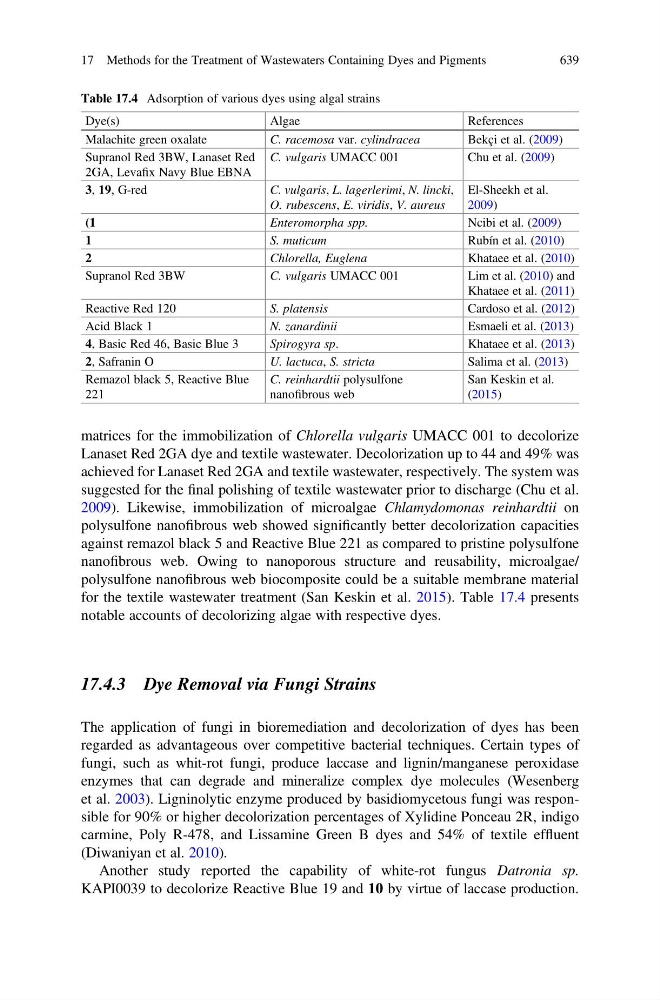
for the textile wastewater treatment (San Keskin et al. 2015). Table 17.4 presents
notable accounts of decolorizing algae with respective dyes.
17.4.3 Dye Removal via Fungi Strains
The application of fungi in bioremediation and decolorization of dyes has been
regarded as advantageous over competitive bacterial techniques. Certain types of
fungi, such as whit-rot fungi, produce laccase and lignin/manganese peroxidase
enzymes that can degrade and mineralize complex dye molecules (Wesenberg
et al. 2003). Ligninolytic enzyme produced by basidiomycetous fungi was responsible for 90% or higher decolorization percentages of Xylidine Ponceau 2R, indigo
carmine, Poly R-478, and Lissamine Green B dyes and 54% of textile effluent
(Diwaniyan et al. 2010).
Another study reported the capability of white-rot fungus Datronia sp.
KAPI0039 to decolorize Reactive Blue 19 and 10 by virtue of laccase production.
Table 17.4 Adsorption of various dyes using algal strains
Dye(s)
Algae
References
Malachite green oxalate
C. racemosa var. cylindracea
Bekçi et al. (2009)
Supranol Red 3BW, Lanaset Red
2GA, Levafix Navy Blue EBNA
C. vulgaris UMACC 001
Chu et al. (2009)
3, 19, G-red
C. vulgaris, L. lagerlerimi, N. lincki,
O. rubescens, E. viridis, V. aureus
El-Sheekh et al.
2009)
(1
Enteromorpha spp.
Ncibi et al. (2009)
1
S. muticum
Rubín et al. (2010)
2
Chlorella, Euglena
Khataee et al. (2010)
Supranol Red 3BW
C. vulgaris UMACC 001
Lim et al. (2010) and
Khataee et al. (2011)
Reactive Red 120
S. platensis
Cardoso et al. (2012)
Acid Black 1
N. zanardinii
Esmaeli et al. (2013)
4, Basic Red 46, Basic Blue 3
Spirogyra sp.
Khataee et al. (2013)
2, Safranin O
U. lactuca, S. stricta
Salima et al. (2013)
Remazol black 5, Reactive Blue
221
C. reinhardtii polysulfone
nanofibrous web
San Keskin et al.
(2015)
17 Methods for the Treatment of Wastewaters Containing Dyes and Pigments
639
Lanaset Red 2GA dye and textile wastewater. Decolorization up to 44 and 49% was
achieved for Lanaset Red 2GA and textile wastewater, respectively. The system was
suggested for the final polishing of textile wastewater prior to discharge (Chu et al.
2009). Likewise, immobilization of microalgae Chlamydomonas reinhardtii on
polysulfone nanofibrous web showed significantly better decolorization capacities
against remazol black 5 and Reactive Blue 221 as compared to pristine polysulfone
nanofibrous web. Owing to nanoporous structure and reusability, microalgae/
polysulfone nanofibrous web biocomposite could be a suitable membrane material
for the textile wastewater treatment (San Keskin et al. 2015). Table 17.4 presents
notable accounts of decolorizing algae with respective dyes.
17.4.3 Dye Removal via Fungi Strains
The application of fungi in bioremediation and decolorization of dyes has been
regarded as advantageous over competitive bacterial techniques. Certain types of
fungi, such as whit-rot fungi, produce laccase and lignin/manganese peroxidase
enzymes that can degrade and mineralize complex dye molecules (Wesenberg
et al. 2003). Ligninolytic enzyme produced by basidiomycetous fungi was responsible for 90% or higher decolorization percentages of Xylidine Ponceau 2R, indigo
carmine, Poly R-478, and Lissamine Green B dyes and 54% of textile effluent
(Diwaniyan et al. 2010).
Another study reported the capability of white-rot fungus Datronia sp.
KAPI0039 to decolorize Reactive Blue 19 and 10 by virtue of laccase production.
Table 17.4 Adsorption of various dyes using algal strains
Dye(s)
Algae
References
Malachite green oxalate
C. racemosa var. cylindracea
Bekçi et al. (2009)
Supranol Red 3BW, Lanaset Red
2GA, Levafix Navy Blue EBNA
C. vulgaris UMACC 001
Chu et al. (2009)
3, 19, G-red
C. vulgaris, L. lagerlerimi, N. lincki,
O. rubescens, E. viridis, V. aureus
El-Sheekh et al.
2009)
(1
Enteromorpha spp.
Ncibi et al. (2009)
1
S. muticum
Rubín et al. (2010)
2
Chlorella, Euglena
Khataee et al. (2010)
Supranol Red 3BW
C. vulgaris UMACC 001
Lim et al. (2010) and
Khataee et al. (2011)
Reactive Red 120
S. platensis
Cardoso et al. (2012)
Acid Black 1
N. zanardinii
Esmaeli et al. (2013)
4, Basic Red 46, Basic Blue 3
Spirogyra sp.
Khataee et al. (2013)
2, Safranin O
U. lactuca, S. stricta
Salima et al. (2013)
Remazol black 5, Reactive Blue
221
C. reinhardtii polysulfone
nanofibrous web
San Keskin et al.
(2015)
17 Methods for the Treatment of Wastewaters Containing Dyes and Pigments
639