

Plastics have become vital parts of human life and provide many advantages and
ease the activities and the interactions with the surroundings and ecosystem
(Hahladakis et al. 2018). These are due to the diverse properties of plastics which
are easily incorporated into a wide range of applications, from domestic to major
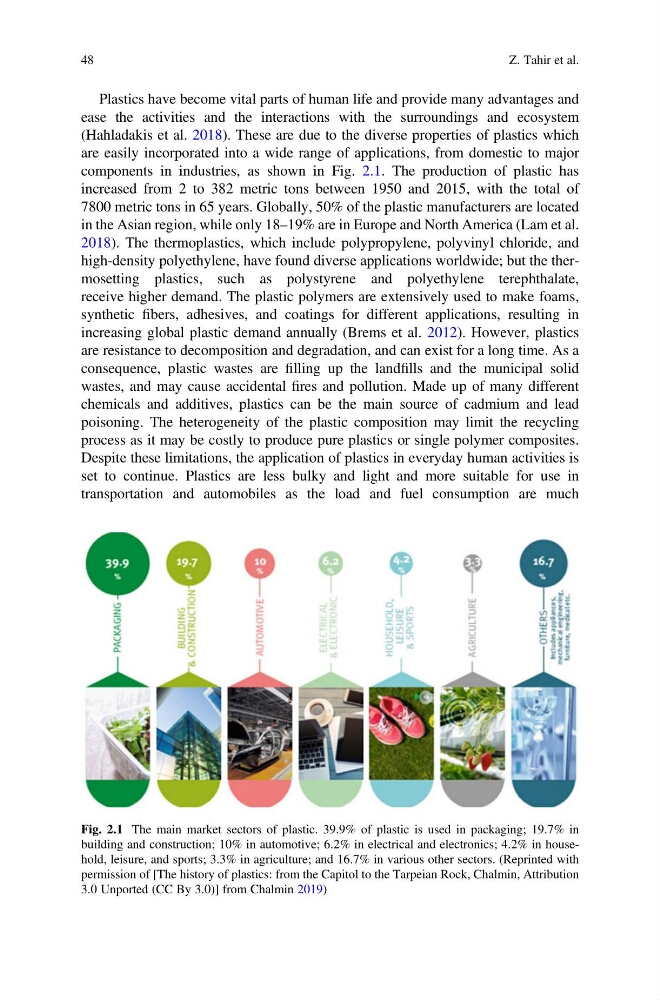
components in industries, as shown in Fig. 2.1. The production of plastic has
increased from 2 to 382 metric tons between 1950 and 2015, with the total of
7800 metric tons in 65 years. Globally, 50% of the plastic manufacturers are located
in the Asian region, while only 18–19% are in Europe and North America (Lam et al.
2018). The thermoplastics, which include polypropylene, polyvinyl chloride, and
high-density polyethylene, have found diverse applications worldwide; but the thermosetting plastics, such as polystyrene and polyethylene terephthalate,
receive higher demand. The plastic polymers are extensively used to make foams,
synthetic fibers, adhesives, and coatings for different applications, resulting in
increasing global plastic demand annually (Brems et al. 2012). However, plastics
are resistance to decomposition and degradation, and can exist for a long time. As a
consequence, plastic wastes are filling up the landfills and the municipal solid
wastes, and may cause accidental fires and pollution. Made up of many different
chemicals and additives, plastics can be the main source of cadmium and lead
poisoning. The heterogeneity of the plastic composition may limit the recycling
process as it may be costly to produce pure plastics or single polymer composites.
Despite these limitations, the application of plastics in everyday human activities is
set to continue. Plastics are less bulky and light and more suitable for use in
transportation and automobiles as the load and fuel consumption are much
Fig. 2.1 The main market sectors of plastic. 39.9% of plastic is used in packaging; 19.7% in
building and construction; 10% in automotive; 6.2% in electrical and electronics; 4.2% in household, leisure, and sports; 3.3% in agriculture; and 16.7% in various other sectors. (Reprinted with
permission of [The history of plastics: from the Capitol to the Tarpeian Rock, Chalmin, Attribution
3.0 Unported (CC By 3.0)] from Chalmin 2019)
48
Z. Tahir et al.
ease the activities and the interactions with the surroundings and ecosystem
(Hahladakis et al. 2018). These are due to the diverse properties of plastics which
are easily incorporated into a wide range of applications, from domestic to major
components in industries, as shown in Fig. 2.1. The production of plastic has
increased from 2 to 382 metric tons between 1950 and 2015, with the total of
7800 metric tons in 65 years. Globally, 50% of the plastic manufacturers are located
in the Asian region, while only 18–19% are in Europe and North America (Lam et al.
2018). The thermoplastics, which include polypropylene, polyvinyl chloride, and
high-density polyethylene, have found diverse applications worldwide; but the thermosetting plastics, such as polystyrene and polyethylene terephthalate,
receive higher demand. The plastic polymers are extensively used to make foams,
synthetic fibers, adhesives, and coatings for different applications, resulting in
increasing global plastic demand annually (Brems et al. 2012). However, plastics
are resistance to decomposition and degradation, and can exist for a long time. As a
consequence, plastic wastes are filling up the landfills and the municipal solid
wastes, and may cause accidental fires and pollution. Made up of many different
chemicals and additives, plastics can be the main source of cadmium and lead
poisoning. The heterogeneity of the plastic composition may limit the recycling
process as it may be costly to produce pure plastics or single polymer composites.
Despite these limitations, the application of plastics in everyday human activities is
set to continue. Plastics are less bulky and light and more suitable for use in
transportation and automobiles as the load and fuel consumption are much
Fig. 2.1 The main market sectors of plastic. 39.9% of plastic is used in packaging; 19.7% in
building and construction; 10% in automotive; 6.2% in electrical and electronics; 4.2% in household, leisure, and sports; 3.3% in agriculture; and 16.7% in various other sectors. (Reprinted with
permission of [The history of plastics: from the Capitol to the Tarpeian Rock, Chalmin, Attribution
3.0 Unported (CC By 3.0)] from Chalmin 2019)
48
Z. Tahir et al.