

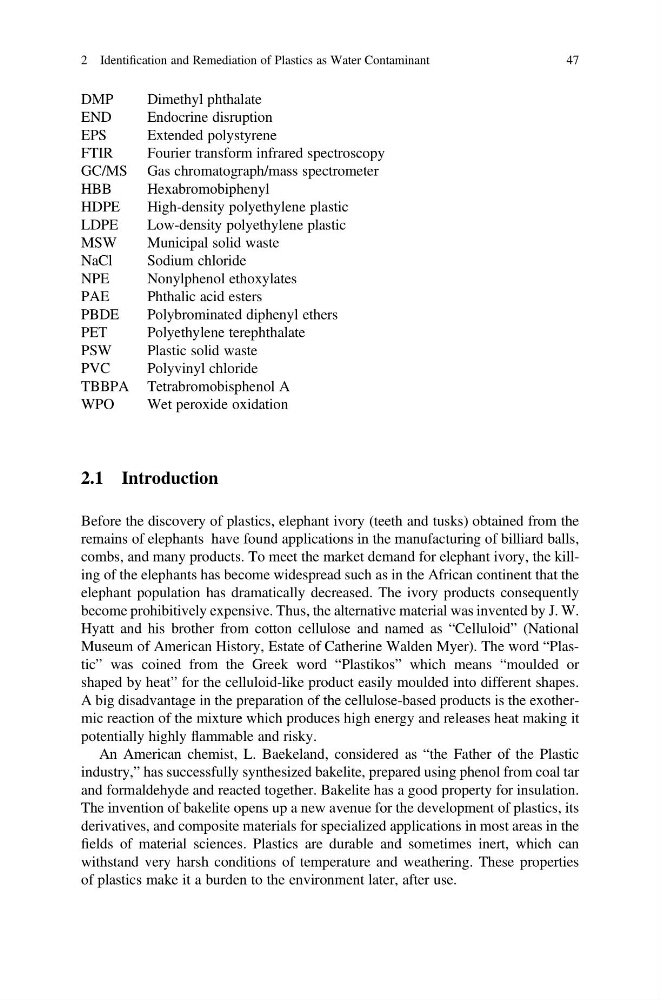
DMP
Dimethyl phthalate
END
Endocrine disruption
EPS
Extended polystyrene
FTIR
Fourier transform infrared spectroscopy
GC/MS Gas chromatograph/mass spectrometer
HBB
Hexabromobiphenyl
HDPE
High-density polyethylene plastic
LDPE
Low-density polyethylene plastic
MSW
Municipal solid waste
NaCl
Sodium chloride
NPE
Nonylphenol ethoxylates
PAE
Phthalic acid esters
PBDE
Polybrominated diphenyl ethers
PET
Polyethylene terephthalate
PSW
Plastic solid waste
PVC
Polyvinyl chloride
TBBPA Tetrabromobisphenol A
WPO
Wet peroxide oxidation
2.1 Introduction
Before the discovery of plastics, elephant ivory (teeth and tusks) obtained from the
remains of elephants have found applications in the manufacturing of billiard balls,
combs, and many products. To meet the market demand for elephant ivory, the killing of the elephants has become widespread such as in the African continent that the
elephant population has dramatically decreased. The ivory products consequently
become prohibitively expensive. Thus, the alternative material was invented by J. W.
Hyatt and his brother from cotton cellulose and named as “Celluloid” (National
Museum of American History, Estate of Catherine Walden Myer). The word “Plastic” was coined from the Greek word “Plastikos” which means “moulded or
shaped by heat” for the celluloid-like product easily moulded into different shapes.
A big disadvantage in the preparation of the cellulose-based products is the exothermic reaction of the mixture which produces high energy and releases heat making it
potentially highly flammable and risky.
An American chemist, L. Baekeland, considered as “the Father of the Plastic
industry,” has successfully synthesized bakelite, prepared using phenol from coal tar
and formaldehyde and reacted together. Bakelite has a good property for insulation.
The invention of bakelite opens up a new avenue for the development of plastics, its
derivatives, and composite materials for specialized applications in most areas in the
fields of material sciences. Plastics are durable and sometimes inert, which can
withstand very harsh conditions of temperature and weathering. These properties
of plastics make it a burden to the environment later, after use.
2 Identification and Remediation of Plastics as Water Contaminant
47
Dimethyl phthalate
END
Endocrine disruption
EPS
Extended polystyrene
FTIR
Fourier transform infrared spectroscopy
GC/MS Gas chromatograph/mass spectrometer
HBB
Hexabromobiphenyl
HDPE
High-density polyethylene plastic
LDPE
Low-density polyethylene plastic
MSW
Municipal solid waste
NaCl
Sodium chloride
NPE
Nonylphenol ethoxylates
PAE
Phthalic acid esters
PBDE
Polybrominated diphenyl ethers
PET
Polyethylene terephthalate
PSW
Plastic solid waste
PVC
Polyvinyl chloride
TBBPA Tetrabromobisphenol A
WPO
Wet peroxide oxidation
2.1 Introduction
Before the discovery of plastics, elephant ivory (teeth and tusks) obtained from the
remains of elephants have found applications in the manufacturing of billiard balls,
combs, and many products. To meet the market demand for elephant ivory, the killing of the elephants has become widespread such as in the African continent that the
elephant population has dramatically decreased. The ivory products consequently
become prohibitively expensive. Thus, the alternative material was invented by J. W.
Hyatt and his brother from cotton cellulose and named as “Celluloid” (National
Museum of American History, Estate of Catherine Walden Myer). The word “Plastic” was coined from the Greek word “Plastikos” which means “moulded or
shaped by heat” for the celluloid-like product easily moulded into different shapes.
A big disadvantage in the preparation of the cellulose-based products is the exothermic reaction of the mixture which produces high energy and releases heat making it
potentially highly flammable and risky.
An American chemist, L. Baekeland, considered as “the Father of the Plastic
industry,” has successfully synthesized bakelite, prepared using phenol from coal tar
and formaldehyde and reacted together. Bakelite has a good property for insulation.
The invention of bakelite opens up a new avenue for the development of plastics, its
derivatives, and composite materials for specialized applications in most areas in the
fields of material sciences. Plastics are durable and sometimes inert, which can
withstand very harsh conditions of temperature and weathering. These properties
of plastics make it a burden to the environment later, after use.
2 Identification and Remediation of Plastics as Water Contaminant
47