

polychlorinated biphenyls, mercury, nickel, and formaldehyde resins (Mwinyihija
2010). Effluents are ranked top as the highest pollutants among the entire industrial
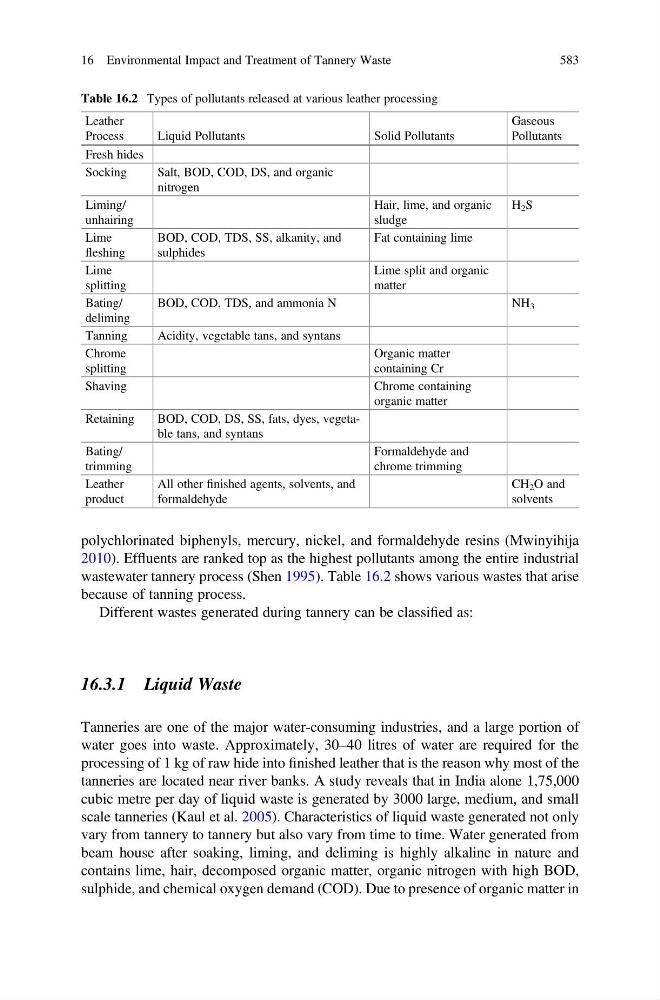
wastewater tannery process (Shen 1995). Table 16.2 shows various wastes that arise
because of tanning process.
Different wastes generated during tannery can be classified as:
16.3.1 Liquid Waste
Tanneries are one of the major water-consuming industries, and a large portion of
water goes into waste. Approximately, 30–40 litres of water are required for the
processing of 1 kg of raw hide into finished leather that is the reason why most of the
tanneries are located near river banks. A study reveals that in India alone 1,75,000
cubic metre per day of liquid waste is generated by 3000 large, medium, and small
scale tanneries (Kaul et al. 2005). Characteristics of liquid waste generated not only
vary from tannery to tannery but also vary from time to time. Water generated from
beam house after soaking, liming, and deliming is highly alkaline in nature and
contains lime, hair, decomposed organic matter, organic nitrogen with high BOD,
sulphide, and chemical oxygen demand (COD). Due to presence of organic matter in
Table 16.2 Types of pollutants released at various leather processing
Leather
Process
Liquid Pollutants
Solid Pollutants
Gaseous
Pollutants
Fresh hides
Socking
Salt, BOD, COD, DS, and organic
nitrogen
Liming/
unhairing
Hair, lime, and organic
sludge
H 2 S
Lime
fleshing
BOD, COD, TDS, SS, alkanity, and
sulphides
Fat containing lime
Lime
splitting
Lime split and organic
matter
Bating/
deliming
BOD, COD, TDS, and ammonia N
NH 3
Tanning
Acidity, vegetable tans, and syntans
Chrome
splitting
Organic matter
containing Cr
Shaving
Chrome containing
organic matter
Retaining
BOD, COD, DS, SS, fats, dyes, vegetable tans, and syntans
Bating/
trimming
Formaldehyde and
chrome trimming
Leather
product
All other finished agents, solvents, and
formaldehyde
CH 2 O and
solvents
16 Environmental Impact and Treatment of Tannery Waste
583
2010). Effluents are ranked top as the highest pollutants among the entire industrial
wastewater tannery process (Shen 1995). Table 16.2 shows various wastes that arise
because of tanning process.
Different wastes generated during tannery can be classified as:
16.3.1 Liquid Waste
Tanneries are one of the major water-consuming industries, and a large portion of
water goes into waste. Approximately, 30–40 litres of water are required for the
processing of 1 kg of raw hide into finished leather that is the reason why most of the
tanneries are located near river banks. A study reveals that in India alone 1,75,000
cubic metre per day of liquid waste is generated by 3000 large, medium, and small
scale tanneries (Kaul et al. 2005). Characteristics of liquid waste generated not only
vary from tannery to tannery but also vary from time to time. Water generated from
beam house after soaking, liming, and deliming is highly alkaline in nature and
contains lime, hair, decomposed organic matter, organic nitrogen with high BOD,
sulphide, and chemical oxygen demand (COD). Due to presence of organic matter in
Table 16.2 Types of pollutants released at various leather processing
Leather
Process
Liquid Pollutants
Solid Pollutants
Gaseous
Pollutants
Fresh hides
Socking
Salt, BOD, COD, DS, and organic
nitrogen
Liming/
unhairing
Hair, lime, and organic
sludge
H 2 S
Lime
fleshing
BOD, COD, TDS, SS, alkanity, and
sulphides
Fat containing lime
Lime
splitting
Lime split and organic
matter
Bating/
deliming
BOD, COD, TDS, and ammonia N
NH 3
Tanning
Acidity, vegetable tans, and syntans
Chrome
splitting
Organic matter
containing Cr
Shaving
Chrome containing
organic matter
Retaining
BOD, COD, DS, SS, fats, dyes, vegetable tans, and syntans
Bating/
trimming
Formaldehyde and
chrome trimming
Leather
product
All other finished agents, solvents, and
formaldehyde
CH 2 O and
solvents
16 Environmental Impact and Treatment of Tannery Waste
583