

Solidified Floating Organic Drop Microextraction
Solidified floating organic drop microextraction uses a low-density extraction solvent with a melting point range of 10–30
C. After extraction and centrifugation, the
extractant floating on the surface of the aqueous phase can be quickly solidified at a
lower temperature, and then the solidified extractant is taken out by using a metal
spoon and placed in a glass vial. After melting at room temperature, the melted
solution is used for analysis. In the recent years, the low-density solvents, such as
dodecane (Ranjbari and Hadjmohammadi 2012), 1-dodecanol (Farahani et al. 2008;
Yang et al. 2018b), and n-hexadecane (Pérez-Outeiral et al. 2016), have been used
often in the extraction of phthalates in water samples. Farahani et al. (2008) used
suspended 1-dodecanol microdrop to extract seven phthalates, including dimethyl
phthalate, diethyl phthalate, diallyl phthalate, dinbutyl phthalate, benzyl butyl
phthalate, dicyclohexyl phthalate, and di(2-ethylhexyl) phthalate from 10 ml of
tap, mineral, and river water samples by magnetic agitation in a sealed vial. After
extraction, the vial was placed in an ice beaker, and 1-dodecanol was quickly
solidified. The solidified 1-dodecanol was transferred into a conical vial and melted
immediately at room temperature. The melted solution was used for analysis. The
detection limits of the method were in the range of 0.02–0.05 μg/L, whereas the
relative standard deviations for the analysis of 5.0 μg/L of the analytes were below
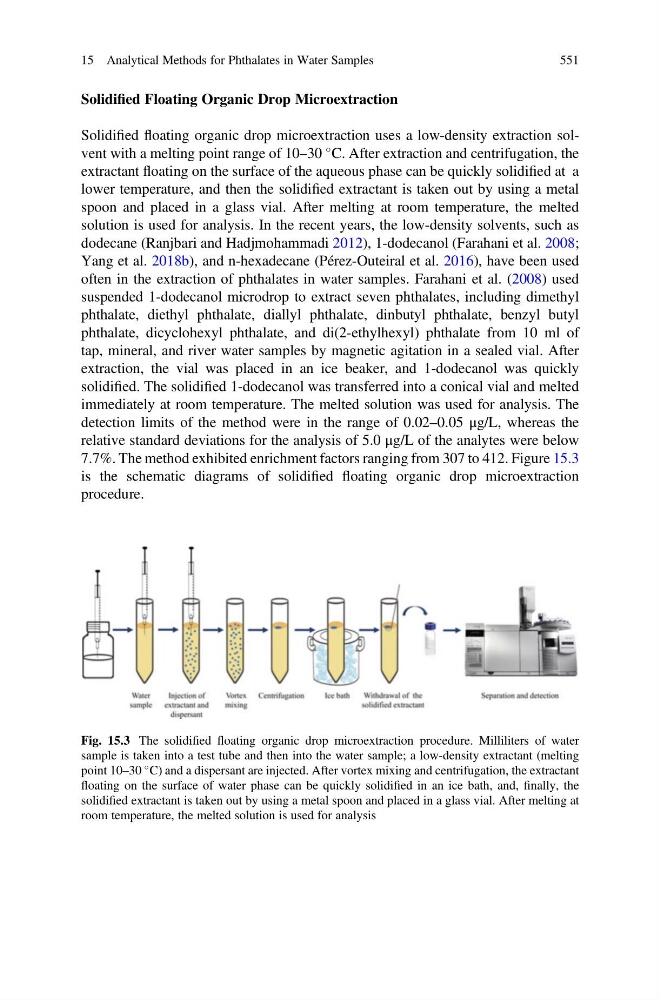
7.7%. The method exhibited enrichment factors ranging from 307 to 412. Figure 15.3
is the schematic diagrams of solidified floating organic drop microextraction
procedure.
Fig. 15.3 The solidified floating organic drop microextraction procedure. Milliliters of water
sample is taken into a test tube and then into the water sample; a low-density extractant (melting
point 10–30
C) and a dispersant are injected. After vortex mixing and centrifugation, the extractant
floating on the surface of water phase can be quickly solidified in an ice bath, and, finally, the
solidified extractant is taken out by using a metal spoon and placed in a glass vial. After melting at
room temperature, the melted solution is used for analysis
15 Analytical Methods for Phthalates in Water Samples
551
Solidified floating organic drop microextraction uses a low-density extraction solvent with a melting point range of 10–30
C. After extraction and centrifugation, the
extractant floating on the surface of the aqueous phase can be quickly solidified at a
lower temperature, and then the solidified extractant is taken out by using a metal
spoon and placed in a glass vial. After melting at room temperature, the melted
solution is used for analysis. In the recent years, the low-density solvents, such as
dodecane (Ranjbari and Hadjmohammadi 2012), 1-dodecanol (Farahani et al. 2008;
Yang et al. 2018b), and n-hexadecane (Pérez-Outeiral et al. 2016), have been used
often in the extraction of phthalates in water samples. Farahani et al. (2008) used
suspended 1-dodecanol microdrop to extract seven phthalates, including dimethyl
phthalate, diethyl phthalate, diallyl phthalate, dinbutyl phthalate, benzyl butyl
phthalate, dicyclohexyl phthalate, and di(2-ethylhexyl) phthalate from 10 ml of
tap, mineral, and river water samples by magnetic agitation in a sealed vial. After
extraction, the vial was placed in an ice beaker, and 1-dodecanol was quickly
solidified. The solidified 1-dodecanol was transferred into a conical vial and melted
immediately at room temperature. The melted solution was used for analysis. The
detection limits of the method were in the range of 0.02–0.05 μg/L, whereas the
relative standard deviations for the analysis of 5.0 μg/L of the analytes were below
7.7%. The method exhibited enrichment factors ranging from 307 to 412. Figure 15.3
is the schematic diagrams of solidified floating organic drop microextraction
procedure.
Fig. 15.3 The solidified floating organic drop microextraction procedure. Milliliters of water
sample is taken into a test tube and then into the water sample; a low-density extractant (melting
point 10–30
C) and a dispersant are injected. After vortex mixing and centrifugation, the extractant
floating on the surface of water phase can be quickly solidified in an ice bath, and, finally, the
solidified extractant is taken out by using a metal spoon and placed in a glass vial. After melting at
room temperature, the melted solution is used for analysis
15 Analytical Methods for Phthalates in Water Samples
551