

the extraction solvent has to be different greatly from that of the aqueous phase to
facilitate the phase separation (Zgoła-Grześkowiak and Grześkowiak 2011). It is
worth to note that the dispersant may change the polarity of the aqueous phase and
affect the partition coefficient of the analytes, in turn, to affect the extraction
efficiency of the analytes. There are many modes, such as ultrasonic-assisted dispersive liquid–liquid microextraction, vortex-assisted dispersive liquid–liquid
microextraction, and air-assisted dispersive liquid–liquid microextraction. Ultrasonic- and vortex-assisted dispersive liquid–liquid microextraction can achieve
dispersion without any dispersant, but it would take much longer time to achieve
full dispersion. For high-density solvent dispersive liquid–liquid microextraction,
after extraction and centrifugation, the extractant deposits under the aqueous phase,
and then it can be withdrawn using a syringe for analysis. For example, carbon tetrachloride (Liang et al. 2008), 1,1,2,2-tetrachloroethane (Farajzadeh and Mogaddam
2012), and the mixture of chloroform, dichloromethane, and carbon tetrachloride
(Farajzadeh and Khoshmaram 2015) have been reported for extraction of phthalates
in water samples. But high-density solvents are usually halogen-containing solvents
which are highly toxic to human health. The low toxic ionic liquid (Zhang et al.
2011) and other low-density organic solvents, such as n-hexane (Xu et al. 2007),
toluene (Psillakis and Kalogerakis 2003; Zhang and Lee 2013), and xylene (Huang
et al. 2012), have been used for extraction of phthalates in water samples. For
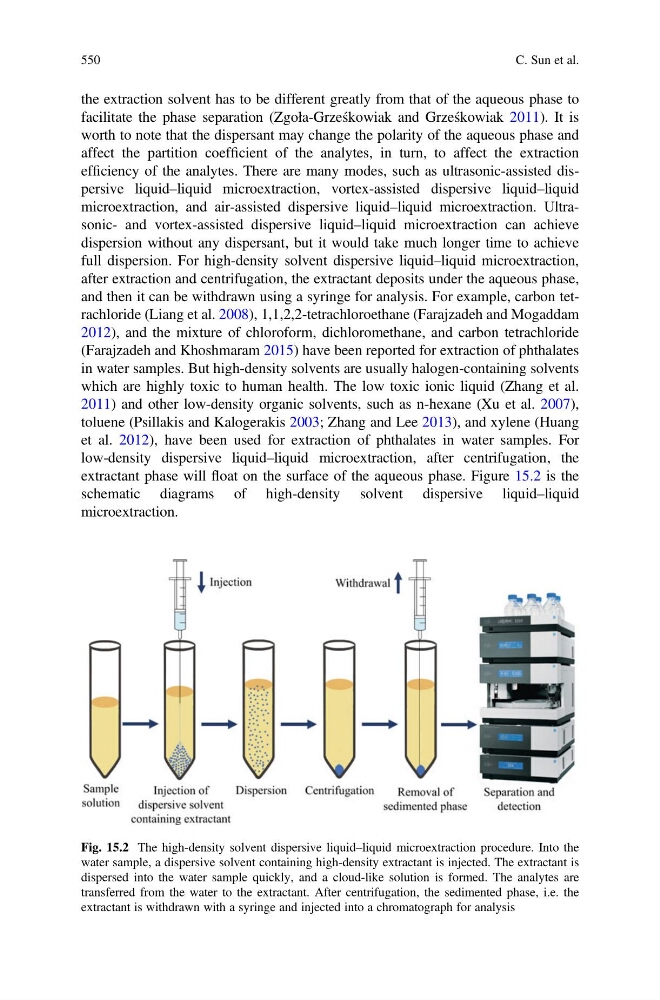
low-density dispersive liquid–liquid microextraction, after centrifugation, the
extractant phase will float on the surface of the aqueous phase. Figure 15.2 is the
schematic diagrams of high-density solvent dispersive liquid–liquid
microextraction.
Fig. 15.2 The high-density solvent dispersive liquid–liquid microextraction procedure. Into the
water sample, a dispersive solvent containing high-density extractant is injected. The extractant is
dispersed into the water sample quickly, and a cloud-like solution is formed. The analytes are
transferred from the water to the extractant. After centrifugation, the sedimented phase, i.e. the
extractant is withdrawn with a syringe and injected into a chromatograph for analysis
550
C. Sun et al.
facilitate the phase separation (Zgoła-Grześkowiak and Grześkowiak 2011). It is
worth to note that the dispersant may change the polarity of the aqueous phase and
affect the partition coefficient of the analytes, in turn, to affect the extraction
efficiency of the analytes. There are many modes, such as ultrasonic-assisted dispersive liquid–liquid microextraction, vortex-assisted dispersive liquid–liquid
microextraction, and air-assisted dispersive liquid–liquid microextraction. Ultrasonic- and vortex-assisted dispersive liquid–liquid microextraction can achieve
dispersion without any dispersant, but it would take much longer time to achieve
full dispersion. For high-density solvent dispersive liquid–liquid microextraction,
after extraction and centrifugation, the extractant deposits under the aqueous phase,
and then it can be withdrawn using a syringe for analysis. For example, carbon tetrachloride (Liang et al. 2008), 1,1,2,2-tetrachloroethane (Farajzadeh and Mogaddam
2012), and the mixture of chloroform, dichloromethane, and carbon tetrachloride
(Farajzadeh and Khoshmaram 2015) have been reported for extraction of phthalates
in water samples. But high-density solvents are usually halogen-containing solvents
which are highly toxic to human health. The low toxic ionic liquid (Zhang et al.
2011) and other low-density organic solvents, such as n-hexane (Xu et al. 2007),
toluene (Psillakis and Kalogerakis 2003; Zhang and Lee 2013), and xylene (Huang
et al. 2012), have been used for extraction of phthalates in water samples. For
low-density dispersive liquid–liquid microextraction, after centrifugation, the
extractant phase will float on the surface of the aqueous phase. Figure 15.2 is the
schematic diagrams of high-density solvent dispersive liquid–liquid
microextraction.
Fig. 15.2 The high-density solvent dispersive liquid–liquid microextraction procedure. Into the
water sample, a dispersive solvent containing high-density extractant is injected. The extractant is
dispersed into the water sample quickly, and a cloud-like solution is formed. The analytes are
transferred from the water to the extractant. After centrifugation, the sedimented phase, i.e. the
extractant is withdrawn with a syringe and injected into a chromatograph for analysis
550
C. Sun et al.