

process was primarily through the combined attack of phenoxy and superoxide
radicals produced by the Fenton reaction mechanism. In a similar kind of study,
aluminium-pillared montmorillonite clay blended with ferric oxalate has also shown
higher stability and resistance to iron leaching during the photo-Fenton degradation
of amoxicillin (Ayodele et al. 2012). Consistent performance on the catalytic activity
was seen due to the increased availability of inner layer catalyst sites of the clay to
reactant molecule due to aluminium pillaring. Iron-pillared montmorillonite clay of
two aggregate sizes ranging below 250 μm and 250–450 μm were prepared at
400 and 600
C calcination temperature for the photo-Fenton discoloration of methylene blue aqueous solution (De Leon et al. 2013). Due to the higher surface area and
pore volume, the catalyst prepared at 400
C had shown higher catalytic activity. In
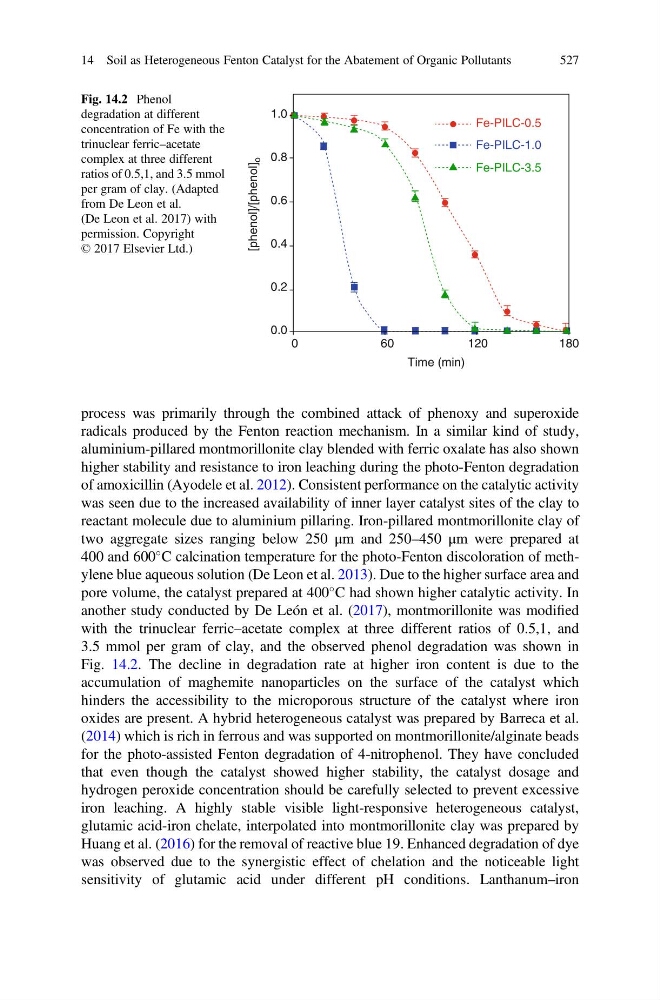
another study conducted by De León et al. (2017), montmorillonite was modified
with the trinuclear ferric–acetate complex at three different ratios of 0.5,1, and
3.5 mmol per gram of clay, and the observed phenol degradation was shown in
Fig. 14.2. The decline in degradation rate at higher iron content is due to the
accumulation of maghemite nanoparticles on the surface of the catalyst which
hinders the accessibility to the microporous structure of the catalyst where iron
oxides are present. A hybrid heterogeneous catalyst was prepared by Barreca et al.
(2014) which is rich in ferrous and was supported on montmorillonite/alginate beads
for the photo-assisted Fenton degradation of 4-nitrophenol. They have concluded
that even though the catalyst showed higher stability, the catalyst dosage and
hydrogen peroxide concentration should be carefully selected to prevent excessive
iron leaching. A highly stable visible light-responsive heterogeneous catalyst,
glutamic acid-iron chelate, interpolated into montmorillonite clay was prepared by
Huang et al. (2016) for the removal of reactive blue 19. Enhanced degradation of dye
was observed due to the synergistic effect of chelation and the noticeable light
sensitivity of glutamic acid under different pH conditions. Lanthanum–iron
1.0
Fe-PILC-0.5
Fe-PILC-1.0
Fe-PILC-3.5
0.8
0.6
[phenol]/[phenol]
o
0.4
0.2
0.0
0
6 0
1 2 0
Time (min)
180
Fig. 14.2 Phenol
degradation at different
concentration of Fe with the
trinuclear ferric–acetate
complex at three different
ratios of 0.5,1, and 3.5 mmol
per gram of clay. (Adapted
from De Leon et al.
(De Leon et al. 2017) with
permission. Copyright
© 2017 Elsevier Ltd.)
14 Soil as Heterogeneous Fenton Catalyst for the Abatement of Organic Pollutants
527
radicals produced by the Fenton reaction mechanism. In a similar kind of study,
aluminium-pillared montmorillonite clay blended with ferric oxalate has also shown
higher stability and resistance to iron leaching during the photo-Fenton degradation
of amoxicillin (Ayodele et al. 2012). Consistent performance on the catalytic activity
was seen due to the increased availability of inner layer catalyst sites of the clay to
reactant molecule due to aluminium pillaring. Iron-pillared montmorillonite clay of
two aggregate sizes ranging below 250 μm and 250–450 μm were prepared at
400 and 600
C calcination temperature for the photo-Fenton discoloration of methylene blue aqueous solution (De Leon et al. 2013). Due to the higher surface area and
pore volume, the catalyst prepared at 400
C had shown higher catalytic activity. In
another study conducted by De León et al. (2017), montmorillonite was modified
with the trinuclear ferric–acetate complex at three different ratios of 0.5,1, and
3.5 mmol per gram of clay, and the observed phenol degradation was shown in
Fig. 14.2. The decline in degradation rate at higher iron content is due to the
accumulation of maghemite nanoparticles on the surface of the catalyst which
hinders the accessibility to the microporous structure of the catalyst where iron
oxides are present. A hybrid heterogeneous catalyst was prepared by Barreca et al.
(2014) which is rich in ferrous and was supported on montmorillonite/alginate beads
for the photo-assisted Fenton degradation of 4-nitrophenol. They have concluded
that even though the catalyst showed higher stability, the catalyst dosage and
hydrogen peroxide concentration should be carefully selected to prevent excessive
iron leaching. A highly stable visible light-responsive heterogeneous catalyst,
glutamic acid-iron chelate, interpolated into montmorillonite clay was prepared by
Huang et al. (2016) for the removal of reactive blue 19. Enhanced degradation of dye
was observed due to the synergistic effect of chelation and the noticeable light
sensitivity of glutamic acid under different pH conditions. Lanthanum–iron
1.0
Fe-PILC-0.5
Fe-PILC-1.0
Fe-PILC-3.5
0.8
0.6
[phenol]/[phenol]
o
0.4
0.2
0.0
0
6 0
1 2 0
Time (min)
180
Fig. 14.2 Phenol
degradation at different
concentration of Fe with the
trinuclear ferric–acetate
complex at three different
ratios of 0.5,1, and 3.5 mmol
per gram of clay. (Adapted
from De Leon et al.
(De Leon et al. 2017) with
permission. Copyright
© 2017 Elsevier Ltd.)
14 Soil as Heterogeneous Fenton Catalyst for the Abatement of Organic Pollutants
527