

laponite clay-based Fe nanocomposite/L, and pH 3. In a parallel study by Feng et al.
(2003) with the same catalyst and operating conditions, a slower kinetic rate was
observed for photo-assisted degradation of orange II. The presence of Fe ions in the
clay mineral and amount of adsorbed dyes on the surface of the catalyst governs the
degradation rate. Further, a detailed investigation was conducted by Sum et al.
(2004) for the synthesis of laponite clay-based Fe nanocatalyst by studying the
effect of thermal ageing and calcination temperature on the crystal structure and
chemical compositions of the catalyst. Entire mineralization of the model pollutant
acid black was observed due to higher photocatalytic property and insignificant Fe
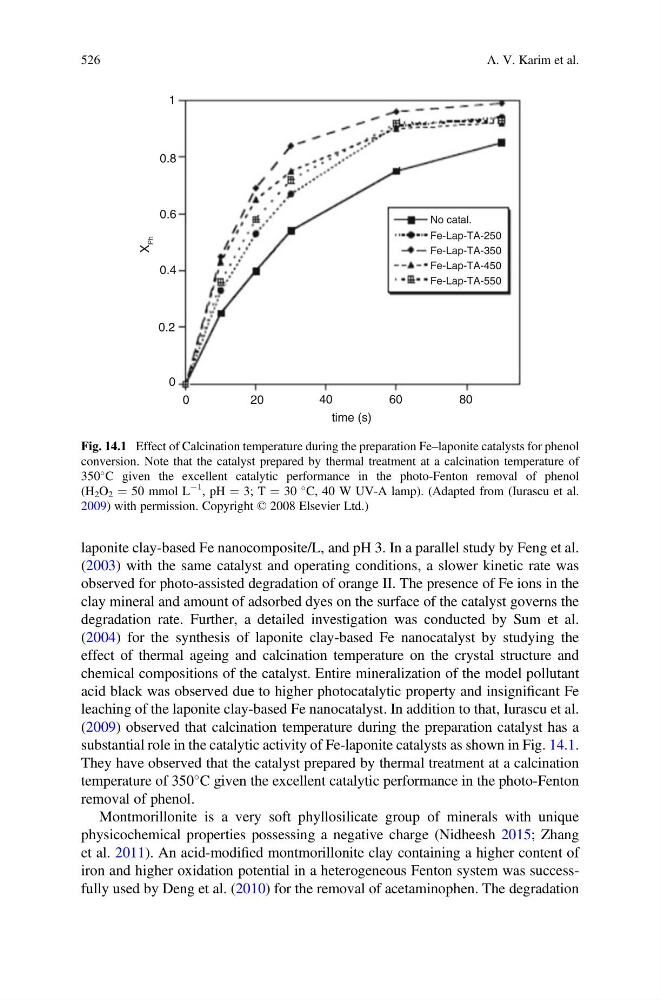
leaching of the laponite clay-based Fe nanocatalyst. In addition to that, Iurascu et al.
(2009) observed that calcination temperature during the preparation catalyst has a
substantial role in the catalytic activity of Fe-laponite catalysts as shown in Fig. 14.1.
They have observed that the catalyst prepared by thermal treatment at a calcination
temperature of 350
C given the excellent catalytic performance in the photo-Fenton
removal of phenol.
Montmorillonite is a very soft phyllosilicate group of minerals with unique
physicochemical properties possessing a negative charge (Nidheesh 2015; Zhang
et al. 2011). An acid-modified montmorillonite clay containing a higher content of
iron and higher oxidation potential in a heterogeneous Fenton system was successfully used by Deng et al. (2010) for the removal of acetaminophen. The degradation
1
0.8
0.6
0.4
0.2
0
0
2 0
40
60
80
time (s)
X
Ph
No catal.
Fe-Lap-TA-250
Fe-Lap-TA-350
Fe-Lap-TA-450
Fe-Lap-TA-550
Fig. 14.1 Effect of Calcination temperature during the preparation Fe–laponite catalysts for phenol
conversion. Note that the catalyst prepared by thermal treatment at a calcination temperature of
350
C given the excellent catalytic performance in the photo-Fenton removal of phenol
(H 2 O 2 ¼ 50 mmol L
À1
, pH ¼ 3; T ¼ 30
C, 40 W UV-A lamp). (Adapted from (Iurascu et al.
2009) with permission. Copyright © 2008 Elsevier Ltd.)
526
A. V. Karim et al.
(2003) with the same catalyst and operating conditions, a slower kinetic rate was
observed for photo-assisted degradation of orange II. The presence of Fe ions in the
clay mineral and amount of adsorbed dyes on the surface of the catalyst governs the
degradation rate. Further, a detailed investigation was conducted by Sum et al.
(2004) for the synthesis of laponite clay-based Fe nanocatalyst by studying the
effect of thermal ageing and calcination temperature on the crystal structure and
chemical compositions of the catalyst. Entire mineralization of the model pollutant
acid black was observed due to higher photocatalytic property and insignificant Fe
leaching of the laponite clay-based Fe nanocatalyst. In addition to that, Iurascu et al.
(2009) observed that calcination temperature during the preparation catalyst has a
substantial role in the catalytic activity of Fe-laponite catalysts as shown in Fig. 14.1.
They have observed that the catalyst prepared by thermal treatment at a calcination
temperature of 350
C given the excellent catalytic performance in the photo-Fenton
removal of phenol.
Montmorillonite is a very soft phyllosilicate group of minerals with unique
physicochemical properties possessing a negative charge (Nidheesh 2015; Zhang
et al. 2011). An acid-modified montmorillonite clay containing a higher content of
iron and higher oxidation potential in a heterogeneous Fenton system was successfully used by Deng et al. (2010) for the removal of acetaminophen. The degradation
1
0.8
0.6
0.4
0.2
0
0
2 0
40
60
80
time (s)
X
Ph
No catal.
Fe-Lap-TA-250
Fe-Lap-TA-350
Fe-Lap-TA-450
Fe-Lap-TA-550
Fig. 14.1 Effect of Calcination temperature during the preparation Fe–laponite catalysts for phenol
conversion. Note that the catalyst prepared by thermal treatment at a calcination temperature of
350
C given the excellent catalytic performance in the photo-Fenton removal of phenol
(H 2 O 2 ¼ 50 mmol L
À1
, pH ¼ 3; T ¼ 30
C, 40 W UV-A lamp). (Adapted from (Iurascu et al.
2009) with permission. Copyright © 2008 Elsevier Ltd.)
526
A. V. Karim et al.