

Keywords Heterogeneous Fenton Process · Soil · Clay · Volcanic soil · Laterite
14.1 Introduction
Advanced oxidation processes gained much attention during the recent decades in
the domain of water and wastewater treatment because of its capability to mineralize
nonbiodegradable organic compounds, including those that are recalcitrant in nature.
Advanced oxidation processes result in the formation of hydroxyl radicals in the
water mainly by chemical methods. Hydroxyl radicals have high oxidation potential
and attack pollutants nonselectively. They are the second-highest oxidant, subsequent to fluorine with a standard oxidation potential of 2.85 eV. Hydroxyl radicals
attack the organic pollutant via redox reaction, dehydrogenation, and hydroxylation
reactions. Complete mineralization of an organic pollutant is the most desirable
feature of all advanced oxidation processes. Organic pollutants, including complex
aromatic compounds, get mineralized into carbon dioxide, water, and other minerals
due to their reaction with hydroxyl radicals. The intermediate compounds formed
during the mineralization process are also found as more biodegradable than the
parent compound, and thus combining advanced oxidation process with biological
treatment was proposed to treat the wastewater to reduce the treatment time as well
as treatment cost. Reduction of toxicity is another advantage of advanced oxidation
processes. In most of the cases, intermediate compounds and byproducts formed
after the oxidation are found less toxic than their parent compounds.
The hydrogen peroxide decomposition and successive production of hydroxyl
radicals are the primary reaction in the advanced oxidation process. Decomposition
of hydrogen peroxide in the presence of ferrous ion known as Fenton reaction is a
recognized advanced oxidation process and got much consideration during the last
few decades in water and wastewater treatment, even though the reaction was first
reported by H. J. Fenton in 1984. All the transition metals having different oxidation
states with a unit difference in oxidation state can decompose hydrogen peroxide as
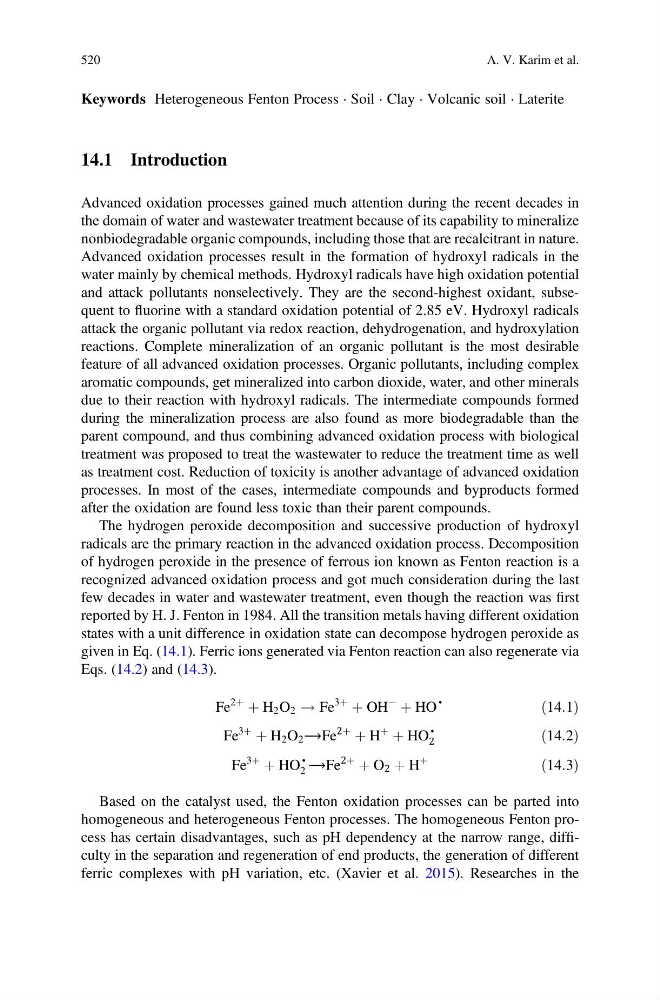
given in Eq. (14.1). Ferric ions generated via Fenton reaction can also regenerate via
Eqs. (14.2) and (14.3).
Fe
2þ
þ H 2 O 2 ! Fe
3þ
þ OH
À
þ HO
•
ð14:1Þ
Fe
3þ
þ H 2 O 2 ⟶Fe
2þ
þ H
þ
þ HO
•
2
ð14:2Þ
Fe
3þ
þ HO
•
2 ⟶Fe
2þ
þ O 2 þ H
þ
ð14:3Þ
Based on the catalyst used, the Fenton oxidation processes can be parted into
homogeneous and heterogeneous Fenton processes. The homogeneous Fenton process has certain disadvantages, such as pH dependency at the narrow range, difficulty in the separation and regeneration of end products, the generation of different
ferric complexes with pH variation, etc. (Xavier et al. 2015). Researches in the
520
A. V. Karim et al.
14.1 Introduction
Advanced oxidation processes gained much attention during the recent decades in
the domain of water and wastewater treatment because of its capability to mineralize
nonbiodegradable organic compounds, including those that are recalcitrant in nature.
Advanced oxidation processes result in the formation of hydroxyl radicals in the
water mainly by chemical methods. Hydroxyl radicals have high oxidation potential
and attack pollutants nonselectively. They are the second-highest oxidant, subsequent to fluorine with a standard oxidation potential of 2.85 eV. Hydroxyl radicals
attack the organic pollutant via redox reaction, dehydrogenation, and hydroxylation
reactions. Complete mineralization of an organic pollutant is the most desirable
feature of all advanced oxidation processes. Organic pollutants, including complex
aromatic compounds, get mineralized into carbon dioxide, water, and other minerals
due to their reaction with hydroxyl radicals. The intermediate compounds formed
during the mineralization process are also found as more biodegradable than the
parent compound, and thus combining advanced oxidation process with biological
treatment was proposed to treat the wastewater to reduce the treatment time as well
as treatment cost. Reduction of toxicity is another advantage of advanced oxidation
processes. In most of the cases, intermediate compounds and byproducts formed
after the oxidation are found less toxic than their parent compounds.
The hydrogen peroxide decomposition and successive production of hydroxyl
radicals are the primary reaction in the advanced oxidation process. Decomposition
of hydrogen peroxide in the presence of ferrous ion known as Fenton reaction is a
recognized advanced oxidation process and got much consideration during the last
few decades in water and wastewater treatment, even though the reaction was first
reported by H. J. Fenton in 1984. All the transition metals having different oxidation
states with a unit difference in oxidation state can decompose hydrogen peroxide as
given in Eq. (14.1). Ferric ions generated via Fenton reaction can also regenerate via
Eqs. (14.2) and (14.3).
Fe
2þ
þ H 2 O 2 ! Fe
3þ
þ OH
À
þ HO
•
ð14:1Þ
Fe
3þ
þ H 2 O 2 ⟶Fe
2þ
þ H
þ
þ HO
•
2
ð14:2Þ
Fe
3þ
þ HO
•
2 ⟶Fe
2þ
þ O 2 þ H
þ
ð14:3Þ
Based on the catalyst used, the Fenton oxidation processes can be parted into
homogeneous and heterogeneous Fenton processes. The homogeneous Fenton process has certain disadvantages, such as pH dependency at the narrow range, difficulty in the separation and regeneration of end products, the generation of different
ferric complexes with pH variation, etc. (Xavier et al. 2015). Researches in the
520
A. V. Karim et al.