

The other common organic pollutants widely studied are polychlorinated biphenyls, perfluorinated compounds, brominated flame retardants, polycyclic aromatic
hydrocarbons, and polychlorinated naphthalenes. Polychlorinated biphenyls have
been widely used as additives to oils and industrial fluids, such as dielectric fluids in
transformers. Generally, a class of 209 chlorinated aromatic compounds is being
extensively used in industrial equipment and consumer products (Breivik et al. 2002;
Breivik et al. 2007). Polychlorinated naphthalenes originate mainly from chlor-alkali
industry and through waste incineration. These compounds deposited in the soils are
being washed away by rain water to surface water.
13.3 Health Impact of Organic Pollutants on Human
The organic compounds not only enter the human body through food chain but also
through water. Chemical disinfection is widely employed as a purification method to
destroy pathogens in water. The disinfection byproducts are one of the main sources
of organic pollutants in water. Disinfection byproducts are reported for the four
major disinfectants: chlorine, ozone, chloramines, and chlorine dioxide, as well as
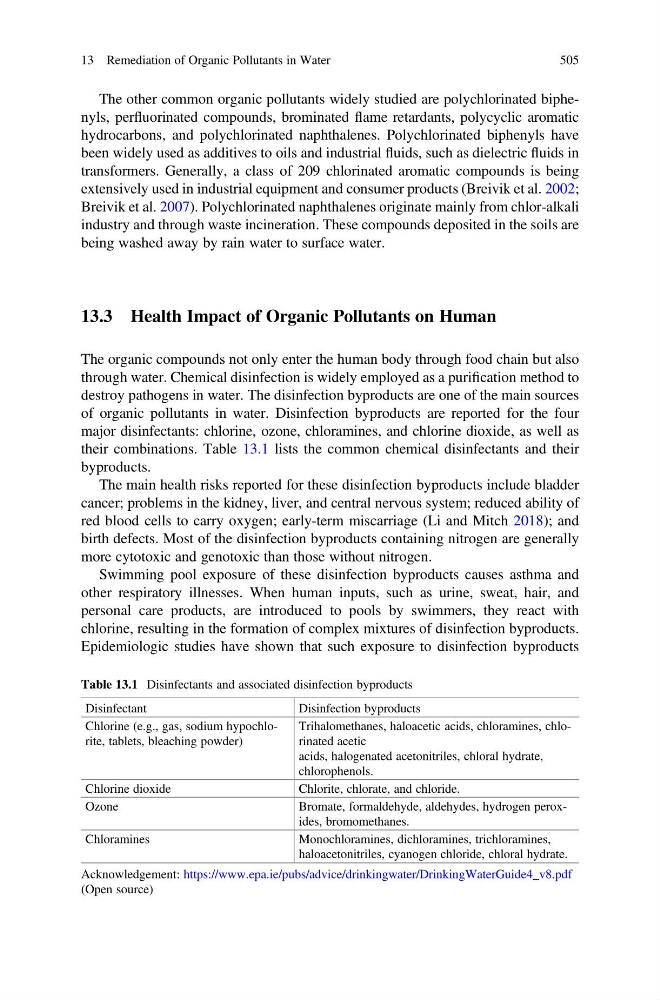
their combinations. Table 13.1 lists the common chemical disinfectants and their
byproducts.
The main health risks reported for these disinfection byproducts include bladder
cancer; problems in the kidney, liver, and central nervous system; reduced ability of
red blood cells to carry oxygen; early-term miscarriage (Li and Mitch 2018); and
birth defects. Most of the disinfection byproducts containing nitrogen are generally
more cytotoxic and genotoxic than those without nitrogen.
Swimming pool exposure of these disinfection byproducts causes asthma and
other respiratory illnesses. When human inputs, such as urine, sweat, hair, and
personal care products, are introduced to pools by swimmers, they react with
chlorine, resulting in the formation of complex mixtures of disinfection byproducts.
Epidemiologic studies have shown that such exposure to disinfection byproducts
Table 13.1 Disinfectants and associated disinfection byproducts
Disinfectant
Disinfection byproducts
Chlorine (e.g., gas, sodium hypochlorite, tablets, bleaching powder)
Trihalomethanes, haloacetic acids, chloramines, chlorinated acetic
acids, halogenated acetonitriles, chloral hydrate,
chlorophenols.
Chlorine dioxide
Chlorite, chlorate, and chloride.
Ozone
Bromate, formaldehyde, aldehydes, hydrogen peroxides, bromomethanes.
Chloramines
Monochloramines, dichloramines, trichloramines,
haloacetonitriles, cyanogen chloride, chloral hydrate.
Acknowledgement: https://www.epa.ie/pubs/advice/drinkingwater/DrinkingWaterGuide4_v8.pdf
(Open source)
13 Remediation of Organic Pollutants in Water
505
hydrocarbons, and polychlorinated naphthalenes. Polychlorinated biphenyls have
been widely used as additives to oils and industrial fluids, such as dielectric fluids in
transformers. Generally, a class of 209 chlorinated aromatic compounds is being
extensively used in industrial equipment and consumer products (Breivik et al. 2002;
Breivik et al. 2007). Polychlorinated naphthalenes originate mainly from chlor-alkali
industry and through waste incineration. These compounds deposited in the soils are
being washed away by rain water to surface water.
13.3 Health Impact of Organic Pollutants on Human
The organic compounds not only enter the human body through food chain but also
through water. Chemical disinfection is widely employed as a purification method to
destroy pathogens in water. The disinfection byproducts are one of the main sources
of organic pollutants in water. Disinfection byproducts are reported for the four
major disinfectants: chlorine, ozone, chloramines, and chlorine dioxide, as well as
their combinations. Table 13.1 lists the common chemical disinfectants and their
byproducts.
The main health risks reported for these disinfection byproducts include bladder
cancer; problems in the kidney, liver, and central nervous system; reduced ability of
red blood cells to carry oxygen; early-term miscarriage (Li and Mitch 2018); and
birth defects. Most of the disinfection byproducts containing nitrogen are generally
more cytotoxic and genotoxic than those without nitrogen.
Swimming pool exposure of these disinfection byproducts causes asthma and
other respiratory illnesses. When human inputs, such as urine, sweat, hair, and
personal care products, are introduced to pools by swimmers, they react with
chlorine, resulting in the formation of complex mixtures of disinfection byproducts.
Epidemiologic studies have shown that such exposure to disinfection byproducts
Table 13.1 Disinfectants and associated disinfection byproducts
Disinfectant
Disinfection byproducts
Chlorine (e.g., gas, sodium hypochlorite, tablets, bleaching powder)
Trihalomethanes, haloacetic acids, chloramines, chlorinated acetic
acids, halogenated acetonitriles, chloral hydrate,
chlorophenols.
Chlorine dioxide
Chlorite, chlorate, and chloride.
Ozone
Bromate, formaldehyde, aldehydes, hydrogen peroxides, bromomethanes.
Chloramines
Monochloramines, dichloramines, trichloramines,
haloacetonitriles, cyanogen chloride, chloral hydrate.
Acknowledgement: https://www.epa.ie/pubs/advice/drinkingwater/DrinkingWaterGuide4_v8.pdf
(Open source)
13 Remediation of Organic Pollutants in Water
505