

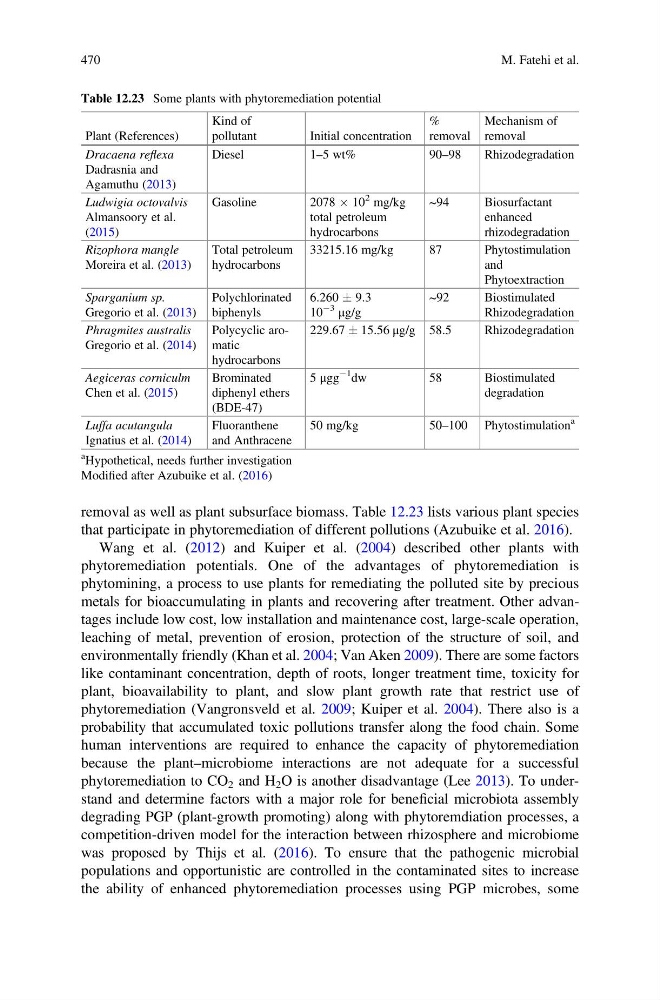
removal as well as plant subsurface biomass. Table 12.23 lists various plant species
that participate in phytoremediation of different pollutions (Azubuike et al. 2016).
Wang et al. (2012) and Kuiper et al. (2004) described other plants with
phytoremediation potentials. One of the advantages of phytoremediation is
phytomining, a process to use plants for remediating the polluted site by precious
metals for bioaccumulating in plants and recovering after treatment. Other advantages include low cost, low installation and maintenance cost, large-scale operation,
leaching of metal, prevention of erosion, protection of the structure of soil, and
environmentally friendly (Khan et al. 2004; Van Aken 2009). There are some factors
like contaminant concentration, depth of roots, longer treatment time, toxicity for
plant, bioavailability to plant, and slow plant growth rate that restrict use of
phytoremediation (Vangronsveld et al. 2009; Kuiper et al. 2004). There also is a
probability that accumulated toxic pollutions transfer along the food chain. Some
human interventions are required to enhance the capacity of phytoremediation
because the plant–microbiome interactions are not adequate for a successful
phytoremediation to CO 2 and H 2 O is another disadvantage (Lee 2013). To understand and determine factors with a major role for beneficial microbiota assembly
degrading PGP (plant-growth promoting) along with phytoremdiation processes, a
competition-driven model for the interaction between rhizosphere and microbiome
was proposed by Thijs et al. (2016). To ensure that the pathogenic microbial
populations and opportunistic are controlled in the contaminated sites to increase
the ability of enhanced phytoremediation processes using PGP microbes, some
Table 12.23 Some plants with phytoremediation potential
Plant (References)
Kind of
pollutant
Initial concentration
%
removal
Mechanism of
removal
Dracaena reflexa
Dadrasnia and
Agamuthu (2013)
Diesel
1–5 wt%
90–98
Rhizodegradation
Ludwigia octovalvis
Almansoory et al.
(2015)
Gasoline
2078 Â 10
2 mg/kg
total petroleum
hydrocarbons
~94
Biosurfactant
enhanced
rhizodegradation
Rizophora mangle
Moreira et al. (2013)
Total petroleum
hydrocarbons
33215.16 mg/kg
87
Phytostimulation
and
Phytoextraction
Sparganium sp.
Gregorio et al. (2013)
Polychlorinated
biphenyls
6.260 Æ 9.3
10
À3 μg/g
~92
Biostimulated
Rhizodegradation
Phragmites australis
Gregorio et al. (2014)
Polycyclic aromatic
hydrocarbons
229.67 Æ 15.56 μg/g 58.5
Rhizodegradation
Aegiceras corniculm
Chen et al. (2015)
Brominated
diphenyl ethers
(BDE-47)
5 μgg
À1
dw
58
Biostimulated
degradation
Luffa acutangula
Ignatius et al. (2014)
Fluoranthene
and Anthracene
50 mg/kg
50–100 Phytostimulation
a
a Hypothetical, needs further investigation
Modified after Azubuike et al. (2016)
470
M. Fatehi et al.
that participate in phytoremediation of different pollutions (Azubuike et al. 2016).
Wang et al. (2012) and Kuiper et al. (2004) described other plants with
phytoremediation potentials. One of the advantages of phytoremediation is
phytomining, a process to use plants for remediating the polluted site by precious
metals for bioaccumulating in plants and recovering after treatment. Other advantages include low cost, low installation and maintenance cost, large-scale operation,
leaching of metal, prevention of erosion, protection of the structure of soil, and
environmentally friendly (Khan et al. 2004; Van Aken 2009). There are some factors
like contaminant concentration, depth of roots, longer treatment time, toxicity for
plant, bioavailability to plant, and slow plant growth rate that restrict use of
phytoremediation (Vangronsveld et al. 2009; Kuiper et al. 2004). There also is a
probability that accumulated toxic pollutions transfer along the food chain. Some
human interventions are required to enhance the capacity of phytoremediation
because the plant–microbiome interactions are not adequate for a successful
phytoremediation to CO 2 and H 2 O is another disadvantage (Lee 2013). To understand and determine factors with a major role for beneficial microbiota assembly
degrading PGP (plant-growth promoting) along with phytoremdiation processes, a
competition-driven model for the interaction between rhizosphere and microbiome
was proposed by Thijs et al. (2016). To ensure that the pathogenic microbial
populations and opportunistic are controlled in the contaminated sites to increase
the ability of enhanced phytoremediation processes using PGP microbes, some
Table 12.23 Some plants with phytoremediation potential
Plant (References)
Kind of
pollutant
Initial concentration
%
removal
Mechanism of
removal
Dracaena reflexa
Dadrasnia and
Agamuthu (2013)
Diesel
1–5 wt%
90–98
Rhizodegradation
Ludwigia octovalvis
Almansoory et al.
(2015)
Gasoline
2078 Â 10
2 mg/kg
total petroleum
hydrocarbons
~94
Biosurfactant
enhanced
rhizodegradation
Rizophora mangle
Moreira et al. (2013)
Total petroleum
hydrocarbons
33215.16 mg/kg
87
Phytostimulation
and
Phytoextraction
Sparganium sp.
Gregorio et al. (2013)
Polychlorinated
biphenyls
6.260 Æ 9.3
10
À3 μg/g
~92
Biostimulated
Rhizodegradation
Phragmites australis
Gregorio et al. (2014)
Polycyclic aromatic
hydrocarbons
229.67 Æ 15.56 μg/g 58.5
Rhizodegradation
Aegiceras corniculm
Chen et al. (2015)
Brominated
diphenyl ethers
(BDE-47)
5 μgg
À1
dw
58
Biostimulated
degradation
Luffa acutangula
Ignatius et al. (2014)
Fluoranthene
and Anthracene
50 mg/kg
50–100 Phytostimulation
a
a Hypothetical, needs further investigation
Modified after Azubuike et al. (2016)
470
M. Fatehi et al.