

Incorporating nanoparticles by some materials with low surface energy in sol–gel
technique has been suggested to produce a superhydrophobic surface, as a costeffective method. The SH surfaces are generally self-cleaning and oleophilic. Nevertheless, improvement of their oleophilicity is very important in order to use them in
practical applications like cleaning up spilled oil. Lakshmi et al. (2012) modified
silica nanoparticles with perfluoroalkylmethacrylic copolymer to fabricate a sol–gel
nanocomposite coating. The wetting property of different coatings like sol–gel,
perfluoroalkylmethacrylic copolymer, sol–gel-perfluoroalkylmethacrylic copolymer, sol–gel-silica and sol–gel-perfluoroalkylmethacrylic copolymer-silica coating
was compared with each other by determining water contact angle, ethylene glycol
contact angle, and lubricant oil contact angle.
The water contact angle of the perfluoroalkylmethacrylic copolymer coating
(108.2
) was greater than that of sol–gel coating (89.0
). With incorporating of
perfluoroalkylmethacrylic copolymer to the sol–gel coating (sol–gelperfluoroalkylmethacrylic copolymer coating), the water contact angle decreased
to 97.3
. While, after incorporating of fumed silica in the sol–gel and sol–gelperfluoroalkylmethacrylic copolymer mixtures, the water contact angle of sol–gelsilica and sol–gel-perfluoroalkylmethacrylic copolymer-silica were 155
and 158
,
respectively. The results of organic contact angle measurements indicated that
ethylene glycol and oil contact angle of perfluoroalkylmethacrylic copolymer coating was greater than those of sol–gel and sol–gel-perfluoroalkylmethacrylic copolymer coating. The greatest amounts of ethylene glycol and oil contact angles were
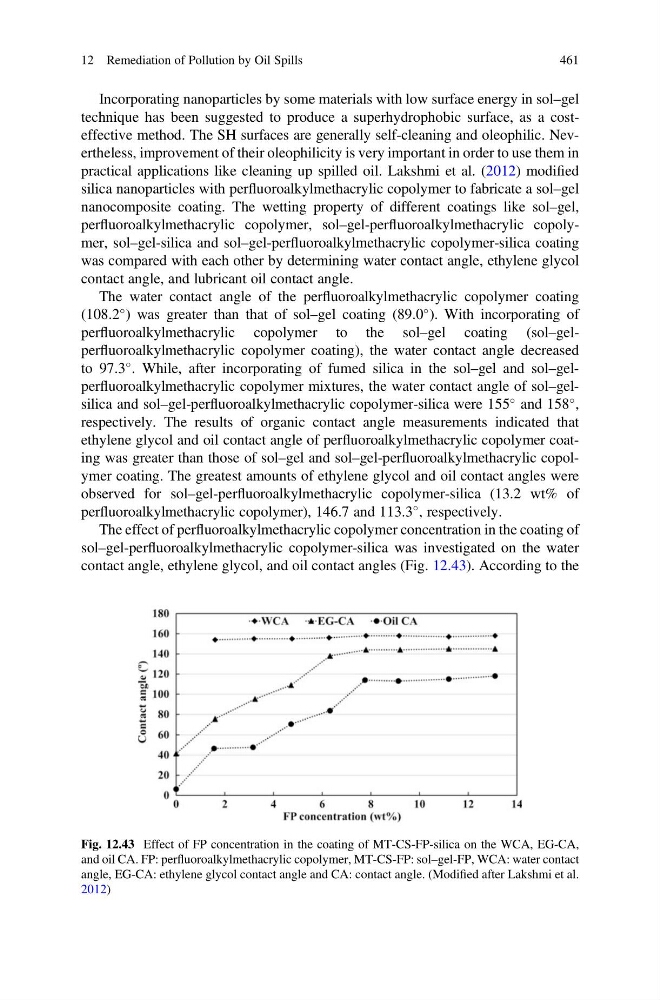
observed for sol–gel-perfluoroalkylmethacrylic copolymer-silica (13.2 wt% of
perfluoroalkylmethacrylic copolymer), 146.7 and 113.3
, respectively.
The effect of perfluoroalkylmethacrylic copolymer concentration in the coating of
sol–gel-perfluoroalkylmethacrylic copolymer-silica was investigated on the water
contact angle, ethylene glycol, and oil contact angles (Fig. 12.43). According to the
Fig. 12.43 Effect of FP concentration in the coating of MT-CS-FP-silica on the WCA, EG-CA,
and oil CA. FP: perfluoroalkylmethacrylic copolymer, MT-CS-FP: sol–gel-FP, WCA: water contact
angle, EG-CA: ethylene glycol contact angle and CA: contact angle. (Modified after Lakshmi et al.
2012)
12 Remediation of Pollution by Oil Spills
461
technique has been suggested to produce a superhydrophobic surface, as a costeffective method. The SH surfaces are generally self-cleaning and oleophilic. Nevertheless, improvement of their oleophilicity is very important in order to use them in
practical applications like cleaning up spilled oil. Lakshmi et al. (2012) modified
silica nanoparticles with perfluoroalkylmethacrylic copolymer to fabricate a sol–gel
nanocomposite coating. The wetting property of different coatings like sol–gel,
perfluoroalkylmethacrylic copolymer, sol–gel-perfluoroalkylmethacrylic copolymer, sol–gel-silica and sol–gel-perfluoroalkylmethacrylic copolymer-silica coating
was compared with each other by determining water contact angle, ethylene glycol
contact angle, and lubricant oil contact angle.
The water contact angle of the perfluoroalkylmethacrylic copolymer coating
(108.2
) was greater than that of sol–gel coating (89.0
). With incorporating of
perfluoroalkylmethacrylic copolymer to the sol–gel coating (sol–gelperfluoroalkylmethacrylic copolymer coating), the water contact angle decreased
to 97.3
. While, after incorporating of fumed silica in the sol–gel and sol–gelperfluoroalkylmethacrylic copolymer mixtures, the water contact angle of sol–gelsilica and sol–gel-perfluoroalkylmethacrylic copolymer-silica were 155
and 158
,
respectively. The results of organic contact angle measurements indicated that
ethylene glycol and oil contact angle of perfluoroalkylmethacrylic copolymer coating was greater than those of sol–gel and sol–gel-perfluoroalkylmethacrylic copolymer coating. The greatest amounts of ethylene glycol and oil contact angles were
observed for sol–gel-perfluoroalkylmethacrylic copolymer-silica (13.2 wt% of
perfluoroalkylmethacrylic copolymer), 146.7 and 113.3
, respectively.
The effect of perfluoroalkylmethacrylic copolymer concentration in the coating of
sol–gel-perfluoroalkylmethacrylic copolymer-silica was investigated on the water
contact angle, ethylene glycol, and oil contact angles (Fig. 12.43). According to the
Fig. 12.43 Effect of FP concentration in the coating of MT-CS-FP-silica on the WCA, EG-CA,
and oil CA. FP: perfluoroalkylmethacrylic copolymer, MT-CS-FP: sol–gel-FP, WCA: water contact
angle, EG-CA: ethylene glycol contact angle and CA: contact angle. (Modified after Lakshmi et al.
2012)
12 Remediation of Pollution by Oil Spills
461