

temperature of about 200–300
C. The obtained iron oxide nanoparticles from this
method only dissolve in nonpolar solvents.
On the other hand, in hydrothermal method, chemical reactions occur at high
temperature and vapor pressure (hydrothermal conditions) in an aqueous phase. The
temperature, reactant concentration, and time of process are the significant conditions of this method, which affect the size, shape, structure, and saturation magnetization of the iron oxide nanoparticles.
The microemulsion method involves dispersed aqueous phase (water) as
nanodroplets, whereafter surfactant molecules surround them in an organic phase
(oil). These nanodroplets influence the shape and size of iron oxide nanoparticles.
This method provides the iron oxide nanoparticles with size range of 3.5 Æ 0.6 nm.
The ION based-magnetic sorbents have the preferred properties that make them
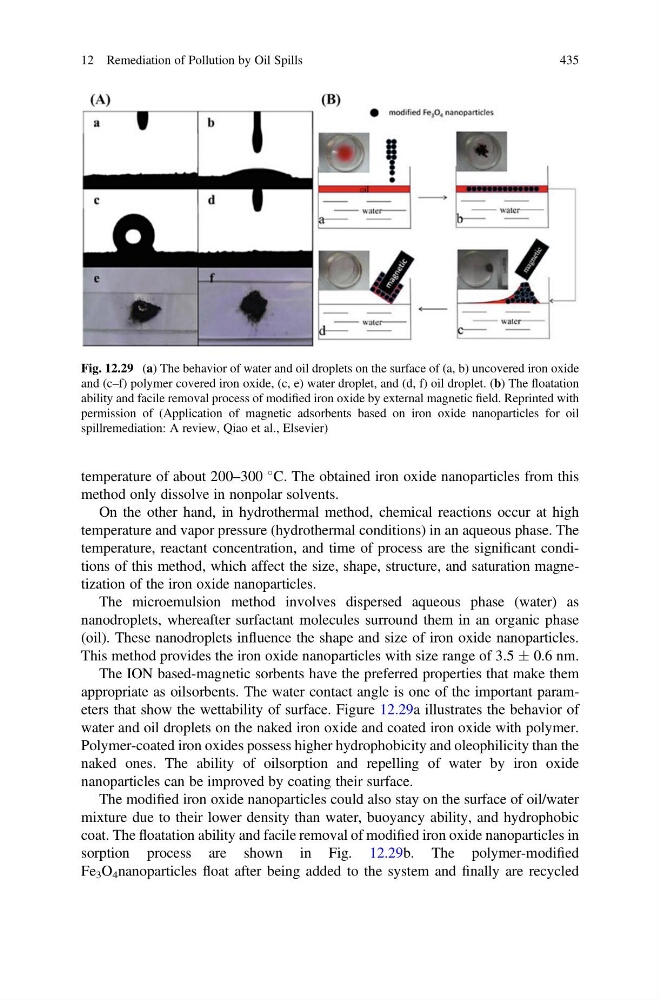
appropriate as oilsorbents. The water contact angle is one of the important parameters that show the wettability of surface. Figure 12.29a illustrates the behavior of
water and oil droplets on the naked iron oxide and coated iron oxide with polymer.
Polymer-coated iron oxides possess higher hydrophobicity and oleophilicity than the
naked ones. The ability of oilsorption and repelling of water by iron oxide
nanoparticles can be improved by coating their surface.
The modified iron oxide nanoparticles could also stay on the surface of oil/water
mixture due to their lower density than water, buoyancy ability, and hydrophobic
coat. The floatation ability and facile removal of modified iron oxide nanoparticles in
sorption process are shown in Fig. 12.29b. The polymer-modified
Fe 3 O 4 nanoparticles float after being added to the system and finally are recycled
Fig. 12.29 (a) The behavior of water and oil droplets on the surface of (a, b) uncovered iron oxide
and (c–f) polymer covered iron oxide, (c, e) water droplet, and (d, f) oil droplet. (b) The floatation
ability and facile removal process of modified iron oxide by external magnetic field. Reprinted with
permission of (Application of magnetic adsorbents based on iron oxide nanoparticles for oil
spillremediation: A review, Qiao et al., Elsevier)
12 Remediation of Pollution by Oil Spills
435
C. The obtained iron oxide nanoparticles from this
method only dissolve in nonpolar solvents.
On the other hand, in hydrothermal method, chemical reactions occur at high
temperature and vapor pressure (hydrothermal conditions) in an aqueous phase. The
temperature, reactant concentration, and time of process are the significant conditions of this method, which affect the size, shape, structure, and saturation magnetization of the iron oxide nanoparticles.
The microemulsion method involves dispersed aqueous phase (water) as
nanodroplets, whereafter surfactant molecules surround them in an organic phase
(oil). These nanodroplets influence the shape and size of iron oxide nanoparticles.
This method provides the iron oxide nanoparticles with size range of 3.5 Æ 0.6 nm.
The ION based-magnetic sorbents have the preferred properties that make them
appropriate as oilsorbents. The water contact angle is one of the important parameters that show the wettability of surface. Figure 12.29a illustrates the behavior of
water and oil droplets on the naked iron oxide and coated iron oxide with polymer.
Polymer-coated iron oxides possess higher hydrophobicity and oleophilicity than the
naked ones. The ability of oilsorption and repelling of water by iron oxide
nanoparticles can be improved by coating their surface.
The modified iron oxide nanoparticles could also stay on the surface of oil/water
mixture due to their lower density than water, buoyancy ability, and hydrophobic
coat. The floatation ability and facile removal of modified iron oxide nanoparticles in
sorption process are shown in Fig. 12.29b. The polymer-modified
Fe 3 O 4 nanoparticles float after being added to the system and finally are recycled
Fig. 12.29 (a) The behavior of water and oil droplets on the surface of (a, b) uncovered iron oxide
and (c–f) polymer covered iron oxide, (c, e) water droplet, and (d, f) oil droplet. (b) The floatation
ability and facile removal process of modified iron oxide by external magnetic field. Reprinted with
permission of (Application of magnetic adsorbents based on iron oxide nanoparticles for oil
spillremediation: A review, Qiao et al., Elsevier)
12 Remediation of Pollution by Oil Spills
435