

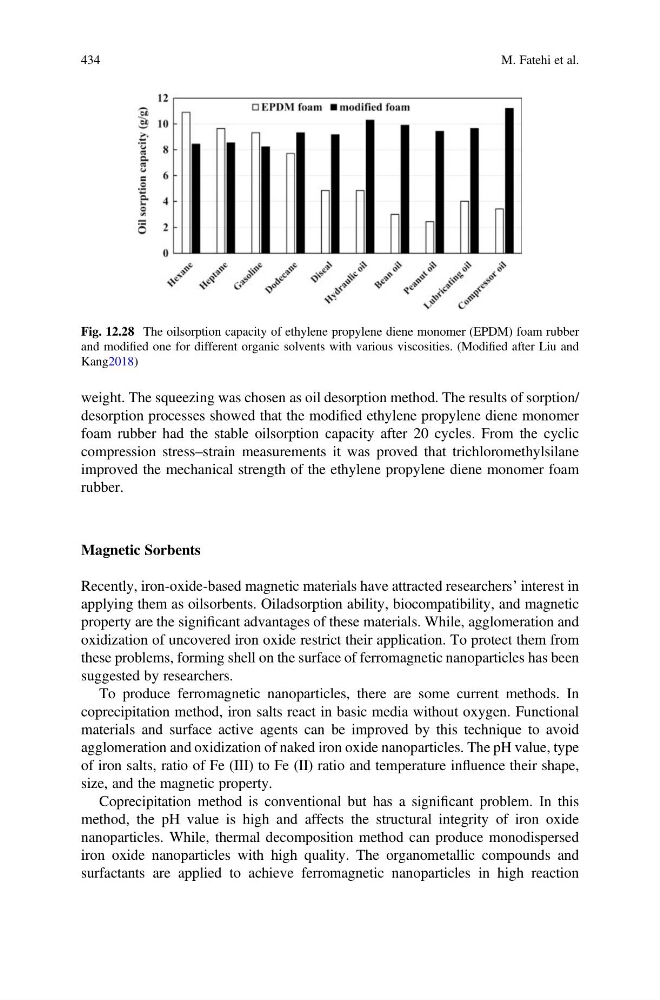
weight. The squeezing was chosen as oil desorption method. The results of sorption/
desorption processes showed that the modified ethylene propylene diene monomer
foam rubber had the stable oilsorption capacity after 20 cycles. From the cyclic
compression stress–strain measurements it was proved that trichloromethylsilane
improved the mechanical strength of the ethylene propylene diene monomer foam
rubber.
Magnetic Sorbents
Recently, iron-oxide-based magnetic materials have attracted researchers’ interest in
applying them as oilsorbents. Oiladsorption ability, biocompatibility, and magnetic
property are the significant advantages of these materials. While, agglomeration and
oxidization of uncovered iron oxide restrict their application. To protect them from
these problems, forming shell on the surface of ferromagnetic nanoparticles has been
suggested by researchers.
To produce ferromagnetic nanoparticles, there are some current methods. In
coprecipitation method, iron salts react in basic media without oxygen. Functional
materials and surface active agents can be improved by this technique to avoid
agglomeration and oxidization of naked iron oxide nanoparticles. The pH value, type
of iron salts, ratio of Fe (III) to Fe (II) ratio and temperature influence their shape,
size, and the magnetic property.
Coprecipitation method is conventional but has a significant problem. In this
method, the pH value is high and affects the structural integrity of iron oxide
nanoparticles. While, thermal decomposition method can produce monodispersed
iron oxide nanoparticles with high quality. The organometallic compounds and
surfactants are applied to achieve ferromagnetic nanoparticles in high reaction
Fig. 12.28 The oilsorption capacity of ethylene propylene diene monomer (EPDM) foam rubber
and modified one for different organic solvents with various viscosities. (Modified after Liu and
Kang2018)
434
M. Fatehi et al.
desorption processes showed that the modified ethylene propylene diene monomer
foam rubber had the stable oilsorption capacity after 20 cycles. From the cyclic
compression stress–strain measurements it was proved that trichloromethylsilane
improved the mechanical strength of the ethylene propylene diene monomer foam
rubber.
Magnetic Sorbents
Recently, iron-oxide-based magnetic materials have attracted researchers’ interest in
applying them as oilsorbents. Oiladsorption ability, biocompatibility, and magnetic
property are the significant advantages of these materials. While, agglomeration and
oxidization of uncovered iron oxide restrict their application. To protect them from
these problems, forming shell on the surface of ferromagnetic nanoparticles has been
suggested by researchers.
To produce ferromagnetic nanoparticles, there are some current methods. In
coprecipitation method, iron salts react in basic media without oxygen. Functional
materials and surface active agents can be improved by this technique to avoid
agglomeration and oxidization of naked iron oxide nanoparticles. The pH value, type
of iron salts, ratio of Fe (III) to Fe (II) ratio and temperature influence their shape,
size, and the magnetic property.
Coprecipitation method is conventional but has a significant problem. In this
method, the pH value is high and affects the structural integrity of iron oxide
nanoparticles. While, thermal decomposition method can produce monodispersed
iron oxide nanoparticles with high quality. The organometallic compounds and
surfactants are applied to achieve ferromagnetic nanoparticles in high reaction
Fig. 12.28 The oilsorption capacity of ethylene propylene diene monomer (EPDM) foam rubber
and modified one for different organic solvents with various viscosities. (Modified after Liu and
Kang2018)
434
M. Fatehi et al.