

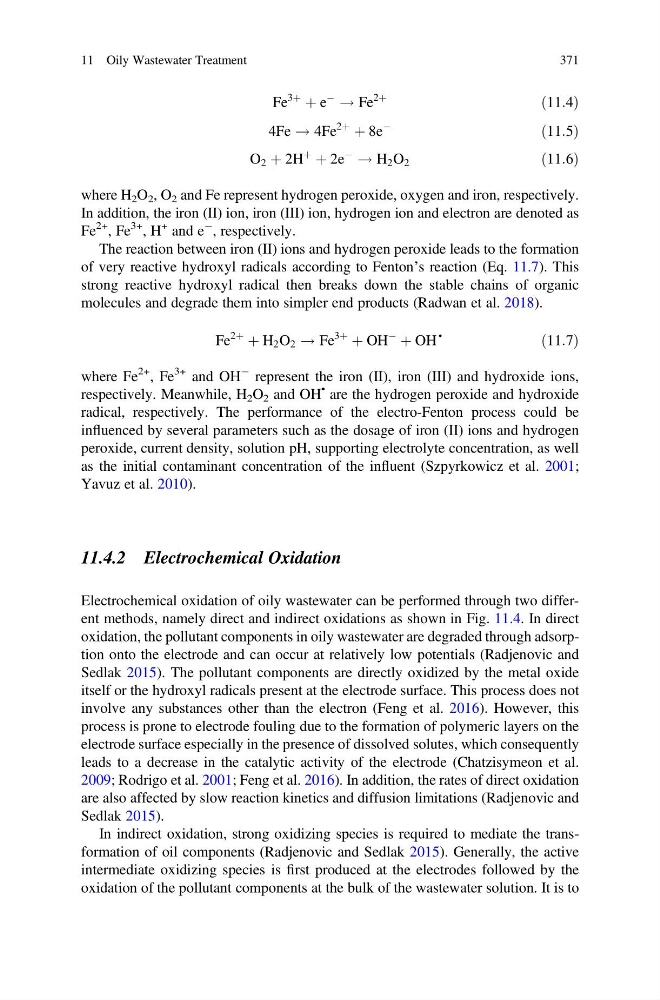
Fe
3þ
þ e
À
! Fe
2þ
ð11:4Þ
4Fe ! 4Fe
2þ
þ 8e
À
ð11:5Þ
O 2 þ 2H
þ
þ 2e
À
! H 2 O 2
ð11:6Þ
where H 2 O 2 , O 2 and Fe represent hydrogen peroxide, oxygen and iron, respectively.
In addition, the iron (II) ion, iron (III) ion, hydrogen ion and electron are denoted as
Fe
2+ , Fe
3+ , H
+ and e
À
, respectively.
The reaction between iron (II) ions and hydrogen peroxide leads to the formation
of very reactive hydroxyl radicals according to Fenton’s reaction (Eq. 11.7). This
strong reactive hydroxyl radical then breaks down the stable chains of organic
molecules and degrade them into simpler end products (Radwan et al. 2018).
Fe
2þ
þ H 2 O 2 ! Fe
3þ
þ OH
À
þ OH
•
ð11:7Þ
where Fe
2+ , Fe
3+ and OH
À represent the iron (II), iron (III) and hydroxide ions,
respectively. Meanwhile, H 2 O 2 and OH
• are the hydrogen peroxide and hydroxide
radical, respectively. The performance of the electro-Fenton process could be
influenced by several parameters such as the dosage of iron (II) ions and hydrogen
peroxide, current density, solution pH, supporting electrolyte concentration, as well
as the initial contaminant concentration of the influent (Szpyrkowicz et al. 2001;
Yavuz et al. 2010).
11.4.2 Electrochemical Oxidation
Electrochemical oxidation of oily wastewater can be performed through two different methods, namely direct and indirect oxidations as shown in Fig. 11.4. In direct
oxidation, the pollutant components in oily wastewater are degraded through adsorption onto the electrode and can occur at relatively low potentials (Radjenovic and
Sedlak 2015). The pollutant components are directly oxidized by the metal oxide
itself or the hydroxyl radicals present at the electrode surface. This process does not
involve any substances other than the electron (Feng et al. 2016). However, this
process is prone to electrode fouling due to the formation of polymeric layers on the
electrode surface especially in the presence of dissolved solutes, which consequently
leads to a decrease in the catalytic activity of the electrode (Chatzisymeon et al.
2009; Rodrigo et al. 2001; Feng et al. 2016). In addition, the rates of direct oxidation
are also affected by slow reaction kinetics and diffusion limitations (Radjenovic and
Sedlak 2015).
In indirect oxidation, strong oxidizing species is required to mediate the transformation of oil components (Radjenovic and Sedlak 2015). Generally, the active
intermediate oxidizing species is first produced at the electrodes followed by the
oxidation of the pollutant components at the bulk of the wastewater solution. It is to
11 Oily Wastewater Treatment
371
3þ
þ e
À
! Fe
2þ
ð11:4Þ
4Fe ! 4Fe
2þ
þ 8e
À
ð11:5Þ
O 2 þ 2H
þ
þ 2e
À
! H 2 O 2
ð11:6Þ
where H 2 O 2 , O 2 and Fe represent hydrogen peroxide, oxygen and iron, respectively.
In addition, the iron (II) ion, iron (III) ion, hydrogen ion and electron are denoted as
Fe
2+ , Fe
3+ , H
+ and e
À
, respectively.
The reaction between iron (II) ions and hydrogen peroxide leads to the formation
of very reactive hydroxyl radicals according to Fenton’s reaction (Eq. 11.7). This
strong reactive hydroxyl radical then breaks down the stable chains of organic
molecules and degrade them into simpler end products (Radwan et al. 2018).
Fe
2þ
þ H 2 O 2 ! Fe
3þ
þ OH
À
þ OH
•
ð11:7Þ
where Fe
2+ , Fe
3+ and OH
À represent the iron (II), iron (III) and hydroxide ions,
respectively. Meanwhile, H 2 O 2 and OH
• are the hydrogen peroxide and hydroxide
radical, respectively. The performance of the electro-Fenton process could be
influenced by several parameters such as the dosage of iron (II) ions and hydrogen
peroxide, current density, solution pH, supporting electrolyte concentration, as well
as the initial contaminant concentration of the influent (Szpyrkowicz et al. 2001;
Yavuz et al. 2010).
11.4.2 Electrochemical Oxidation
Electrochemical oxidation of oily wastewater can be performed through two different methods, namely direct and indirect oxidations as shown in Fig. 11.4. In direct
oxidation, the pollutant components in oily wastewater are degraded through adsorption onto the electrode and can occur at relatively low potentials (Radjenovic and
Sedlak 2015). The pollutant components are directly oxidized by the metal oxide
itself or the hydroxyl radicals present at the electrode surface. This process does not
involve any substances other than the electron (Feng et al. 2016). However, this
process is prone to electrode fouling due to the formation of polymeric layers on the
electrode surface especially in the presence of dissolved solutes, which consequently
leads to a decrease in the catalytic activity of the electrode (Chatzisymeon et al.
2009; Rodrigo et al. 2001; Feng et al. 2016). In addition, the rates of direct oxidation
are also affected by slow reaction kinetics and diffusion limitations (Radjenovic and
Sedlak 2015).
In indirect oxidation, strong oxidizing species is required to mediate the transformation of oil components (Radjenovic and Sedlak 2015). Generally, the active
intermediate oxidizing species is first produced at the electrodes followed by the
oxidation of the pollutant components at the bulk of the wastewater solution. It is to
11 Oily Wastewater Treatment
371