

There are several mechanisms involved in a coagulation process such as ionic layer
compression, adsorption and charge neutralization, inter-particle bridging, and
sweep coagulation (Menezes et al. 1996). These mechanisms are crucial for the
formation of large flocs of residue oil and suspended solids which would easily settle
down and be removed. The mechanisms of the coagulation process are greatly
influenced by the selection and dosage of coagulant, as well as the characteristics
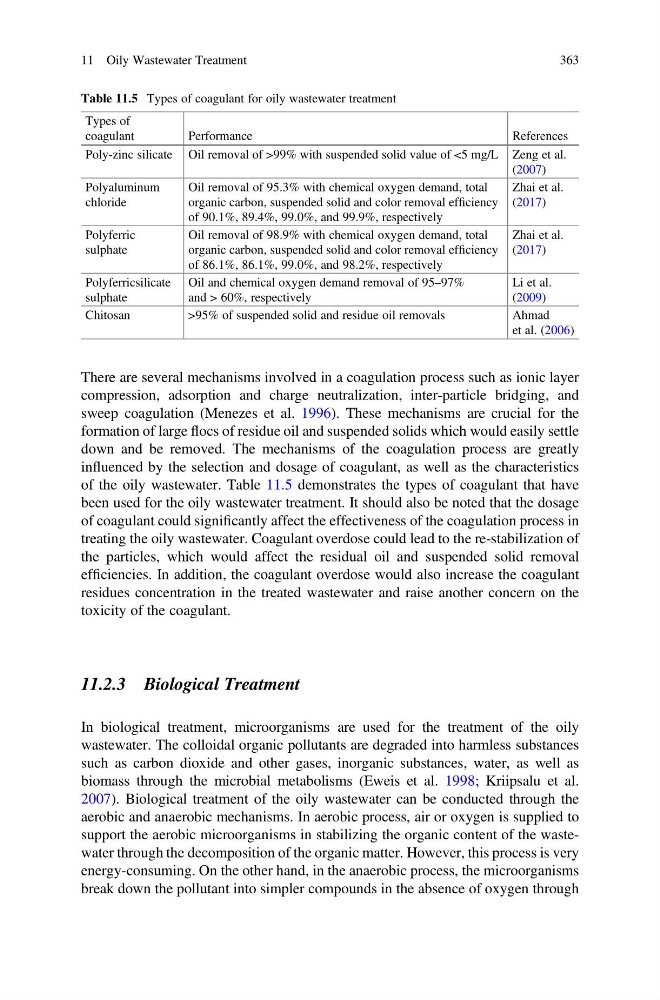
of the oily wastewater. Table 11.5 demonstrates the types of coagulant that have
been used for the oily wastewater treatment. It should also be noted that the dosage
of coagulant could significantly affect the effectiveness of the coagulation process in
treating the oily wastewater. Coagulant overdose could lead to the re-stabilization of
the particles, which would affect the residual oil and suspended solid removal
efficiencies. In addition, the coagulant overdose would also increase the coagulant
residues concentration in the treated wastewater and raise another concern on the
toxicity of the coagulant.
11.2.3 Biological Treatment
In biological treatment, microorganisms are used for the treatment of the oily
wastewater. The colloidal organic pollutants are degraded into harmless substances
such as carbon dioxide and other gases, inorganic substances, water, as well as
biomass through the microbial metabolisms (Eweis et al. 1998; Kriipsalu et al.
2007). Biological treatment of the oily wastewater can be conducted through the
aerobic and anaerobic mechanisms. In aerobic process, air or oxygen is supplied to
support the aerobic microorganisms in stabilizing the organic content of the wastewater through the decomposition of the organic matter. However, this process is very
energy-consuming. On the other hand, in the anaerobic process, the microorganisms
break down the pollutant into simpler compounds in the absence of oxygen through
Table 11.5 Types of coagulant for oily wastewater treatment
Types of
coagulant
Performance
References
Poly-zinc silicate Oil removal of >99% with suspended solid value of <5 mg/L Zeng et al.
(2007)
Polyaluminum
chloride
Oil removal of 95.3% with chemical oxygen demand, total
organic carbon, suspended solid and color removal efficiency
of 90.1%, 89.4%, 99.0%, and 99.9%, respectively
Zhai et al.
(2017)
Polyferric
sulphate
Oil removal of 98.9% with chemical oxygen demand, total
organic carbon, suspended solid and color removal efficiency
of 86.1%, 86.1%, 99.0%, and 98.2%, respectively
Zhai et al.
(2017)
Polyferricsilicate
sulphate
Oil and chemical oxygen demand removal of 95–97%
and > 60%, respectively
Li et al.
(2009)
Chitosan
>95% of suspended solid and residue oil removals
Ahmad
et al. (2006)
11 Oily Wastewater Treatment
363
compression, adsorption and charge neutralization, inter-particle bridging, and
sweep coagulation (Menezes et al. 1996). These mechanisms are crucial for the
formation of large flocs of residue oil and suspended solids which would easily settle
down and be removed. The mechanisms of the coagulation process are greatly
influenced by the selection and dosage of coagulant, as well as the characteristics
of the oily wastewater. Table 11.5 demonstrates the types of coagulant that have
been used for the oily wastewater treatment. It should also be noted that the dosage
of coagulant could significantly affect the effectiveness of the coagulation process in
treating the oily wastewater. Coagulant overdose could lead to the re-stabilization of
the particles, which would affect the residual oil and suspended solid removal
efficiencies. In addition, the coagulant overdose would also increase the coagulant
residues concentration in the treated wastewater and raise another concern on the
toxicity of the coagulant.
11.2.3 Biological Treatment
In biological treatment, microorganisms are used for the treatment of the oily
wastewater. The colloidal organic pollutants are degraded into harmless substances
such as carbon dioxide and other gases, inorganic substances, water, as well as
biomass through the microbial metabolisms (Eweis et al. 1998; Kriipsalu et al.
2007). Biological treatment of the oily wastewater can be conducted through the
aerobic and anaerobic mechanisms. In aerobic process, air or oxygen is supplied to
support the aerobic microorganisms in stabilizing the organic content of the wastewater through the decomposition of the organic matter. However, this process is very
energy-consuming. On the other hand, in the anaerobic process, the microorganisms
break down the pollutant into simpler compounds in the absence of oxygen through
Table 11.5 Types of coagulant for oily wastewater treatment
Types of
coagulant
Performance
References
Poly-zinc silicate Oil removal of >99% with suspended solid value of <5 mg/L Zeng et al.
(2007)
Polyaluminum
chloride
Oil removal of 95.3% with chemical oxygen demand, total
organic carbon, suspended solid and color removal efficiency
of 90.1%, 89.4%, 99.0%, and 99.9%, respectively
Zhai et al.
(2017)
Polyferric
sulphate
Oil removal of 98.9% with chemical oxygen demand, total
organic carbon, suspended solid and color removal efficiency
of 86.1%, 86.1%, 99.0%, and 98.2%, respectively
Zhai et al.
(2017)
Polyferricsilicate
sulphate
Oil and chemical oxygen demand removal of 95–97%
and > 60%, respectively
Li et al.
(2009)
Chitosan
>95% of suspended solid and residue oil removals
Ahmad
et al. (2006)
11 Oily Wastewater Treatment
363