

Column flotation is also another flotation mode that has attracted the interest for
the oily wastewater treatment applications. Today, several flotation column devices
have been developed for quick and high oil separation efficiency. For instance, Gu
and Chiang (1999) developed a multistage loop-flow flotation column which greatly
improved the contact between the oil particles and gas bubbles, resulting in excellent
efficiencies of 90–93% for continuous operation with the feed rates of 1–3.8 L/min.
The multistage flotation column developed by Xiao et al. (2002) with air dispersed at
the bottom of the tray column showed the oil separation efficiencies reaching 94%.
In addition, Li et al. (2007) reported a new type of flotation device which combined
the dissolved air flotation with column flotation. This device has also shown its
ability for effective oily wastewater treatment with the oil removal efficiency of more
than 90%.
11.2.2 Coagulation Treatment
Coagulation is widely used in the oily wastewater treatment due to its capability to
remove emulsified and dissolved oils, as well as some difficult biodegradable
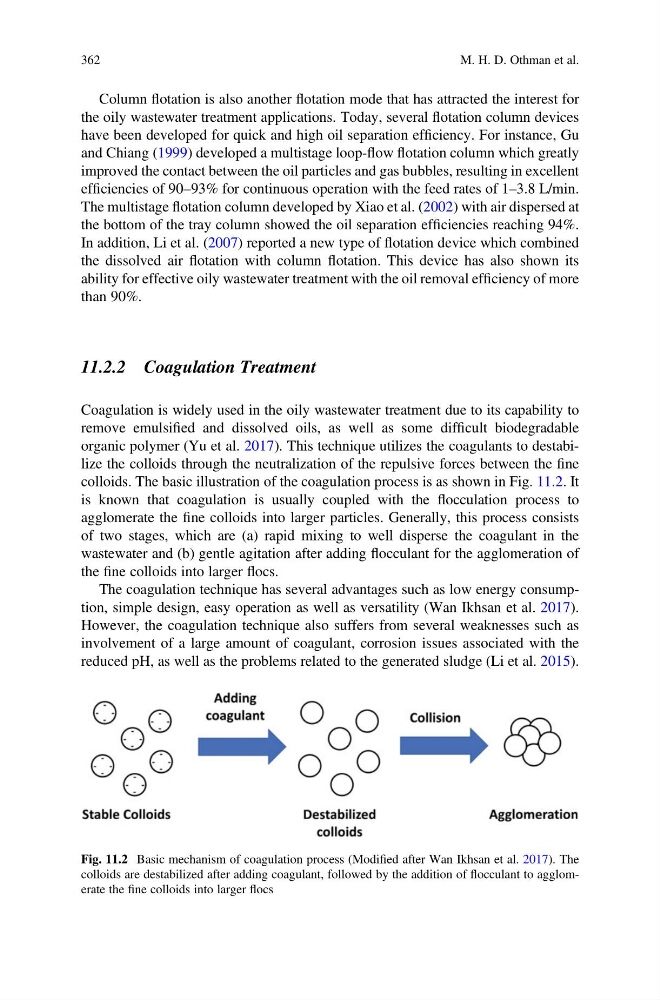
organic polymer (Yu et al. 2017). This technique utilizes the coagulants to destabilize the colloids through the neutralization of the repulsive forces between the fine
colloids. The basic illustration of the coagulation process is as shown in Fig. 11.2. It
is known that coagulation is usually coupled with the flocculation process to
agglomerate the fine colloids into larger particles. Generally, this process consists
of two stages, which are (a) rapid mixing to well disperse the coagulant in the
wastewater and (b) gentle agitation after adding flocculant for the agglomeration of
the fine colloids into larger flocs.
The coagulation technique has several advantages such as low energy consumption, simple design, easy operation as well as versatility (Wan Ikhsan et al. 2017).
However, the coagulation technique also suffers from several weaknesses such as
involvement of a large amount of coagulant, corrosion issues associated with the
reduced pH, as well as the problems related to the generated sludge (Li et al. 2015).
Fig. 11.2 Basic mechanism of coagulation process (Modified after Wan Ikhsan et al. 2017). The
colloids are destabilized after adding coagulant, followed by the addition of flocculant to agglomerate the fine colloids into larger flocs
362
M. H. D. Othman et al.
the oily wastewater treatment applications. Today, several flotation column devices
have been developed for quick and high oil separation efficiency. For instance, Gu
and Chiang (1999) developed a multistage loop-flow flotation column which greatly
improved the contact between the oil particles and gas bubbles, resulting in excellent
efficiencies of 90–93% for continuous operation with the feed rates of 1–3.8 L/min.
The multistage flotation column developed by Xiao et al. (2002) with air dispersed at
the bottom of the tray column showed the oil separation efficiencies reaching 94%.
In addition, Li et al. (2007) reported a new type of flotation device which combined
the dissolved air flotation with column flotation. This device has also shown its
ability for effective oily wastewater treatment with the oil removal efficiency of more
than 90%.
11.2.2 Coagulation Treatment
Coagulation is widely used in the oily wastewater treatment due to its capability to
remove emulsified and dissolved oils, as well as some difficult biodegradable
organic polymer (Yu et al. 2017). This technique utilizes the coagulants to destabilize the colloids through the neutralization of the repulsive forces between the fine
colloids. The basic illustration of the coagulation process is as shown in Fig. 11.2. It
is known that coagulation is usually coupled with the flocculation process to
agglomerate the fine colloids into larger particles. Generally, this process consists
of two stages, which are (a) rapid mixing to well disperse the coagulant in the
wastewater and (b) gentle agitation after adding flocculant for the agglomeration of
the fine colloids into larger flocs.
The coagulation technique has several advantages such as low energy consumption, simple design, easy operation as well as versatility (Wan Ikhsan et al. 2017).
However, the coagulation technique also suffers from several weaknesses such as
involvement of a large amount of coagulant, corrosion issues associated with the
reduced pH, as well as the problems related to the generated sludge (Li et al. 2015).
Fig. 11.2 Basic mechanism of coagulation process (Modified after Wan Ikhsan et al. 2017). The
colloids are destabilized after adding coagulant, followed by the addition of flocculant to agglomerate the fine colloids into larger flocs
362
M. H. D. Othman et al.