

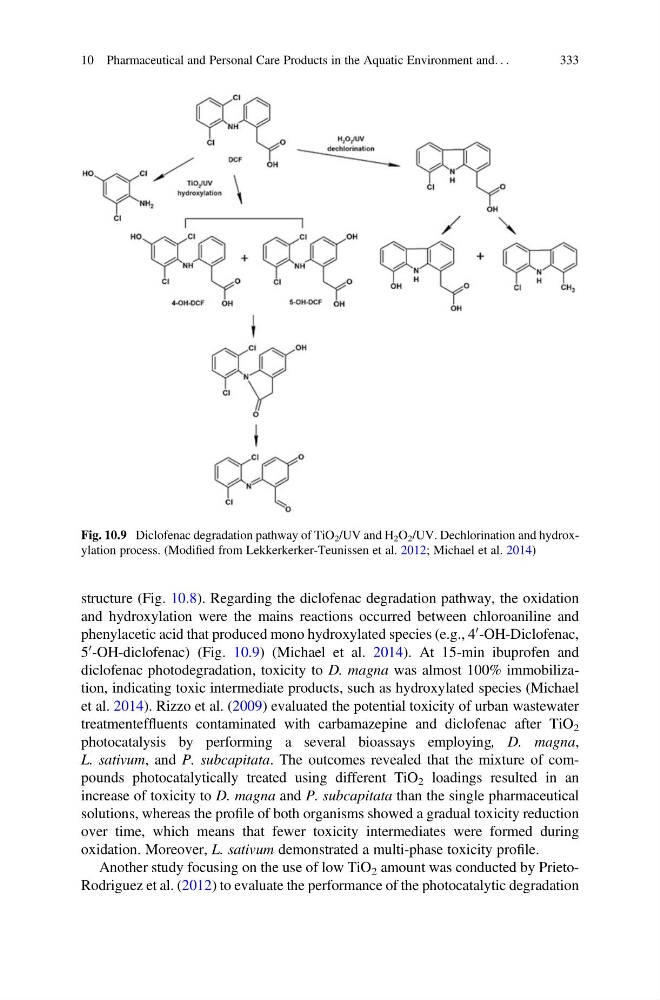
structure (Fig. 10.8). Regarding the diclofenac degradation pathway, the oxidation
and hydroxylation were the mains reactions occurred between chloroaniline and
phenylacetic acid that produced mono hydroxylated species (e.g., 4
0 -OH-Diclofenac,
5
0 -OH-diclofenac) (Fig. 10.9) (Michael et al. 2014). At 15-min ibuprofen and
diclofenac photodegradation, toxicity to D. magna was almost 100% immobilization, indicating toxic intermediate products, such as hydroxylated species (Michael
et al. 2014). Rizzo et al. (2009) evaluated the potential toxicity of urban wastewater
treatmenteffluents contaminated with carbamazepine and diclofenac after TiO 2
photocatalysis by performing a several bioassays employing, D. magna,
L. sativum, and P. subcapitata. The outcomes revealed that the mixture of compounds photocatalytically treated using different TiO 2 loadings resulted in an
increase of toxicity to D. magna and P. subcapitata than the single pharmaceutical
solutions, whereas the profile of both organisms showed a gradual toxicity reduction
over time, which means that fewer toxicity intermediates were formed during
oxidation. Moreover, L. sativum demonstrated a multi-phase toxicity profile.
Another study focusing on the use of low TiO 2 amount was conducted by PrietoRodriguez et al. (2012) to evaluate the performance of the photocatalytic degradation
Fig. 10.9 Diclofenac degradation pathway of TiO 2 /UV and H 2 O 2 /UV. Dechlorination and hydroxylation process. (Modified from Lekkerkerker-Teunissen et al. 2012; Michael et al. 2014)
10 Pharmaceutical and Personal Care Products in the Aquatic Environment and. . .
333
and hydroxylation were the mains reactions occurred between chloroaniline and
phenylacetic acid that produced mono hydroxylated species (e.g., 4
0 -OH-Diclofenac,
5
0 -OH-diclofenac) (Fig. 10.9) (Michael et al. 2014). At 15-min ibuprofen and
diclofenac photodegradation, toxicity to D. magna was almost 100% immobilization, indicating toxic intermediate products, such as hydroxylated species (Michael
et al. 2014). Rizzo et al. (2009) evaluated the potential toxicity of urban wastewater
treatmenteffluents contaminated with carbamazepine and diclofenac after TiO 2
photocatalysis by performing a several bioassays employing, D. magna,
L. sativum, and P. subcapitata. The outcomes revealed that the mixture of compounds photocatalytically treated using different TiO 2 loadings resulted in an
increase of toxicity to D. magna and P. subcapitata than the single pharmaceutical
solutions, whereas the profile of both organisms showed a gradual toxicity reduction
over time, which means that fewer toxicity intermediates were formed during
oxidation. Moreover, L. sativum demonstrated a multi-phase toxicity profile.
Another study focusing on the use of low TiO 2 amount was conducted by PrietoRodriguez et al. (2012) to evaluate the performance of the photocatalytic degradation
Fig. 10.9 Diclofenac degradation pathway of TiO 2 /UV and H 2 O 2 /UV. Dechlorination and hydroxylation process. (Modified from Lekkerkerker-Teunissen et al. 2012; Michael et al. 2014)
10 Pharmaceutical and Personal Care Products in the Aquatic Environment and. . .
333