

Heterogeneous Photocatalysis
The majority of published research on heterogeneous photocatalysis of selected
compounds mediated by TiO 2 employ the semiconductor in the slurry and perform
toxicity tests for treated wastewater (Table 10.3). Méndez-Arriaga et al. (2008)
studied the influence of different operational conditions on the photocatalytic degradation of anti-inflammatory employing TiO 2, following the variation of toxicity
by Vibrio fischeri bioluminescence inhibition. The results showed the high rate
degradation of ibuprofen and diclofenac was achieved with 1 and 0.1 g/L of
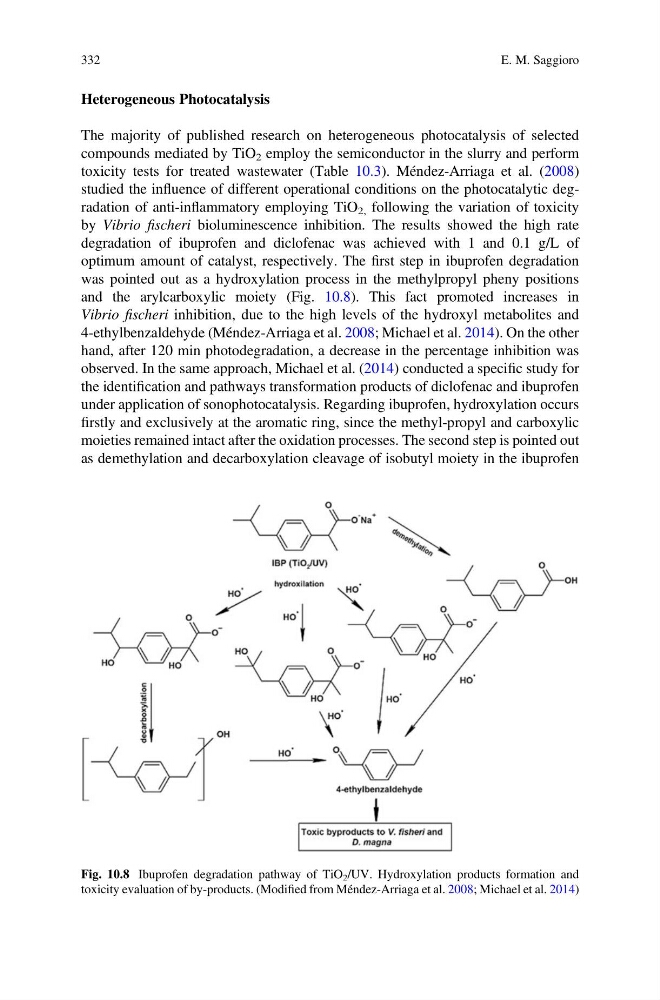
optimum amount of catalyst, respectively. The first step in ibuprofen degradation
was pointed out as a hydroxylation process in the methylpropyl pheny positions
and the arylcarboxylic moiety (Fig. 10.8). This fact promoted increases in
Vibrio fischeri inhibition, due to the high levels of the hydroxyl metabolites and
4-ethylbenzaldehyde (Méndez-Arriaga et al. 2008; Michael et al. 2014). On the other
hand, after 120 min photodegradation, a decrease in the percentage inhibition was
observed. In the same approach, Michael et al. (2014) conducted a specific study for
the identification and pathways transformation products of diclofenac and ibuprofen
under application of sonophotocatalysis. Regarding ibuprofen, hydroxylation occurs
firstly and exclusively at the aromatic ring, since the methyl-propyl and carboxylic
moieties remained intact after the oxidation processes. The second step is pointed out
as demethylation and decarboxylation cleavage of isobutyl moiety in the ibuprofen
Fig. 10.8 Ibuprofen degradation pathway of TiO 2 /UV. Hydroxylation products formation and
toxicity evaluation of by-products. (Modified from Méndez-Arriaga et al. 2008; Michael et al. 2014)
332
E. M. Saggioro
The majority of published research on heterogeneous photocatalysis of selected
compounds mediated by TiO 2 employ the semiconductor in the slurry and perform
toxicity tests for treated wastewater (Table 10.3). Méndez-Arriaga et al. (2008)
studied the influence of different operational conditions on the photocatalytic degradation of anti-inflammatory employing TiO 2, following the variation of toxicity
by Vibrio fischeri bioluminescence inhibition. The results showed the high rate
degradation of ibuprofen and diclofenac was achieved with 1 and 0.1 g/L of
optimum amount of catalyst, respectively. The first step in ibuprofen degradation
was pointed out as a hydroxylation process in the methylpropyl pheny positions
and the arylcarboxylic moiety (Fig. 10.8). This fact promoted increases in
Vibrio fischeri inhibition, due to the high levels of the hydroxyl metabolites and
4-ethylbenzaldehyde (Méndez-Arriaga et al. 2008; Michael et al. 2014). On the other
hand, after 120 min photodegradation, a decrease in the percentage inhibition was
observed. In the same approach, Michael et al. (2014) conducted a specific study for
the identification and pathways transformation products of diclofenac and ibuprofen
under application of sonophotocatalysis. Regarding ibuprofen, hydroxylation occurs
firstly and exclusively at the aromatic ring, since the methyl-propyl and carboxylic
moieties remained intact after the oxidation processes. The second step is pointed out
as demethylation and decarboxylation cleavage of isobutyl moiety in the ibuprofen
Fig. 10.8 Ibuprofen degradation pathway of TiO 2 /UV. Hydroxylation products formation and
toxicity evaluation of by-products. (Modified from Méndez-Arriaga et al. 2008; Michael et al. 2014)
332
E. M. Saggioro