

Polyethylene and polypropylene have densities below 1 g per cm
3 ; polystyrene
has a density close to that of 1 g per cm
3 ; polyvinyl chloride and polyethylene
terephthalate have densities of 1.3–1.7 g per cm
3 . The higher the density, the easier
the sedimentation occurs, which is the main reason why less polyvinyl chloride and
polyethylene terephthalate are found (Koelmans et al. 2019). Table 1.1 shows the
different polymers found in some freshwater studies. The most commonly found
polymers are polyethylene, polypropylene, and polystyrene.
1.5 Microplastics in Marine Environments
Microplastics are found in almost every marine environment on the Earth. Both
research on these particles and concentrations in the marine environment have not
ceased to grow. There are citations of the presence of microplastics in all types of
environments, including those considered to be the most virgin or distant from the
sources of production of these particles, such as the depths of the oceans or Arctic ice
(Obbard et al. 2014; Woodall et al. 2014). Microplastics are present in the marine
and coastal environments and accessible to ingestion by a wide variety of organisms.
Although the harmful effects of microplastics into the food chain are not yet well
known, it has been demonstrated that one of the main problems is the capacity of
these particles to absorb hydrophobic compounds on their surface, accumulating
them and entering the living organisms that consume them including humans
(Brennecke et al. 2016; Llorca et al. 2018; Li et al. 2018; Wu et al. 2019). An
important environmental effect derives from the fact that microplastics not only
adsorb pollutants from water but they also release additives or persistent organic
compounds into the environment (Bakir et al. 2014; Moore 2008). These compounds
have been described by the US Environmental Protection Agency as a risk to human
health, as they enter and accumulate in the food chain.
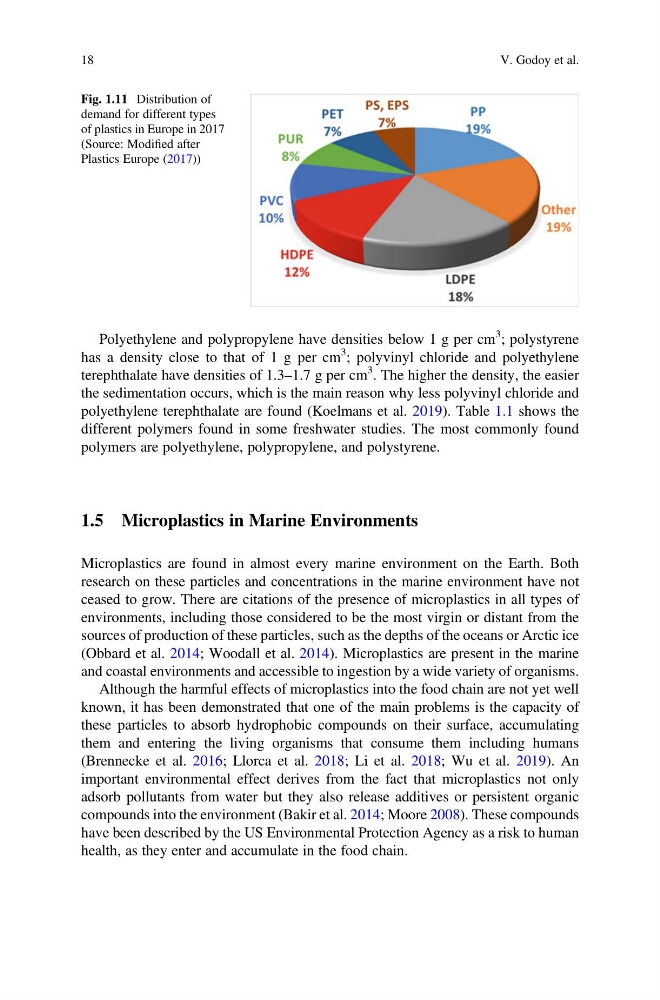
Fig. 1.11 Distribution of
demand for different types
of plastics in Europe in 2017
(Source: Modified after
Plastics Europe (2017))
18
V. Godoy et al.
3 ; polystyrene
has a density close to that of 1 g per cm
3 ; polyvinyl chloride and polyethylene
terephthalate have densities of 1.3–1.7 g per cm
3 . The higher the density, the easier
the sedimentation occurs, which is the main reason why less polyvinyl chloride and
polyethylene terephthalate are found (Koelmans et al. 2019). Table 1.1 shows the
different polymers found in some freshwater studies. The most commonly found
polymers are polyethylene, polypropylene, and polystyrene.
1.5 Microplastics in Marine Environments
Microplastics are found in almost every marine environment on the Earth. Both
research on these particles and concentrations in the marine environment have not
ceased to grow. There are citations of the presence of microplastics in all types of
environments, including those considered to be the most virgin or distant from the
sources of production of these particles, such as the depths of the oceans or Arctic ice
(Obbard et al. 2014; Woodall et al. 2014). Microplastics are present in the marine
and coastal environments and accessible to ingestion by a wide variety of organisms.
Although the harmful effects of microplastics into the food chain are not yet well
known, it has been demonstrated that one of the main problems is the capacity of
these particles to absorb hydrophobic compounds on their surface, accumulating
them and entering the living organisms that consume them including humans
(Brennecke et al. 2016; Llorca et al. 2018; Li et al. 2018; Wu et al. 2019). An
important environmental effect derives from the fact that microplastics not only
adsorb pollutants from water but they also release additives or persistent organic
compounds into the environment (Bakir et al. 2014; Moore 2008). These compounds
have been described by the US Environmental Protection Agency as a risk to human
health, as they enter and accumulate in the food chain.
Fig. 1.11 Distribution of
demand for different types
of plastics in Europe in 2017
(Source: Modified after
Plastics Europe (2017))
18
V. Godoy et al.