

the most abundant microplastic particles in freshwater had a size less than 1 mm,
while it is insignificant with the presence of microplastics greater than 2 mm.
The most studied shapes were fragments, fibers, film, foam, or pellet, but beads,
lines, spherules, sheets, flakes, paint, foil, and nurdle can also be found. For example,
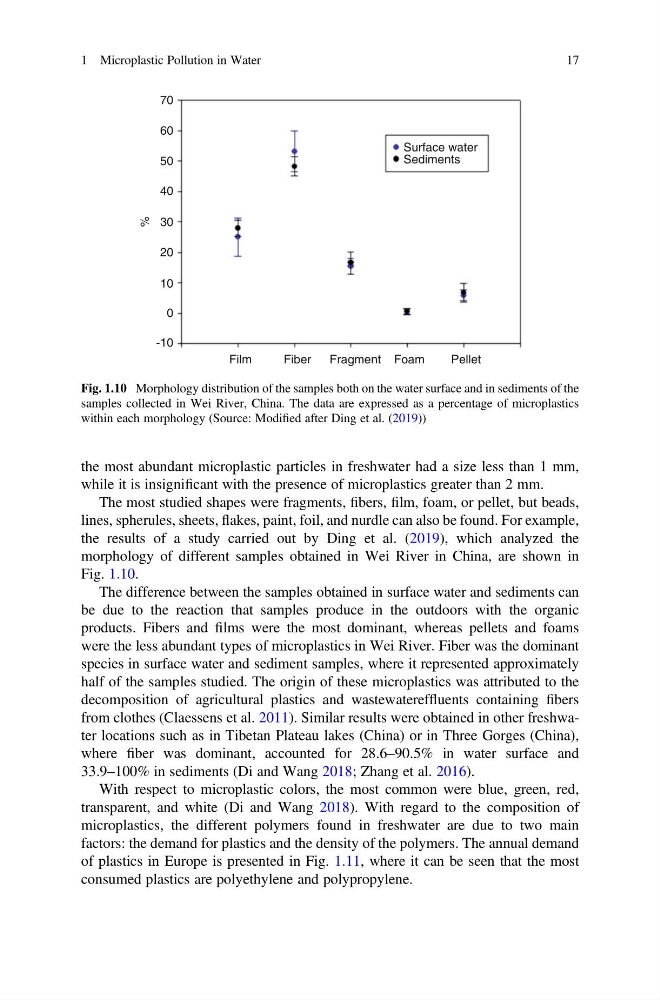
the results of a study carried out by Ding et al. (2019), which analyzed the
morphology of different samples obtained in Wei River in China, are shown in
Fig. 1.10.
The difference between the samples obtained in surface water and sediments can
be due to the reaction that samples produce in the outdoors with the organic
products. Fibers and films were the most dominant, whereas pellets and foams
were the less abundant types of microplastics in Wei River. Fiber was the dominant
species in surface water and sediment samples, where it represented approximately
half of the samples studied. The origin of these microplastics was attributed to the
decomposition of agricultural plastics and wastewatereffluents containing fibers
from clothes (Claessens et al. 2011). Similar results were obtained in other freshwater locations such as in Tibetan Plateau lakes (China) or in Three Gorges (China),
where fiber was dominant, accounted for 28.6–90.5% in water surface and
33.9–100% in sediments (Di and Wang 2018; Zhang et al. 2016).
With respect to microplastic colors, the most common were blue, green, red,
transparent, and white (Di and Wang 2018). With regard to the composition of
microplastics, the different polymers found in freshwater are due to two main
factors: the demand for plastics and the density of the polymers. The annual demand
of plastics in Europe is presented in Fig. 1.11, where it can be seen that the most
consumed plastics are polyethylene and polypropylene.
70
60
30
20
10
-10
0
50
40
%
Film
Fiber
Fragment Foam
Pellet
Surface water
Sediments
Fig. 1.10 Morphology distribution of the samples both on the water surface and in sediments of the
samples collected in Wei River, China. The data are expressed as a percentage of microplastics
within each morphology (Source: Modified after Ding et al. (2019))
1 Microplastic Pollution in Water
17
while it is insignificant with the presence of microplastics greater than 2 mm.
The most studied shapes were fragments, fibers, film, foam, or pellet, but beads,
lines, spherules, sheets, flakes, paint, foil, and nurdle can also be found. For example,
the results of a study carried out by Ding et al. (2019), which analyzed the
morphology of different samples obtained in Wei River in China, are shown in
Fig. 1.10.
The difference between the samples obtained in surface water and sediments can
be due to the reaction that samples produce in the outdoors with the organic
products. Fibers and films were the most dominant, whereas pellets and foams
were the less abundant types of microplastics in Wei River. Fiber was the dominant
species in surface water and sediment samples, where it represented approximately
half of the samples studied. The origin of these microplastics was attributed to the
decomposition of agricultural plastics and wastewatereffluents containing fibers
from clothes (Claessens et al. 2011). Similar results were obtained in other freshwater locations such as in Tibetan Plateau lakes (China) or in Three Gorges (China),
where fiber was dominant, accounted for 28.6–90.5% in water surface and
33.9–100% in sediments (Di and Wang 2018; Zhang et al. 2016).
With respect to microplastic colors, the most common were blue, green, red,
transparent, and white (Di and Wang 2018). With regard to the composition of
microplastics, the different polymers found in freshwater are due to two main
factors: the demand for plastics and the density of the polymers. The annual demand
of plastics in Europe is presented in Fig. 1.11, where it can be seen that the most
consumed plastics are polyethylene and polypropylene.
70
60
30
20
10
-10
0
50
40
%
Film
Fiber
Fragment Foam
Pellet
Surface water
Sediments
Fig. 1.10 Morphology distribution of the samples both on the water surface and in sediments of the
samples collected in Wei River, China. The data are expressed as a percentage of microplastics
within each morphology (Source: Modified after Ding et al. (2019))
1 Microplastic Pollution in Water
17