

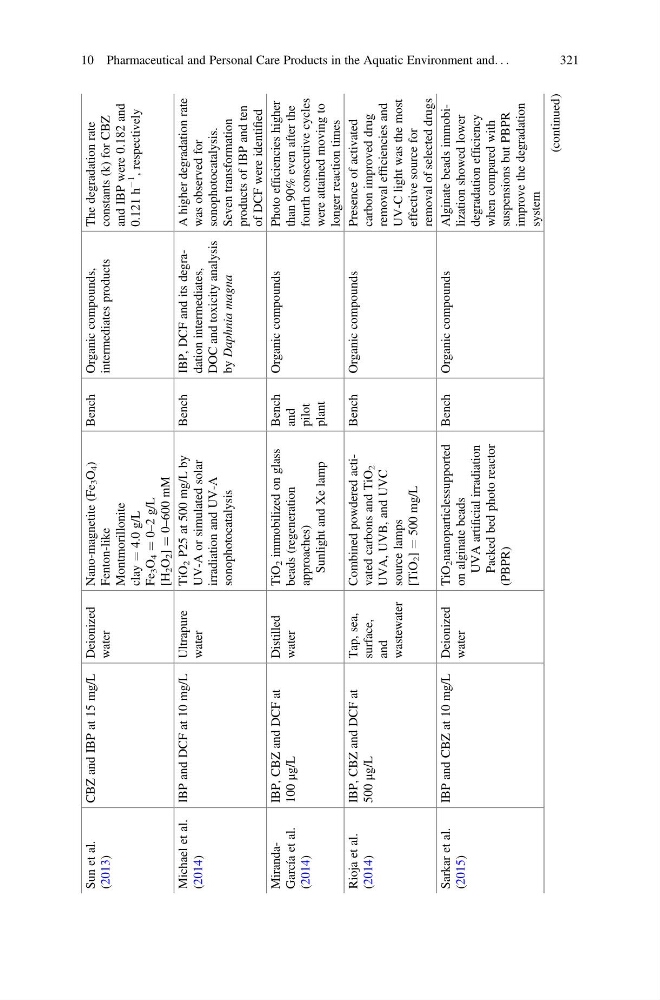
Sun et al.
(2013)
CBZ and IBP at 15 mg/L Deionized
water
Nano-magnetite (Fe
3 O
4 )
Fenton-like
Montmorillonite
clay
¼ 4.0 g/L
Fe
3 O
4
¼ 0–2 g/L
[H
2 O
2 ]
¼ 0–600 mM
Bench
Organic compounds,
intermediates products
The degradation rate
constants (k) for CBZ
and IBP were 0.182 and
0.121 h
À1
, respectively
Michael et al.
(2014)
IBP and DCF at 10 mg/L Ultrapure
water
TiO
2 P25 at 500 mg/L by
UV-A or simulated solar
irradiation and UV-A
sonophotocatalysis
Bench
IBP, DCF and its degradation intermediates,
DOC and toxicity analysis
by Daphnia magna
A higher degradation rate
was observed for
sonophotocatalysis.
Seven transformation
products of IBP and ten
of DCF were identified
MirandaGarcía et al.
(2014)
IBP, CBZ and DCF at
100
μg/L
Distilled
water
TiO
2 immobilized on glass
beads (regeneration
approaches)
Sunlight and Xe lamp
Bench
and
pilot
plant
Organic compounds
Photo efficiencies higher
than 90% even after the
fourth consecutive cycles
were attained moving to
longer reaction times
Rioja et al.
(2014)
IBP, CBZ and DCF at
500
μg/L
Tap, sea,
surface,
and
wastewater
Combined powdered activated carbons and TiO
2
UVA, UVB, and UVC
source lamps
[TiO
2 ]
¼ 500 mg/L
Bench
Organic compounds
Presence of activated
carbon improved drug
removal efficiencies and
UV-C light was the most
effective source for
removal of selected drugs
Sarkar et al.
(2015)
IBP and CBZ at 10 mg/L Deionized
water
TiO
2 nanoparticlessupported
on alginate beads
UVA artificial irradiation
Packed bed photo reactor
(PBPR)
Bench
Organic compounds
Alginate beads immobilization showed lower
degradation efficiency
when compared with
suspensions but PBPR
improve the degradation
system
(continued)
10 Pharmaceutical and Personal Care Products in the Aquatic Environment and. . .
321
(2013)
CBZ and IBP at 15 mg/L Deionized
water
Nano-magnetite (Fe
3 O
4 )
Fenton-like
Montmorillonite
clay
¼ 4.0 g/L
Fe
3 O
4
¼ 0–2 g/L
[H
2 O
2 ]
¼ 0–600 mM
Bench
Organic compounds,
intermediates products
The degradation rate
constants (k) for CBZ
and IBP were 0.182 and
0.121 h
À1
, respectively
Michael et al.
(2014)
IBP and DCF at 10 mg/L Ultrapure
water
TiO
2 P25 at 500 mg/L by
UV-A or simulated solar
irradiation and UV-A
sonophotocatalysis
Bench
IBP, DCF and its degradation intermediates,
DOC and toxicity analysis
by Daphnia magna
A higher degradation rate
was observed for
sonophotocatalysis.
Seven transformation
products of IBP and ten
of DCF were identified
MirandaGarcía et al.
(2014)
IBP, CBZ and DCF at
100
μg/L
Distilled
water
TiO
2 immobilized on glass
beads (regeneration
approaches)
Sunlight and Xe lamp
Bench
and
pilot
plant
Organic compounds
Photo efficiencies higher
than 90% even after the
fourth consecutive cycles
were attained moving to
longer reaction times
Rioja et al.
(2014)
IBP, CBZ and DCF at
500
μg/L
Tap, sea,
surface,
and
wastewater
Combined powdered activated carbons and TiO
2
UVA, UVB, and UVC
source lamps
[TiO
2 ]
¼ 500 mg/L
Bench
Organic compounds
Presence of activated
carbon improved drug
removal efficiencies and
UV-C light was the most
effective source for
removal of selected drugs
Sarkar et al.
(2015)
IBP and CBZ at 10 mg/L Deionized
water
TiO
2 nanoparticlessupported
on alginate beads
UVA artificial irradiation
Packed bed photo reactor
(PBPR)
Bench
Organic compounds
Alginate beads immobilization showed lower
degradation efficiency
when compared with
suspensions but PBPR
improve the degradation
system
(continued)
10 Pharmaceutical and Personal Care Products in the Aquatic Environment and. . .
321