

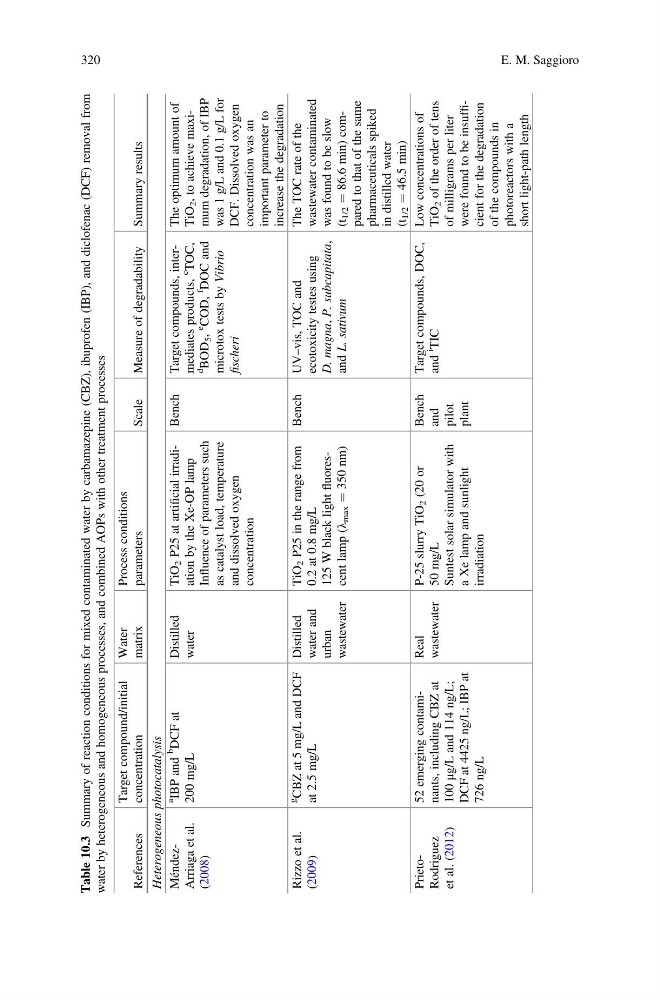
Table 10.3
Summary of reaction conditions for mixed contaminated water by carbamazepine (CBZ), ibuprofen (IBP), and diclofenac (DCF) removal from
water by heterogeneous and homogeneous processes, and combined AOPs with other treatment processes
References
Target compound/initial
concentration
Water
matrix
Process conditions
parameters
Scale
Measure of degradability
Summary results
Heterogeneous photocatalysis
MéndezArriaga et al.
(2008)
a
IBP and
b
DCF at
200 mg/L
Distilled
water
TiO
2 P25 at artificial irradiation by the Xe-OP lamp
Influence of parameters such
as catalyst load, temperature
and dissolved oxygen
concentration
Bench
Target compounds, intermediates products,
c
TOC,
d
BOD
5 ,
e
COD,
f
DOC and
microtox tests by Vibrio
fischeri
The optimum amount of
TiO
2 , to achieve maximum degradation, of IBP
was 1 g/L and 0.1 g/L for
DCF. Dissolved oxygen
concentration was an
important parameter to
increase the degradation
Rizzo et al.
(2009)
g
CBZ at 5 mg/L and DCF
at 2.5 mg/L
Distilled
water and
urban
wastewater
TiO
2 P25 in the range from
0.2 at 0.8 mg/L
125 W black light
fluorescent lamp (λ
max
¼ 350 nm)
Bench
UV–vis, TOC and
ecotoxicity testes using
D. magna, P. subcapitata,
and L. sativum
The TOC rate of the
wastewater contaminated
was found to be slow
(t
1/2
¼ 86.6 min) compared to that of the same
pharmaceuticals spiked
in distilled water
(t
1/2
¼ 46.5 min)
PrietoRodriguez
et al. (2012)
52 emerging contaminants, including CBZ at
100
μg/L and 114 ng/L;
DCF at 4425 ng/L; IBP at
726 ng/L
Real
wastewater
P-25 slurry TiO
2 (20 or
50 mg/L
Suntest solar simulator with
a Xe lamp and sunlight
irradiation
Bench
and
pilot
plant
Target compounds, DOC,
and
i
TIC
Low concentrations of
TiO
2 of the order of tens
of milligrams per liter
were found to be insufficient for the degradation
of the compounds in
photoreactors with a
short light-path length
320
E. M. Saggioro
Summary of reaction conditions for mixed contaminated water by carbamazepine (CBZ), ibuprofen (IBP), and diclofenac (DCF) removal from
water by heterogeneous and homogeneous processes, and combined AOPs with other treatment processes
References
Target compound/initial
concentration
Water
matrix
Process conditions
parameters
Scale
Measure of degradability
Summary results
Heterogeneous photocatalysis
MéndezArriaga et al.
(2008)
a
IBP and
b
DCF at
200 mg/L
Distilled
water
TiO
2 P25 at artificial irradiation by the Xe-OP lamp
Influence of parameters such
as catalyst load, temperature
and dissolved oxygen
concentration
Bench
Target compounds, intermediates products,
c
TOC,
d
BOD
5 ,
e
COD,
f
DOC and
microtox tests by Vibrio
fischeri
The optimum amount of
TiO
2 , to achieve maximum degradation, of IBP
was 1 g/L and 0.1 g/L for
DCF. Dissolved oxygen
concentration was an
important parameter to
increase the degradation
Rizzo et al.
(2009)
g
CBZ at 5 mg/L and DCF
at 2.5 mg/L
Distilled
water and
urban
wastewater
TiO
2 P25 in the range from
0.2 at 0.8 mg/L
125 W black light
fluorescent lamp (λ
max
¼ 350 nm)
Bench
UV–vis, TOC and
ecotoxicity testes using
D. magna, P. subcapitata,
and L. sativum
The TOC rate of the
wastewater contaminated
was found to be slow
(t
1/2
¼ 86.6 min) compared to that of the same
pharmaceuticals spiked
in distilled water
(t
1/2
¼ 46.5 min)
PrietoRodriguez
et al. (2012)
52 emerging contaminants, including CBZ at
100
μg/L and 114 ng/L;
DCF at 4425 ng/L; IBP at
726 ng/L
Real
wastewater
P-25 slurry TiO
2 (20 or
50 mg/L
Suntest solar simulator with
a Xe lamp and sunlight
irradiation
Bench
and
pilot
plant
Target compounds, DOC,
and
i
TIC
Low concentrations of
TiO
2 of the order of tens
of milligrams per liter
were found to be insufficient for the degradation
of the compounds in
photoreactors with a
short light-path length
320
E. M. Saggioro