

biological contactors may be incorporated into grit chamber, settling tank and
comminutors for better removal of organic pollutants (International Petroleum
Industry Environmental Conservation Association 2010; Shahryar 2017; Alireza
2014).
Nitrification and Denitrification
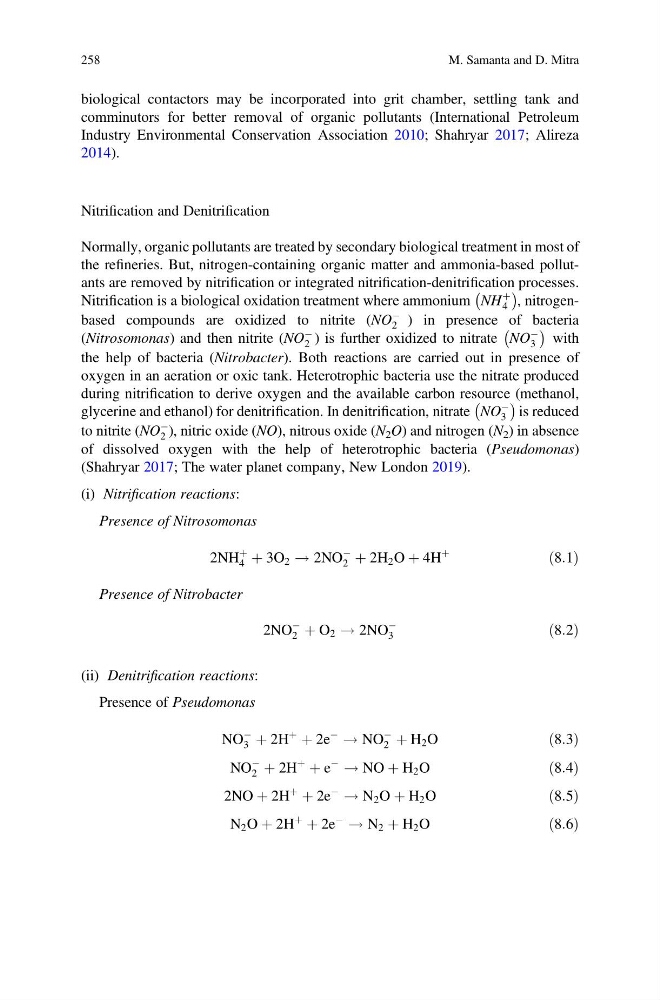
Normally, organic pollutants are treated by secondary biological treatment in most of
the refineries. But, nitrogen-containing organic matter and ammonia-based pollutants are removed by nitrification or integrated nitrification-denitrification processes.
Nitrification is a biological oxidation treatment where ammonium NH
þ
4
À
Á
, nitrogenbased compounds are oxidized to nitrite (NO
À
2 ) in presence of bacteria
(Nitrosomonas) and then nitrite (NO
À
2 ) is further oxidized to nitrate NO
À
3
À
Á
with
the help of bacteria (Nitrobacter). Both reactions are carried out in presence of
oxygen in an aeration or oxic tank. Heterotrophic bacteria use the nitrate produced
during nitrification to derive oxygen and the available carbon resource (methanol,
glycerine and ethanol) for denitrification. In denitrification, nitrate NO
À
3
À
Á
is reduced
to nitrite (NO
À
2 ), nitric oxide (NO), nitrous oxide (N 2 O) and nitrogen (N 2 ) in absence
of dissolved oxygen with the help of heterotrophic bacteria (Pseudomonas)
(Shahryar 2017; The water planet company, New London 2019).
(i) Nitrification reactions:
Presence of Nitrosomonas
2NH
þ
4 þ 3O 2 ! 2NO
À
2 þ 2H 2 O þ 4H
þ
ð8:1Þ
Presence of Nitrobacter
2NO
À
2 þ O 2 ! 2NO
À
3
ð8:2Þ
(ii) Denitrification reactions:
Presence of Pseudomonas
NO
À
3 þ 2H
þ
þ 2e
À
! NO
À
2 þ H 2 O
ð8:3Þ
NO
À
2 þ 2H
þ
þ e
À
! NO þ H 2 O
ð8:4Þ
2NO þ 2H
þ
þ 2e
À
! N 2 O þ H 2 O
ð8:5Þ
N 2 O þ 2H
þ
þ 2e
À
! N 2 þ H 2 O
ð8:6Þ
258
M. Samanta and D. Mitra
comminutors for better removal of organic pollutants (International Petroleum
Industry Environmental Conservation Association 2010; Shahryar 2017; Alireza
2014).
Nitrification and Denitrification
Normally, organic pollutants are treated by secondary biological treatment in most of
the refineries. But, nitrogen-containing organic matter and ammonia-based pollutants are removed by nitrification or integrated nitrification-denitrification processes.
Nitrification is a biological oxidation treatment where ammonium NH
þ
4
À
Á
, nitrogenbased compounds are oxidized to nitrite (NO
À
2 ) in presence of bacteria
(Nitrosomonas) and then nitrite (NO
À
2 ) is further oxidized to nitrate NO
À
3
À
Á
with
the help of bacteria (Nitrobacter). Both reactions are carried out in presence of
oxygen in an aeration or oxic tank. Heterotrophic bacteria use the nitrate produced
during nitrification to derive oxygen and the available carbon resource (methanol,
glycerine and ethanol) for denitrification. In denitrification, nitrate NO
À
3
À
Á
is reduced
to nitrite (NO
À
2 ), nitric oxide (NO), nitrous oxide (N 2 O) and nitrogen (N 2 ) in absence
of dissolved oxygen with the help of heterotrophic bacteria (Pseudomonas)
(Shahryar 2017; The water planet company, New London 2019).
(i) Nitrification reactions:
Presence of Nitrosomonas
2NH
þ
4 þ 3O 2 ! 2NO
À
2 þ 2H 2 O þ 4H
þ
ð8:1Þ
Presence of Nitrobacter
2NO
À
2 þ O 2 ! 2NO
À
3
ð8:2Þ
(ii) Denitrification reactions:
Presence of Pseudomonas
NO
À
3 þ 2H
þ
þ 2e
À
! NO
À
2 þ H 2 O
ð8:3Þ
NO
À
2 þ 2H
þ
þ e
À
! NO þ H 2 O
ð8:4Þ
2NO þ 2H
þ
þ 2e
À
! N 2 O þ H 2 O
ð8:5Þ
N 2 O þ 2H
þ
þ 2e
À
! N 2 þ H 2 O
ð8:6Þ
258
M. Samanta and D. Mitra