

naphthalene, using the chlorophyte Chlamydomonas angulosa (Soto et al. 1975;
Soto et al. 1977). The microalgae were able only to intracellularly accumulate
naphthalene without metabolizing the pollutant. Further, Cerniglia et al. (1979,
1980a, b, c, 1982; Cerniglia 1981) showed the capability of microalgae and diatoms
Navicula sp., a Nitzschia sp., and a Synedra sp. to oxidize naphthalene-producing
metabolites as α-naphthol or aromatic diols. Successive studies showed that the
green algae Scenedesmus obliquus is able to use different substituted aromatic
compounds, that is, some naphthalene sulfonic acids, as nutrient source (Luther
and Soeder 1987, 1991; Luther 1990).
Species Skeletonema costatum and Nitzschia sp., isolated from mangrove,
exhibited the capability to degrade phenanthrene and fluoranthene simultaneously,
with high efficiency (Hong et al. 2008). Similar results were obtained using Chlorella vulgaris, Scenedesmus platydiscus, Scenedesmus quadricauda, and
Selenastrum capricornutum to break down a mixture of fluoranthene and pyrene
(Lei et al. 2007). More detailed studies were conducted to evaluate the potential
benzo[a]-pyrene biodegradation ability of the chlorophyte alga Selenastrum c.
(Lindquist and Warshawsky 1985a, b; Schoeny et al. 1988; Warshawsky et al.
1988, 1990, 1995a, b). Selenastrum capricornutum utilizes a dioxygenase enzyme
system to metabolize benzo[a]-pyrene to cis-dihydrodiols (cis-4,5-, 7,8-, 9,10-,
11,12- dihydrodiols), which is then transformed in an ester. More recent studies
(Ke et al. 2010; Luo et al. 2014) reported transformation of a mixture of polycyclic
aromatic hydrocarbons by the green algae Selenastrum c. under different spectral
irradiance. The capability to degrade crude oil by microalgae in absence of light has
also been tested (Walker et al. 1975; Cerniglia 1992; Uzoh et al. 2015). The
heterotrophic strains of the achlorophyllous alga Prototheca zopfii and of the
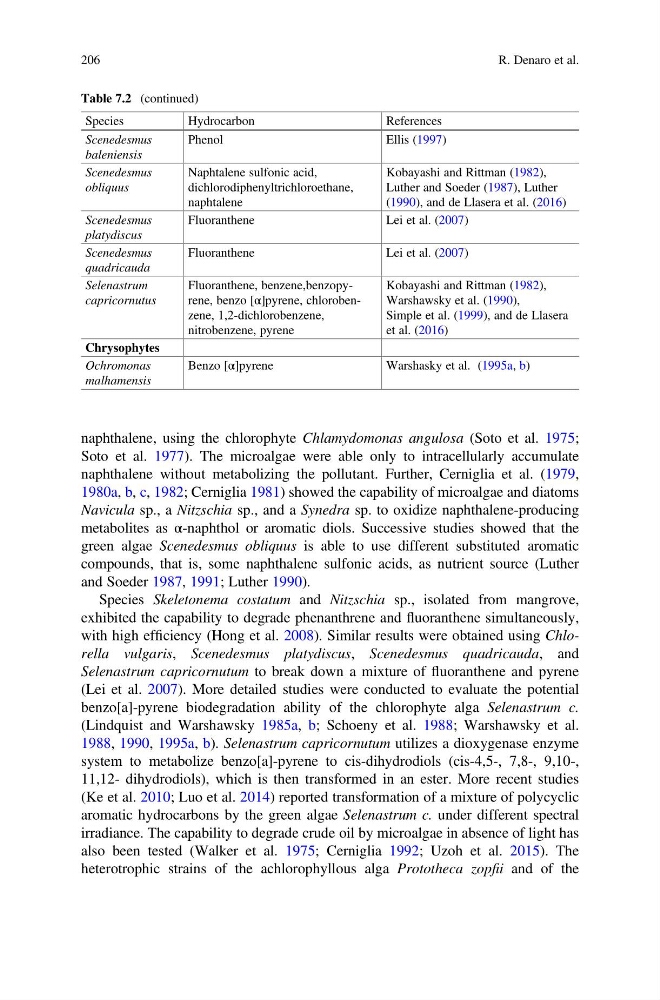
Table 7.2 (continued)
Species
Hydrocarbon
References
Scenedesmus
baleniensis
Phenol
Ellis (1997)
Scenedesmus
obliquus
Naphtalene sulfonic acid,
dichlorodiphenyltrichloroethane,
naphtalene
Kobayashi and Rittman (1982),
Luther and Soeder (1987), Luther
(1990), and de Llasera et al. (2016)
Scenedesmus
platydiscus
Fluoranthene
Lei et al. (2007)
Scenedesmus
quadricauda
Fluoranthene
Lei et al. (2007)
Selenastrum
capricornutus
Fluoranthene, benzene,benzopyrene, benzo [α]pyrene, chlorobenzene, 1,2-dichlorobenzene,
nitrobenzene, pyrene
Kobayashi and Rittman (1982),
Warshawsky et al. (1990),
Simple et al. (1999), and de Llasera
et al. (2016)
Chrysophytes
Ochromonas
malhamensis
Benzo [α]pyrene
Warshasky et al. (1995a, b)
206
R. Denaro et al.
Soto et al. 1977). The microalgae were able only to intracellularly accumulate
naphthalene without metabolizing the pollutant. Further, Cerniglia et al. (1979,
1980a, b, c, 1982; Cerniglia 1981) showed the capability of microalgae and diatoms
Navicula sp., a Nitzschia sp., and a Synedra sp. to oxidize naphthalene-producing
metabolites as α-naphthol or aromatic diols. Successive studies showed that the
green algae Scenedesmus obliquus is able to use different substituted aromatic
compounds, that is, some naphthalene sulfonic acids, as nutrient source (Luther
and Soeder 1987, 1991; Luther 1990).
Species Skeletonema costatum and Nitzschia sp., isolated from mangrove,
exhibited the capability to degrade phenanthrene and fluoranthene simultaneously,
with high efficiency (Hong et al. 2008). Similar results were obtained using Chlorella vulgaris, Scenedesmus platydiscus, Scenedesmus quadricauda, and
Selenastrum capricornutum to break down a mixture of fluoranthene and pyrene
(Lei et al. 2007). More detailed studies were conducted to evaluate the potential
benzo[a]-pyrene biodegradation ability of the chlorophyte alga Selenastrum c.
(Lindquist and Warshawsky 1985a, b; Schoeny et al. 1988; Warshawsky et al.
1988, 1990, 1995a, b). Selenastrum capricornutum utilizes a dioxygenase enzyme
system to metabolize benzo[a]-pyrene to cis-dihydrodiols (cis-4,5-, 7,8-, 9,10-,
11,12- dihydrodiols), which is then transformed in an ester. More recent studies
(Ke et al. 2010; Luo et al. 2014) reported transformation of a mixture of polycyclic
aromatic hydrocarbons by the green algae Selenastrum c. under different spectral
irradiance. The capability to degrade crude oil by microalgae in absence of light has
also been tested (Walker et al. 1975; Cerniglia 1992; Uzoh et al. 2015). The
heterotrophic strains of the achlorophyllous alga Prototheca zopfii and of the
Table 7.2 (continued)
Species
Hydrocarbon
References
Scenedesmus
baleniensis
Phenol
Ellis (1997)
Scenedesmus
obliquus
Naphtalene sulfonic acid,
dichlorodiphenyltrichloroethane,
naphtalene
Kobayashi and Rittman (1982),
Luther and Soeder (1987), Luther
(1990), and de Llasera et al. (2016)
Scenedesmus
platydiscus
Fluoranthene
Lei et al. (2007)
Scenedesmus
quadricauda
Fluoranthene
Lei et al. (2007)
Selenastrum
capricornutus
Fluoranthene, benzene,benzopyrene, benzo [α]pyrene, chlorobenzene, 1,2-dichlorobenzene,
nitrobenzene, pyrene
Kobayashi and Rittman (1982),
Warshawsky et al. (1990),
Simple et al. (1999), and de Llasera
et al. (2016)
Chrysophytes
Ochromonas
malhamensis
Benzo [α]pyrene
Warshasky et al. (1995a, b)
206
R. Denaro et al.