

was done to understand the mechanism behind the good results found with the
functionalized nanocatalysts. In the presence of light source (ultraviolet or visible),
the electron from the lower energy level gets promoted to the higher level with the
formation of holes of same number. Electron and hole generated in this way migrate
upon the surface of the catalyst, where these participate in the redox reactions to
form various radicals (superoxide, hydroxyl) (Huang et al. 2017a, b). These radicals
are ultimately responsible for the direct oxidation, degradation, and mineralization of
organic pollutants. Upon coupling or functionalization, the photogenerated e
À is
transferred to the other materials higher level, causing efficient separation of charge
carriers and, hence, lower recombination rate.
The reactive species facilitate the degradation of polycyclic aromatic hydrocarbons by attacking their most active site and disturb the arrangement of electron cloud
of aromatic rings. This disturbance generates various intermediate products of
polycyclic aromatic hydrocarbons; these further get converted into stable/less harmful products (carbon dioxide and water) (Mukwevho et al. 2019). According to
energy band theory, when one material absorbs quanta of energy more than difference between energy levels, the transfer of electrons takes place to generate holes.
The functionalization helps in shifting the optical properties toward the visible
region that is responsible for the better activity of nanocatalyst for polycyclic
aromatic hydrocarbons degradation (Xia et al. 2015).
Subramanian et al. suggested that nanocomposite of BiFeO 3 –GdFeO 3 showed
reasonably better catalytic activity owing to the various factors. Firstly, BiFeO 3
being not completely covered with GdFeO 3 makes it available for photo absorption
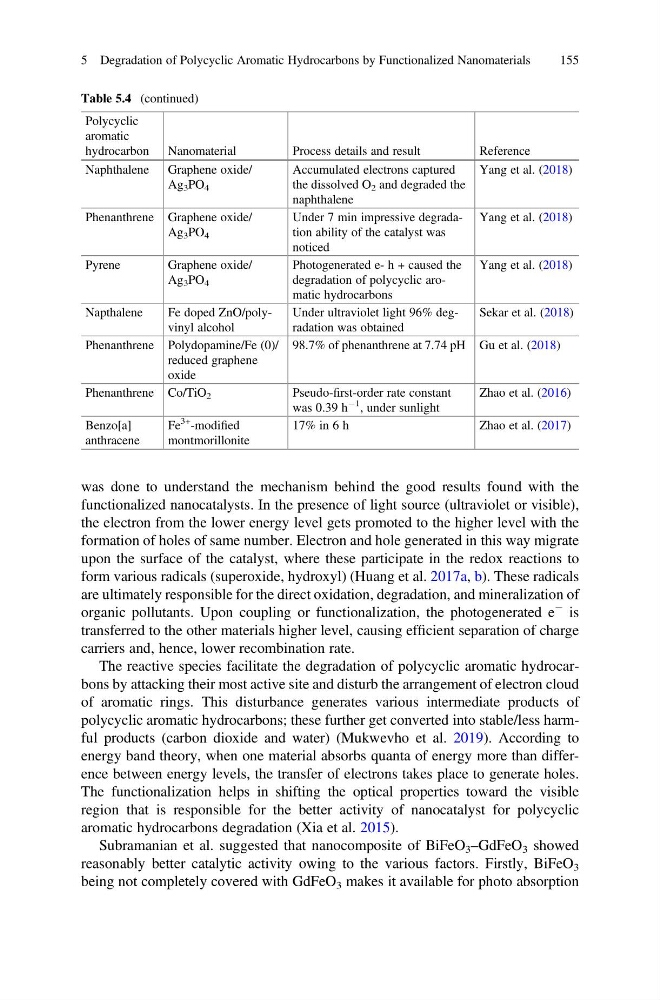
Table 5.4 (continued)
Polycyclic
aromatic
hydrocarbon Nanomaterial
Process details and result
Reference
Naphthalene Graphene oxide/
Ag 3 PO 4
Accumulated electrons captured
the dissolved O 2 and degraded the
naphthalene
Yang et al. (2018)
Phenanthrene Graphene oxide/
Ag 3 PO 4
Under 7 min impressive degradation ability of the catalyst was
noticed
Yang et al. (2018)
Pyrene
Graphene oxide/
Ag 3 PO 4
Photogenerated e- h + caused the
degradation of polycyclic aromatic hydrocarbons
Yang et al. (2018)
Napthalene
Fe doped ZnO/polyvinyl alcohol
Under ultraviolet light 96% degradation was obtained
Sekar et al. (2018)
Phenanthrene Polydopamine/Fe (0)/
reduced graphene
oxide
98.7% of phenanthrene at 7.74 pH Gu et al. (2018)
Phenanthrene Co/TiO 2
Pseudo-first-order rate constant
was 0.39 h
À1
, under sunlight
Zhao et al. (2016)
Benzo[a]
anthracene
Fe
3+ -modified
montmorillonite
17% in 6 h
Zhao et al. (2017)
5 Degradation of Polycyclic Aromatic Hydrocarbons by Functionalized Nanomaterials
155
functionalized nanocatalysts. In the presence of light source (ultraviolet or visible),
the electron from the lower energy level gets promoted to the higher level with the
formation of holes of same number. Electron and hole generated in this way migrate
upon the surface of the catalyst, where these participate in the redox reactions to
form various radicals (superoxide, hydroxyl) (Huang et al. 2017a, b). These radicals
are ultimately responsible for the direct oxidation, degradation, and mineralization of
organic pollutants. Upon coupling or functionalization, the photogenerated e
À is
transferred to the other materials higher level, causing efficient separation of charge
carriers and, hence, lower recombination rate.
The reactive species facilitate the degradation of polycyclic aromatic hydrocarbons by attacking their most active site and disturb the arrangement of electron cloud
of aromatic rings. This disturbance generates various intermediate products of
polycyclic aromatic hydrocarbons; these further get converted into stable/less harmful products (carbon dioxide and water) (Mukwevho et al. 2019). According to
energy band theory, when one material absorbs quanta of energy more than difference between energy levels, the transfer of electrons takes place to generate holes.
The functionalization helps in shifting the optical properties toward the visible
region that is responsible for the better activity of nanocatalyst for polycyclic
aromatic hydrocarbons degradation (Xia et al. 2015).
Subramanian et al. suggested that nanocomposite of BiFeO 3 –GdFeO 3 showed
reasonably better catalytic activity owing to the various factors. Firstly, BiFeO 3
being not completely covered with GdFeO 3 makes it available for photo absorption
Table 5.4 (continued)
Polycyclic
aromatic
hydrocarbon Nanomaterial
Process details and result
Reference
Naphthalene Graphene oxide/
Ag 3 PO 4
Accumulated electrons captured
the dissolved O 2 and degraded the
naphthalene
Yang et al. (2018)
Phenanthrene Graphene oxide/
Ag 3 PO 4
Under 7 min impressive degradation ability of the catalyst was
noticed
Yang et al. (2018)
Pyrene
Graphene oxide/
Ag 3 PO 4
Photogenerated e- h + caused the
degradation of polycyclic aromatic hydrocarbons
Yang et al. (2018)
Napthalene
Fe doped ZnO/polyvinyl alcohol
Under ultraviolet light 96% degradation was obtained
Sekar et al. (2018)
Phenanthrene Polydopamine/Fe (0)/
reduced graphene
oxide
98.7% of phenanthrene at 7.74 pH Gu et al. (2018)
Phenanthrene Co/TiO 2
Pseudo-first-order rate constant
was 0.39 h
À1
, under sunlight
Zhao et al. (2016)
Benzo[a]
anthracene
Fe
3+ -modified
montmorillonite
17% in 6 h
Zhao et al. (2017)
5 Degradation of Polycyclic Aromatic Hydrocarbons by Functionalized Nanomaterials
155