

5.2 Classification of Polycyclic Aromatic Hydrocarbons
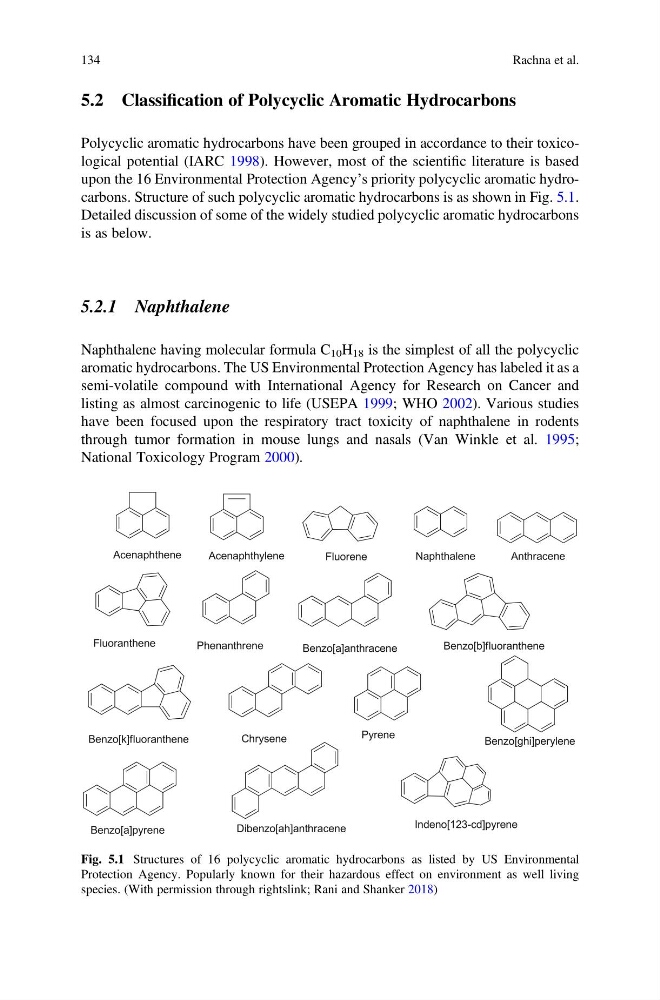
Polycyclic aromatic hydrocarbons have been grouped in accordance to their toxicological potential (IARC 1998). However, most of the scientific literature is based
upon the 16 Environmental Protection Agency’s priority polycyclic aromatic hydrocarbons. Structure of such polycyclic aromatic hydrocarbons is as shown in Fig. 5.1.
Detailed discussion of some of the widely studied polycyclic aromatic hydrocarbons
is as below.
5.2.1 Naphthalene
Naphthalene having molecular formula C 10 H 18 is the simplest of all the polycyclic
aromatic hydrocarbons. The US Environmental Protection Agency has labeled it as a
semi-volatile compound with International Agency for Research on Cancer and
listing as almost carcinogenic to life (USEPA 1999; WHO 2002). Various studies
have been focused upon the respiratory tract toxicity of naphthalene in rodents
through tumor formation in mouse lungs and nasals (Van Winkle et al. 1995;
National Toxicology Program 2000).
Acenaphthene
Acenaphthylene
Fluorene
Naphthalene
Anthracene
Fluoranthene
Phenanthrene
Benzo[a]anthracene
Benzo[b]fluoranthene
Benzo[k]fluoranthene
Chrysene
Pyrene
Benzo[ghi]perylene
Benzo[a]pyrene
Dibenzo[ah]anthracene
Indeno[123-cd]pyrene
Fig. 5.1 Structures of 16 polycyclic aromatic hydrocarbons as listed by US Environmental
Protection Agency. Popularly known for their hazardous effect on environment as well living
species. (With permission through rightslink; Rani and Shanker 2018)
134
Rachna et al.
Polycyclic aromatic hydrocarbons have been grouped in accordance to their toxicological potential (IARC 1998). However, most of the scientific literature is based
upon the 16 Environmental Protection Agency’s priority polycyclic aromatic hydrocarbons. Structure of such polycyclic aromatic hydrocarbons is as shown in Fig. 5.1.
Detailed discussion of some of the widely studied polycyclic aromatic hydrocarbons
is as below.
5.2.1 Naphthalene
Naphthalene having molecular formula C 10 H 18 is the simplest of all the polycyclic
aromatic hydrocarbons. The US Environmental Protection Agency has labeled it as a
semi-volatile compound with International Agency for Research on Cancer and
listing as almost carcinogenic to life (USEPA 1999; WHO 2002). Various studies
have been focused upon the respiratory tract toxicity of naphthalene in rodents
through tumor formation in mouse lungs and nasals (Van Winkle et al. 1995;
National Toxicology Program 2000).
Acenaphthene
Acenaphthylene
Fluorene
Naphthalene
Anthracene
Fluoranthene
Phenanthrene
Benzo[a]anthracene
Benzo[b]fluoranthene
Benzo[k]fluoranthene
Chrysene
Pyrene
Benzo[ghi]perylene
Benzo[a]pyrene
Dibenzo[ah]anthracene
Indeno[123-cd]pyrene
Fig. 5.1 Structures of 16 polycyclic aromatic hydrocarbons as listed by US Environmental
Protection Agency. Popularly known for their hazardous effect on environment as well living
species. (With permission through rightslink; Rani and Shanker 2018)
134
Rachna et al.