

Distribution and Impact of Microplastics in the Aquatic …
93
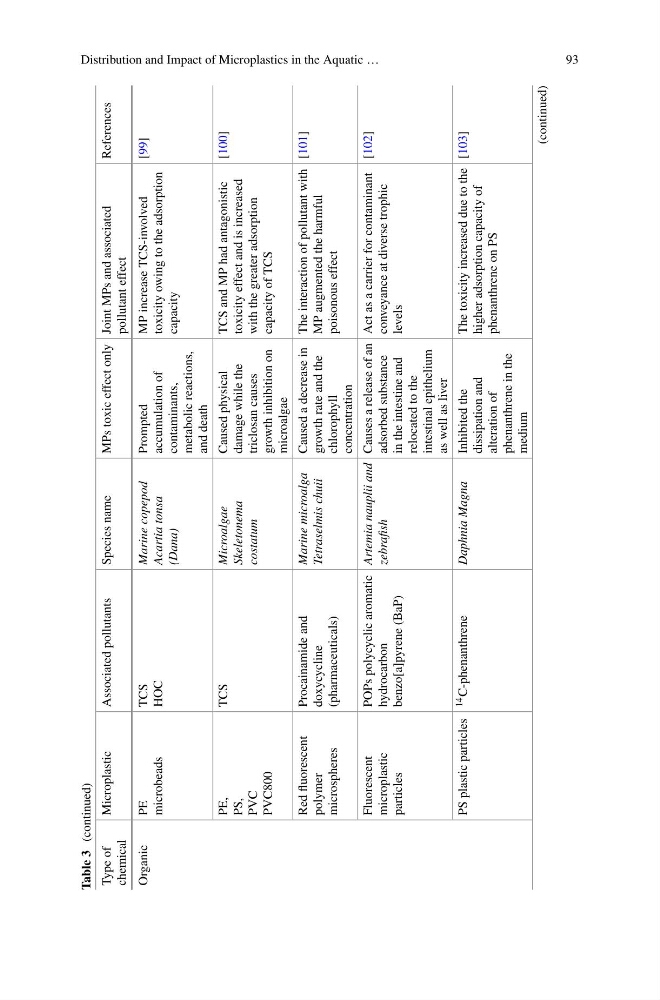
Table 3
(continued)
Type of
chemical
Microplastic
Associated pollutants
Species name
MPs toxic effect only Joint MPs and associated
pollutant effect
References
Organic
PE
microbeads
TCS
HOC
Marine copepod
Acartia tonsa
(Dana)
Prompted
accumulation of
contaminants,
metabolic reactions,
and death
MP increase TCS-involved
toxicity owing to the adsorption
capacity
[99]
PE,
PS,
PVC
PVC800
TCS
Microalgae
Skeletonema
costatum
Caused physical
damage while the
triclosan causes
growth inhibition on
microalgae
TCS and MP had antagonistic
toxicity effect and is increased
with the greater adsorption
capacity of TCS
[100]
Red fluorescent
polymer
microspheres
Procainamide and
doxycycline
(pharmaceuticals)
Marine microalga
Tetraselmis chuii
Caused a decrease in
growth rate and the
chlorophyll
concentration
The interaction of pollutant with
MP augmented the harmful
poisonous effect
[101]
Fluorescent
microplastic
particles
POPs polycyclic aromatic
hydrocarbon
benzo[a]pyrene (BaP)
Artemia nauplii and
zebrafish
Causes a release of an
adsorbed substance
in the intestine and
relocated to the
intestinal epithelium
as well as liver
Act as a carrier for contaminant
conveyance at diverse trophic
levels
[102]
PS plastic particles 14
C-phenanthrene
Daphnia Magna
Inhibited the
dissipation and
alteration of
phenanthrene in the
medium
The toxicity increased due to the
higher adsorption capacity of
phenanthrene on PS
[103]
(continued)
93
Table 3
(continued)
Type of
chemical
Microplastic
Associated pollutants
Species name
MPs toxic effect only Joint MPs and associated
pollutant effect
References
Organic
PE
microbeads
TCS
HOC
Marine copepod
Acartia tonsa
(Dana)
Prompted
accumulation of
contaminants,
metabolic reactions,
and death
MP increase TCS-involved
toxicity owing to the adsorption
capacity
[99]
PE,
PS,
PVC
PVC800
TCS
Microalgae
Skeletonema
costatum
Caused physical
damage while the
triclosan causes
growth inhibition on
microalgae
TCS and MP had antagonistic
toxicity effect and is increased
with the greater adsorption
capacity of TCS
[100]
Red fluorescent
polymer
microspheres
Procainamide and
doxycycline
(pharmaceuticals)
Marine microalga
Tetraselmis chuii
Caused a decrease in
growth rate and the
chlorophyll
concentration
The interaction of pollutant with
MP augmented the harmful
poisonous effect
[101]
Fluorescent
microplastic
particles
POPs polycyclic aromatic
hydrocarbon
benzo[a]pyrene (BaP)
Artemia nauplii and
zebrafish
Causes a release of an
adsorbed substance
in the intestine and
relocated to the
intestinal epithelium
as well as liver
Act as a carrier for contaminant
conveyance at diverse trophic
levels
[102]
PS plastic particles 14
C-phenanthrene
Daphnia Magna
Inhibited the
dissipation and
alteration of
phenanthrene in the
medium
The toxicity increased due to the
higher adsorption capacity of
phenanthrene on PS
[103]
(continued)