

Distribution and Impact of Microplastics in the Aquatic …
79
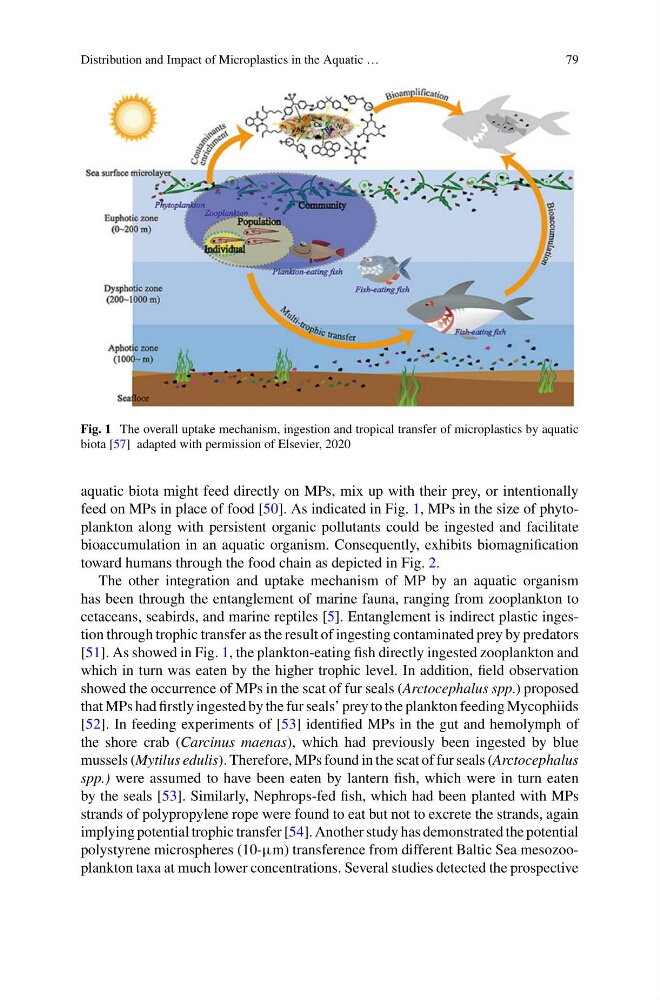
Fig. 1 The overall uptake mechanism, ingestion and tropical transfer of microplastics by aquatic
biota [57] adapted with permission of Elsevier, 2020
aquatic biota might feed directly on MPs, mix up with their prey, or intentionally
feed on MPs in place of food [50]. As indicated in Fig. 1, MPs in the size of phytoplankton along with persistent organic pollutants could be ingested and facilitate
bioaccumulation in an aquatic organism. Consequently, exhibits biomagnification
toward humans through the food chain as depicted in Fig. 2.
The other integration and uptake mechanism of MP by an aquatic organism
has been through the entanglement of marine fauna, ranging from zooplankton to
cetaceans, seabirds, and marine reptiles [5]. Entanglement is indirect plastic ingestion through trophic transfer as the result of ingesting contaminated prey by predators
[51]. As showed in Fig. 1, the plankton-eating fish directly ingested zooplankton and
which in turn was eaten by the higher trophic level. In addition, field observation
showed the occurrence of MPs in the scat of fur seals (Arctocephalus spp.) proposed
that MPs had firstly ingested by the fur seals’ prey to the plankton feeding Mycophiids
[52]. In feeding experiments of [53] identified MPs in the gut and hemolymph of
the shore crab (Carcinus maenas), which had previously been ingested by blue
mussels (Mytilus edulis). Therefore, MPs found in the scat of fur seals (Arctocephalus
spp.) were assumed to have been eaten by lantern fish, which were in turn eaten
by the seals [53]. Similarly, Nephrops-fed fish, which had been planted with MPs
strands of polypropylene rope were found to eat but not to excrete the strands, again
implying potential trophic transfer [54]. Another study has demonstrated the potential
polystyrene microspheres (10-μm) transference from different Baltic Sea mesozooplankton taxa at much lower concentrations. Several studies detected the prospective
79
Fig. 1 The overall uptake mechanism, ingestion and tropical transfer of microplastics by aquatic
biota [57] adapted with permission of Elsevier, 2020
aquatic biota might feed directly on MPs, mix up with their prey, or intentionally
feed on MPs in place of food [50]. As indicated in Fig. 1, MPs in the size of phytoplankton along with persistent organic pollutants could be ingested and facilitate
bioaccumulation in an aquatic organism. Consequently, exhibits biomagnification
toward humans through the food chain as depicted in Fig. 2.
The other integration and uptake mechanism of MP by an aquatic organism
has been through the entanglement of marine fauna, ranging from zooplankton to
cetaceans, seabirds, and marine reptiles [5]. Entanglement is indirect plastic ingestion through trophic transfer as the result of ingesting contaminated prey by predators
[51]. As showed in Fig. 1, the plankton-eating fish directly ingested zooplankton and
which in turn was eaten by the higher trophic level. In addition, field observation
showed the occurrence of MPs in the scat of fur seals (Arctocephalus spp.) proposed
that MPs had firstly ingested by the fur seals’ prey to the plankton feeding Mycophiids
[52]. In feeding experiments of [53] identified MPs in the gut and hemolymph of
the shore crab (Carcinus maenas), which had previously been ingested by blue
mussels (Mytilus edulis). Therefore, MPs found in the scat of fur seals (Arctocephalus
spp.) were assumed to have been eaten by lantern fish, which were in turn eaten
by the seals [53]. Similarly, Nephrops-fed fish, which had been planted with MPs
strands of polypropylene rope were found to eat but not to excrete the strands, again
implying potential trophic transfer [54]. Another study has demonstrated the potential
polystyrene microspheres (10-μm) transference from different Baltic Sea mesozooplankton taxa at much lower concentrations. Several studies detected the prospective