

Microplastics in Dentistry—A Review
163
Table 1 (continued)
Sl.
no
Objective of study
Methodology adopted Findings
References
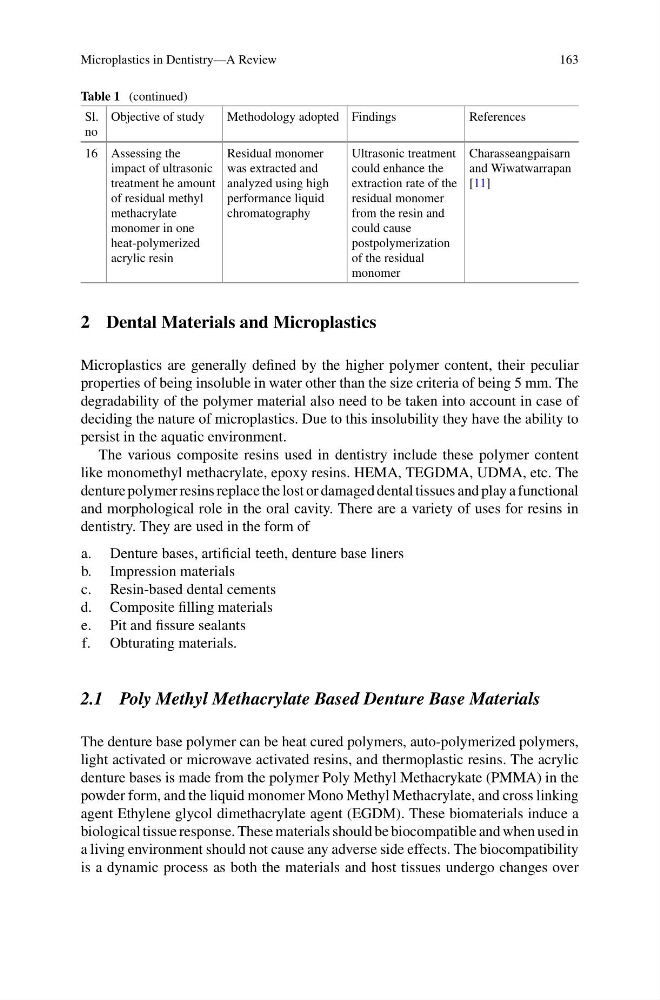
16 Assessing the
impact of ultrasonic
treatment he amount
of residual methyl
methacrylate
monomer in one
heat-polymerized
acrylic resin
Residual monomer
was extracted and
analyzed using high
performance liquid
chromatography
Ultrasonic treatment
could enhance the
extraction rate of the
residual monomer
from the resin and
could cause
postpolymerization
of the residual
monomer
Charasseangpaisarn
and Wiwatwarrapan
[11]
2 Dental Materials and Microplastics
Microplastics are generally defined by the higher polymer content, their peculiar
properties of being insoluble in water other than the size criteria of being 5 mm. The
degradability of the polymer material also need to be taken into account in case of
deciding the nature of microplastics. Due to this insolubility they have the ability to
persist in the aquatic environment.
The various composite resins used in dentistry include these polymer content
like monomethyl methacrylate, epoxy resins. HEMA, TEGDMA, UDMA, etc. The
denture polymer resins replace the lost or damaged dental tissues and play a functional
and morphological role in the oral cavity. There are a variety of uses for resins in
dentistry. They are used in the form of
a. Denture bases, artificial teeth, denture base liners
b. Impression materials
c. Resin-based dental cements
d. Composite filling materials
e. Pit and fissure sealants
f. Obturating materials.
2.1 Poly Methyl Methacrylate Based Denture Base Materials
The denture base polymer can be heat cured polymers, auto-polymerized polymers,
light activated or microwave activated resins, and thermoplastic resins. The acrylic
denture bases is made from the polymer Poly Methyl Methacrykate (PMMA) in the
powder form, and the liquid monomer Mono Methyl Methacrylate, and cross linking
agent Ethylene glycol dimethacrylate agent (EGDM). These biomaterials induce a
biological tissue response. These materials should be biocompatible and when used in
a living environment should not cause any adverse side effects. The biocompatibility
is a dynamic process as both the materials and host tissues undergo changes over
163
Table 1 (continued)
Sl.
no
Objective of study
Methodology adopted Findings
References
16 Assessing the
impact of ultrasonic
treatment he amount
of residual methyl
methacrylate
monomer in one
heat-polymerized
acrylic resin
Residual monomer
was extracted and
analyzed using high
performance liquid
chromatography
Ultrasonic treatment
could enhance the
extraction rate of the
residual monomer
from the resin and
could cause
postpolymerization
of the residual
monomer
Charasseangpaisarn
and Wiwatwarrapan
[11]
2 Dental Materials and Microplastics
Microplastics are generally defined by the higher polymer content, their peculiar
properties of being insoluble in water other than the size criteria of being 5 mm. The
degradability of the polymer material also need to be taken into account in case of
deciding the nature of microplastics. Due to this insolubility they have the ability to
persist in the aquatic environment.
The various composite resins used in dentistry include these polymer content
like monomethyl methacrylate, epoxy resins. HEMA, TEGDMA, UDMA, etc. The
denture polymer resins replace the lost or damaged dental tissues and play a functional
and morphological role in the oral cavity. There are a variety of uses for resins in
dentistry. They are used in the form of
a. Denture bases, artificial teeth, denture base liners
b. Impression materials
c. Resin-based dental cements
d. Composite filling materials
e. Pit and fissure sealants
f. Obturating materials.
2.1 Poly Methyl Methacrylate Based Denture Base Materials
The denture base polymer can be heat cured polymers, auto-polymerized polymers,
light activated or microwave activated resins, and thermoplastic resins. The acrylic
denture bases is made from the polymer Poly Methyl Methacrykate (PMMA) in the
powder form, and the liquid monomer Mono Methyl Methacrylate, and cross linking
agent Ethylene glycol dimethacrylate agent (EGDM). These biomaterials induce a
biological tissue response. These materials should be biocompatible and when used in
a living environment should not cause any adverse side effects. The biocompatibility
is a dynamic process as both the materials and host tissues undergo changes over