

162
T. Chandran et al.
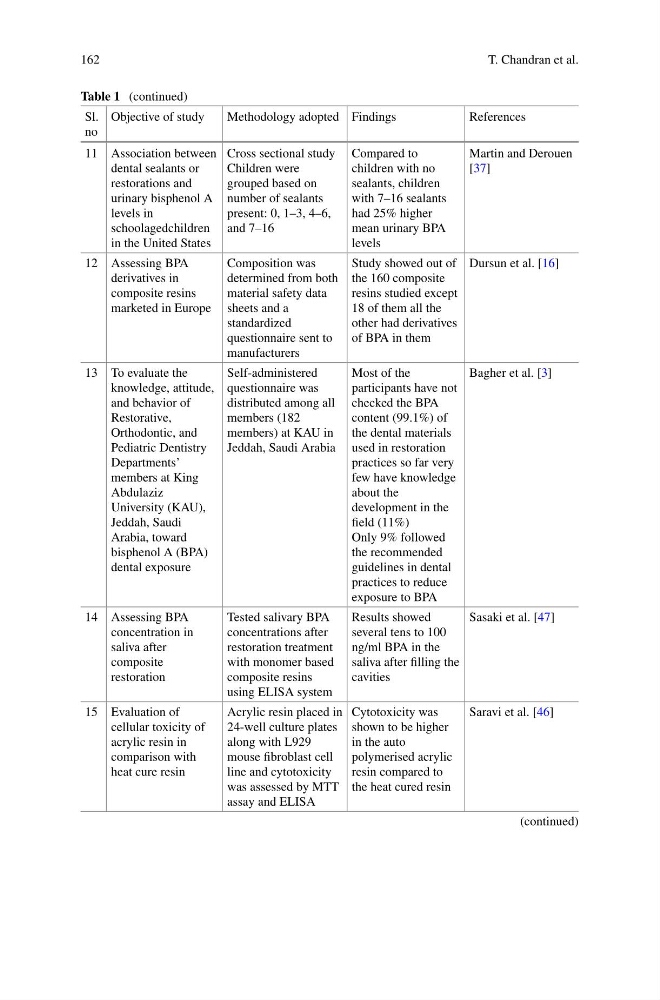
Table 1 (continued)
Sl.
no
Objective of study
Methodology adopted Findings
References
11 Association between
dental sealants or
restorations and
urinary bisphenol A
levels in
schoolagedchildren
in the United States
Cross sectional study
Children were
grouped based on
number of sealants
present: 0, 1–3, 4–6,
and 7–16
Compared to
children with no
sealants, children
with 7–16 sealants
had 25% higher
mean urinary BPA
levels
Martin and Derouen
[37]
12 Assessing BPA
derivatives in
composite resins
marketed in Europe
Composition was
determined from both
material safety data
sheets and a
standardized
questionnaire sent to
manufacturers
Study showed out of
the 160 composite
resins studied except
18 of them all the
other had derivatives
of BPA in them
Dursun et al. [16]
13 To evaluate the
knowledge, attitude,
and behavior of
Restorative,
Orthodontic, and
Pediatric Dentistry
Departments’
members at King
Abdulaziz
University (KAU),
Jeddah, Saudi
Arabia, toward
bisphenol A (BPA)
dental exposure
Self-administered
questionnaire was
distributed among all
members (182
members) at KAU in
Jeddah, Saudi Arabia
Most of the
participants have not
checked the BPA
content (99.1%) of
the dental materials
used in restoration
practices so far very
few have knowledge
about the
development in the
field (11%)
Only 9% followed
the recommended
guidelines in dental
practices to reduce
exposure to BPA
Bagher et al. [3]
14 Assessing BPA
concentration in
saliva after
composite
restoration
Tested salivary BPA
concentrations after
restoration treatment
with monomer based
composite resins
using ELISA system
Results showed
several tens to 100
ng/ml BPA in the
saliva after filling the
cavities
Sasaki et al. [47]
15 Evaluation of
cellular toxicity of
acrylic resin in
comparison with
heat cure resin
Acrylic resin placed in
24-well culture plates
along with L929
mouse fibroblast cell
line and cytotoxicity
was assessed by MTT
assay and ELISA
Cytotoxicity was
shown to be higher
in the auto
polymerised acrylic
resin compared to
the heat cured resin
Saravi et al. [46]
(continued)
T. Chandran et al.
Table 1 (continued)
Sl.
no
Objective of study
Methodology adopted Findings
References
11 Association between
dental sealants or
restorations and
urinary bisphenol A
levels in
schoolagedchildren
in the United States
Cross sectional study
Children were
grouped based on
number of sealants
present: 0, 1–3, 4–6,
and 7–16
Compared to
children with no
sealants, children
with 7–16 sealants
had 25% higher
mean urinary BPA
levels
Martin and Derouen
[37]
12 Assessing BPA
derivatives in
composite resins
marketed in Europe
Composition was
determined from both
material safety data
sheets and a
standardized
questionnaire sent to
manufacturers
Study showed out of
the 160 composite
resins studied except
18 of them all the
other had derivatives
of BPA in them
Dursun et al. [16]
13 To evaluate the
knowledge, attitude,
and behavior of
Restorative,
Orthodontic, and
Pediatric Dentistry
Departments’
members at King
Abdulaziz
University (KAU),
Jeddah, Saudi
Arabia, toward
bisphenol A (BPA)
dental exposure
Self-administered
questionnaire was
distributed among all
members (182
members) at KAU in
Jeddah, Saudi Arabia
Most of the
participants have not
checked the BPA
content (99.1%) of
the dental materials
used in restoration
practices so far very
few have knowledge
about the
development in the
field (11%)
Only 9% followed
the recommended
guidelines in dental
practices to reduce
exposure to BPA
Bagher et al. [3]
14 Assessing BPA
concentration in
saliva after
composite
restoration
Tested salivary BPA
concentrations after
restoration treatment
with monomer based
composite resins
using ELISA system
Results showed
several tens to 100
ng/ml BPA in the
saliva after filling the
cavities
Sasaki et al. [47]
15 Evaluation of
cellular toxicity of
acrylic resin in
comparison with
heat cure resin
Acrylic resin placed in
24-well culture plates
along with L929
mouse fibroblast cell
line and cytotoxicity
was assessed by MTT
assay and ELISA
Cytotoxicity was
shown to be higher
in the auto
polymerised acrylic
resin compared to
the heat cured resin
Saravi et al. [46]
(continued)