

136
R. Rathinamoorthy and S. Raja Balasaraswathi
is negligible. The researcher came up with a different hypothesis that describes the
hydrophobic nature of the synthetic textile over cotton fabric. Due to the hydrophobic
nature, the synthetic textile did not get wet and the presence of surfactant from
detergent reduced the friction with fabric due to the lower surface tension. This might
be the reason for lower microfiber shedding in the synthetic textile in the presence of
detergent compared to the washing process without detergent. The researcher also
pointed out that, they have conducted testing in commercial laundry machines over
the laboratory testing machine. Unlike the colourfastness and tensile test kind of
tests, the laundry process in a laboratory did not represent the real-life situation as
the commercial washing machine does. The laboratory machines act more harshly on
the fabric. The researchers pointed out that this might be the reason for the difference
in microfiber shedding in the presence of the detergent [31].
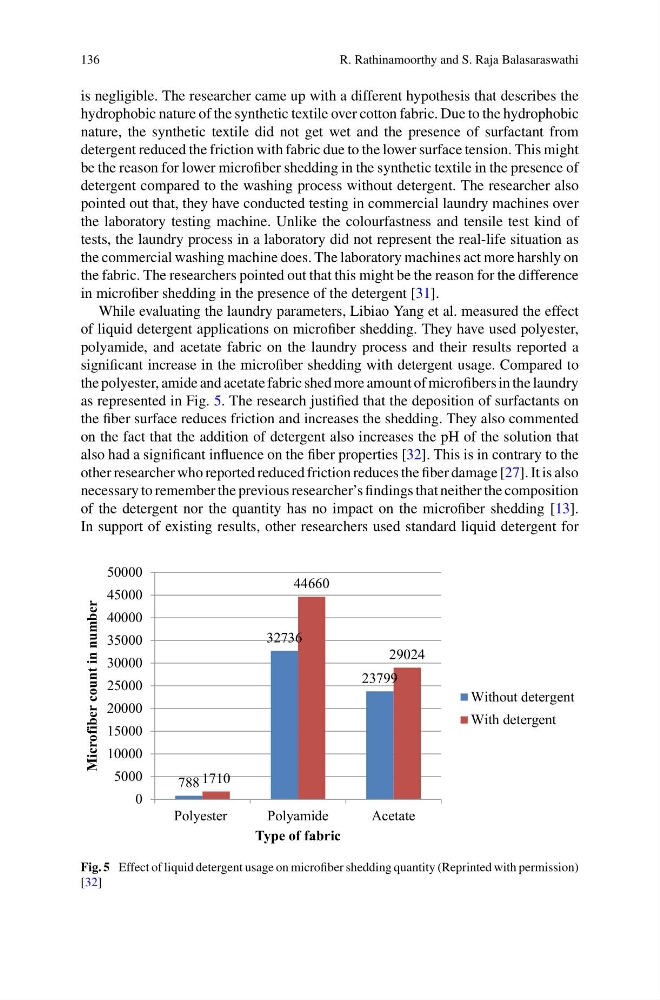
While evaluating the laundry parameters, Libiao Yang et al. measured the effect
of liquid detergent applications on microfiber shedding. They have used polyester,
polyamide, and acetate fabric on the laundry process and their results reported a
significant increase in the microfiber shedding with detergent usage. Compared to
the polyester, amide and acetate fabric shed more amount of microfibers in the laundry
as represented in Fig. 5. The research justified that the deposition of surfactants on
the fiber surface reduces friction and increases the shedding. They also commented
on the fact that the addition of detergent also increases the pH of the solution that
also had a significant influence on the fiber properties [32]. This is in contrary to the
other researcher who reported reduced friction reduces the fiber damage [27]. It is also
necessary to remember the previous researcher’s findings that neither the composition
of the detergent nor the quantity has no impact on the microfiber shedding [13].
In support of existing results, other researchers used standard liquid detergent for
788
32736
23799
1710
44660
29024
0
5000
10000
15000
20000
25000
30000
35000
40000
45000
50000
Polyester
Polyamide
Acetate
Microfiber count in number
Type of fabric
Without detergent
With detergent
Fig. 5 Effect of liquid detergent usage on microfiber shedding quantity (Reprinted with permission)
[32]
R. Rathinamoorthy and S. Raja Balasaraswathi
is negligible. The researcher came up with a different hypothesis that describes the
hydrophobic nature of the synthetic textile over cotton fabric. Due to the hydrophobic
nature, the synthetic textile did not get wet and the presence of surfactant from
detergent reduced the friction with fabric due to the lower surface tension. This might
be the reason for lower microfiber shedding in the synthetic textile in the presence of
detergent compared to the washing process without detergent. The researcher also
pointed out that, they have conducted testing in commercial laundry machines over
the laboratory testing machine. Unlike the colourfastness and tensile test kind of
tests, the laundry process in a laboratory did not represent the real-life situation as
the commercial washing machine does. The laboratory machines act more harshly on
the fabric. The researchers pointed out that this might be the reason for the difference
in microfiber shedding in the presence of the detergent [31].
While evaluating the laundry parameters, Libiao Yang et al. measured the effect
of liquid detergent applications on microfiber shedding. They have used polyester,
polyamide, and acetate fabric on the laundry process and their results reported a
significant increase in the microfiber shedding with detergent usage. Compared to
the polyester, amide and acetate fabric shed more amount of microfibers in the laundry
as represented in Fig. 5. The research justified that the deposition of surfactants on
the fiber surface reduces friction and increases the shedding. They also commented
on the fact that the addition of detergent also increases the pH of the solution that
also had a significant influence on the fiber properties [32]. This is in contrary to the
other researcher who reported reduced friction reduces the fiber damage [27]. It is also
necessary to remember the previous researcher’s findings that neither the composition
of the detergent nor the quantity has no impact on the microfiber shedding [13].
In support of existing results, other researchers used standard liquid detergent for
788
32736
23799
1710
44660
29024
0
5000
10000
15000
20000
25000
30000
35000
40000
45000
50000
Polyester
Polyamide
Acetate
Microfiber count in number
Type of fabric
Without detergent
With detergent
Fig. 5 Effect of liquid detergent usage on microfiber shedding quantity (Reprinted with permission)
[32]