

Domestic Laundry and Microfiber Shedding of Synthetic Textiles
135
nature. Hence, during the laundry, the addition of powdered detergent changes the
pH drastically, and this damages the polyester fiber by slow alkalization [27]. It also
mentioned the possibilities of potential errors in the case of powder detergent due to
the presence of insoluble detergent in the filters [29].
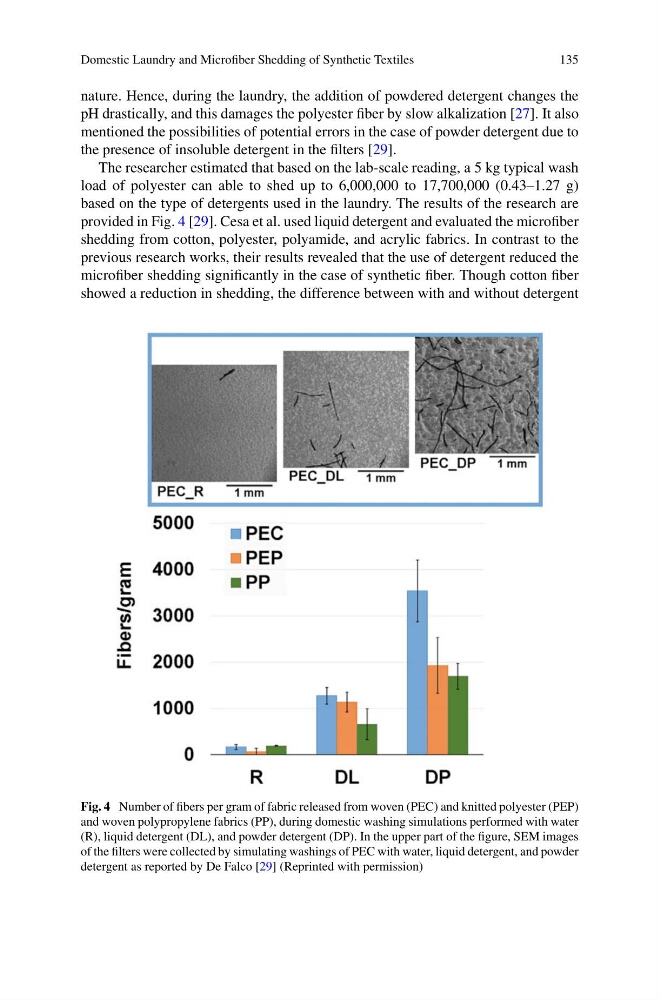
The researcher estimated that based on the lab-scale reading, a 5 kg typical wash
load of polyester can able to shed up to 6,000,000 to 17,700,000 (0.43–1.27 g)
based on the type of detergents used in the laundry. The results of the research are
provided in Fig. 4 [29]. Cesa et al. used liquid detergent and evaluated the microfiber
shedding from cotton, polyester, polyamide, and acrylic fabrics. In contrast to the
previous research works, their results revealed that the use of detergent reduced the
microfiber shedding significantly in the case of synthetic fiber. Though cotton fiber
showed a reduction in shedding, the difference between with and without detergent
Fig. 4 Number of fibers per gram of fabric released from woven (PEC) and knitted polyester (PEP)
and woven polypropylene fabrics (PP), during domestic washing simulations performed with water
(R), liquid detergent (DL), and powder detergent (DP). In the upper part of the figure, SEM images
of the filters were collected by simulating washings of PEC with water, liquid detergent, and powder
detergent as reported by De Falco [29] (Reprinted with permission)
135
nature. Hence, during the laundry, the addition of powdered detergent changes the
pH drastically, and this damages the polyester fiber by slow alkalization [27]. It also
mentioned the possibilities of potential errors in the case of powder detergent due to
the presence of insoluble detergent in the filters [29].
The researcher estimated that based on the lab-scale reading, a 5 kg typical wash
load of polyester can able to shed up to 6,000,000 to 17,700,000 (0.43–1.27 g)
based on the type of detergents used in the laundry. The results of the research are
provided in Fig. 4 [29]. Cesa et al. used liquid detergent and evaluated the microfiber
shedding from cotton, polyester, polyamide, and acrylic fabrics. In contrast to the
previous research works, their results revealed that the use of detergent reduced the
microfiber shedding significantly in the case of synthetic fiber. Though cotton fiber
showed a reduction in shedding, the difference between with and without detergent
Fig. 4 Number of fibers per gram of fabric released from woven (PEC) and knitted polyester (PEP)
and woven polypropylene fabrics (PP), during domestic washing simulations performed with water
(R), liquid detergent (DL), and powder detergent (DP). In the upper part of the figure, SEM images
of the filters were collected by simulating washings of PEC with water, liquid detergent, and powder
detergent as reported by De Falco [29] (Reprinted with permission)