

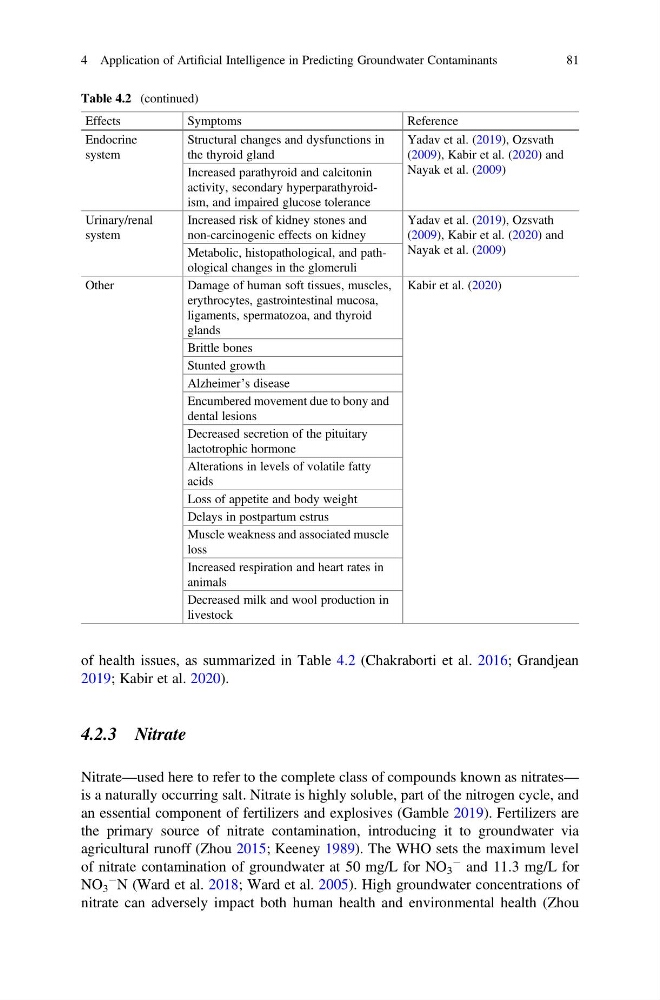
of health issues, as summarized in Table 4.2 (Chakraborti et al. 2016; Grandjean
2019; Kabir et al. 2020).
4.2.3 Nitrate
Nitrate—used here to refer to the complete class of compounds known as nitrates—
is a naturally occurring salt. Nitrate is highly soluble, part of the nitrogen cycle, and
an essential component of fertilizers and explosives (Gamble 2019). Fertilizers are
the primary source of nitrate contamination, introducing it to groundwater via
agricultural runoff (Zhou 2015; Keeney 1989). The WHO sets the maximum level
of nitrate contamination of groundwater at 50 mg/L for NO 3
À and 11.3 mg/L for
NO 3
À N (Ward et al. 2018; Ward et al. 2005). High groundwater concentrations of
nitrate can adversely impact both human health and environmental health (Zhou
Table 4.2 (continued)
Effects
Symptoms
Reference
Endocrine
system
Structural changes and dysfunctions in
the thyroid gland
Yadav et al. (2019), Ozsvath
(2009), Kabir et al. (2020) and
Nayak et al. (2009)
Increased parathyroid and calcitonin
activity, secondary hyperparathyroidism, and impaired glucose tolerance
Urinary/renal
system
Increased risk of kidney stones and
non-carcinogenic effects on kidney
Yadav et al. (2019), Ozsvath
(2009), Kabir et al. (2020) and
Nayak et al. (2009)
Metabolic, histopathological, and pathological changes in the glomeruli
Other
Damage of human soft tissues, muscles,
erythrocytes, gastrointestinal mucosa,
ligaments, spermatozoa, and thyroid
glands
Kabir et al. (2020)
Brittle bones
Stunted growth
Alzheimer’s disease
Encumbered movement due to bony and
dental lesions
Decreased secretion of the pituitary
lactotrophic hormone
Alterations in levels of volatile fatty
acids
Loss of appetite and body weight
Delays in postpartum estrus
Muscle weakness and associated muscle
loss
Increased respiration and heart rates in
animals
Decreased milk and wool production in
livestock
4 Application of Artificial Intelligence in Predicting Groundwater Contaminants
81
2019; Kabir et al. 2020).
4.2.3 Nitrate
Nitrate—used here to refer to the complete class of compounds known as nitrates—
is a naturally occurring salt. Nitrate is highly soluble, part of the nitrogen cycle, and
an essential component of fertilizers and explosives (Gamble 2019). Fertilizers are
the primary source of nitrate contamination, introducing it to groundwater via
agricultural runoff (Zhou 2015; Keeney 1989). The WHO sets the maximum level
of nitrate contamination of groundwater at 50 mg/L for NO 3
À and 11.3 mg/L for
NO 3
À N (Ward et al. 2018; Ward et al. 2005). High groundwater concentrations of
nitrate can adversely impact both human health and environmental health (Zhou
Table 4.2 (continued)
Effects
Symptoms
Reference
Endocrine
system
Structural changes and dysfunctions in
the thyroid gland
Yadav et al. (2019), Ozsvath
(2009), Kabir et al. (2020) and
Nayak et al. (2009)
Increased parathyroid and calcitonin
activity, secondary hyperparathyroidism, and impaired glucose tolerance
Urinary/renal
system
Increased risk of kidney stones and
non-carcinogenic effects on kidney
Yadav et al. (2019), Ozsvath
(2009), Kabir et al. (2020) and
Nayak et al. (2009)
Metabolic, histopathological, and pathological changes in the glomeruli
Other
Damage of human soft tissues, muscles,
erythrocytes, gastrointestinal mucosa,
ligaments, spermatozoa, and thyroid
glands
Kabir et al. (2020)
Brittle bones
Stunted growth
Alzheimer’s disease
Encumbered movement due to bony and
dental lesions
Decreased secretion of the pituitary
lactotrophic hormone
Alterations in levels of volatile fatty
acids
Loss of appetite and body weight
Delays in postpartum estrus
Muscle weakness and associated muscle
loss
Increased respiration and heart rates in
animals
Decreased milk and wool production in
livestock
4 Application of Artificial Intelligence in Predicting Groundwater Contaminants
81