

4.2.2 Fluoride
Fluoride, the world’s 13th most abundant element, occupies 0.06–0.09% of the
earth’s crust. Being highly reactive, it changes its elemental form rapidly and is
converted into both organic and inorganic compounds. In groundwater, it is present
in concentrations lower than 1 mg/L. At the 1.5 mg/L level, fluoride improves bone
growth and helps protect against dental caries (cavities). Around the world, over
200 million individuals across 84 countries are at risk due to fluoride-contaminated
drinking water (Fig. 4.2) (Jha et al. 2013; Ali et al. 2016).
Ironically, human beings require a low concentration of fluoride, for example,
between 0.5 and 1.5 mg/L, to strengthen bones and teeth. However, higher doses of
fluoride, imbibed through water, air, food, or any other source, can lead to a variety
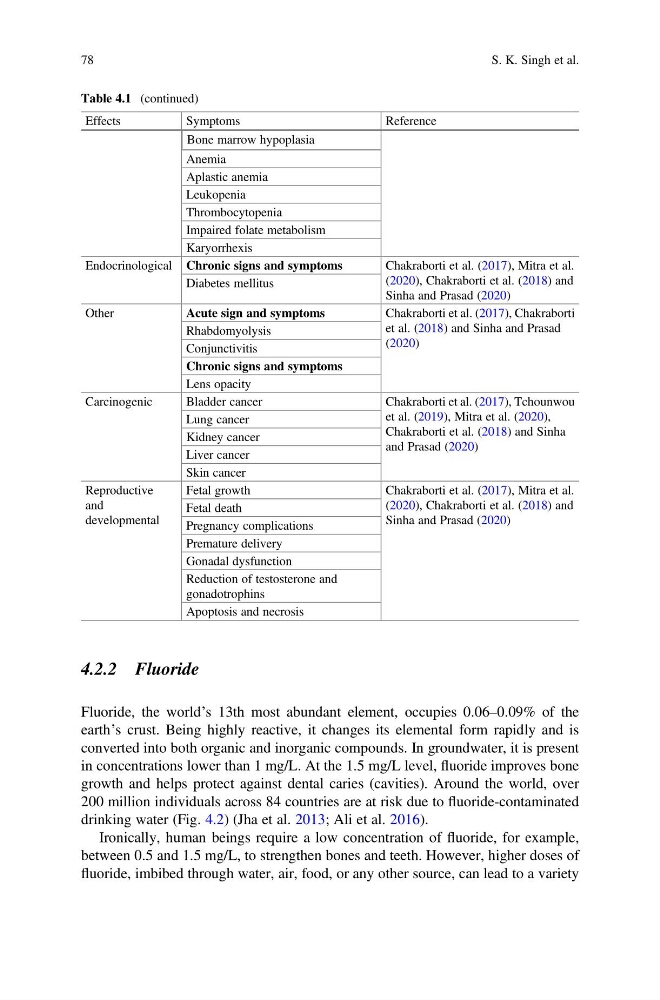
Table 4.1 (continued)
Effects
Symptoms
Reference
Bone marrow hypoplasia
Anemia
Aplastic anemia
Leukopenia
Thrombocytopenia
Impaired folate metabolism
Karyorrhexis
Endocrinological Chronic signs and symptoms
Chakraborti et al. (2017), Mitra et al.
(2020), Chakraborti et al. (2018) and
Sinha and Prasad (2020)
Diabetes mellitus
Other
Acute sign and symptoms
Chakraborti et al. (2017), Chakraborti
et al. (2018) and Sinha and Prasad
(2020)
Rhabdomyolysis
Conjunctivitis
Chronic signs and symptoms
Lens opacity
Carcinogenic
Bladder cancer
Chakraborti et al. (2017), Tchounwou
et al. (2019), Mitra et al. (2020),
Chakraborti et al. (2018) and Sinha
and Prasad (2020)
Lung cancer
Kidney cancer
Liver cancer
Skin cancer
Reproductive
and
developmental
Fetal growth
Chakraborti et al. (2017), Mitra et al.
(2020), Chakraborti et al. (2018) and
Sinha and Prasad (2020)
Fetal death
Pregnancy complications
Premature delivery
Gonadal dysfunction
Reduction of testosterone and
gonadotrophins
Apoptosis and necrosis
78
S. K. Singh et al.
Fluoride, the world’s 13th most abundant element, occupies 0.06–0.09% of the
earth’s crust. Being highly reactive, it changes its elemental form rapidly and is
converted into both organic and inorganic compounds. In groundwater, it is present
in concentrations lower than 1 mg/L. At the 1.5 mg/L level, fluoride improves bone
growth and helps protect against dental caries (cavities). Around the world, over
200 million individuals across 84 countries are at risk due to fluoride-contaminated
drinking water (Fig. 4.2) (Jha et al. 2013; Ali et al. 2016).
Ironically, human beings require a low concentration of fluoride, for example,
between 0.5 and 1.5 mg/L, to strengthen bones and teeth. However, higher doses of
fluoride, imbibed through water, air, food, or any other source, can lead to a variety
Table 4.1 (continued)
Effects
Symptoms
Reference
Bone marrow hypoplasia
Anemia
Aplastic anemia
Leukopenia
Thrombocytopenia
Impaired folate metabolism
Karyorrhexis
Endocrinological Chronic signs and symptoms
Chakraborti et al. (2017), Mitra et al.
(2020), Chakraborti et al. (2018) and
Sinha and Prasad (2020)
Diabetes mellitus
Other
Acute sign and symptoms
Chakraborti et al. (2017), Chakraborti
et al. (2018) and Sinha and Prasad
(2020)
Rhabdomyolysis
Conjunctivitis
Chronic signs and symptoms
Lens opacity
Carcinogenic
Bladder cancer
Chakraborti et al. (2017), Tchounwou
et al. (2019), Mitra et al. (2020),
Chakraborti et al. (2018) and Sinha
and Prasad (2020)
Lung cancer
Kidney cancer
Liver cancer
Skin cancer
Reproductive
and
developmental
Fetal growth
Chakraborti et al. (2017), Mitra et al.
(2020), Chakraborti et al. (2018) and
Sinha and Prasad (2020)
Fetal death
Pregnancy complications
Premature delivery
Gonadal dysfunction
Reduction of testosterone and
gonadotrophins
Apoptosis and necrosis
78
S. K. Singh et al.