

across the outer membrane more easier (Poirel et al. 2005). Cephalosporins are
similar to beta-lactam with semi-synthetically side chains (3,6-dihydro-2
H-1,3-thiazane) rings, which enable them to be resistant to penicillinase by binding
to different penicillin-binding proteins (PBPs) in the cell wall, as well as to invade
the blood-brain barrier (Etebul and Arikekpar 2016). Unlike beta-lactams,
macrolides characterized with unique macrocyclic lactose ring contains l-cladinose
and D-desosamine sugars, which increase their spectrum activity (Moore 2015).
Macrolides are able to kill or inhibit bacterial protein synthesis by binding to
ribosomes and preventing the addition of amino acids to polypeptide chains (Kapoor
et al. 2017). Teteracyclines and doxycycline are firstly semi-synthetic derivatives,
which target protein synthesis processes (Yoneyama and Katsumata 2006). Furthermore, other pharmaceuticals target the DNA replication and transcription processes
by interfering with DNA gyrase such as quinolones and nalidixic acids (Higgins
et al. 2003). The wide-spectrum activity and high efficiency of quinolones are due to
their chemical structure with two rings in their side chains, with additional ring in the
recent generation (Etebul and Arikekpar 2016). The unusual structure of
aminoglycoside with 3-amino glycans joined by glycosidic bonds stands behind
the wide-spectrum activity against microorganisms. Protein synthesis inhibition is
the main target of aminoglycoside (Peterson 2008). The scope of this review is to
outline the presence, dissemination, and impact of macropollutants in different
environmental compartments around the world, and the ways by which these
drugs are delivered to the surface water. In addition, the review has pointed out
the mode action of most detectable antibiotics and the rate of detection in the
environment.
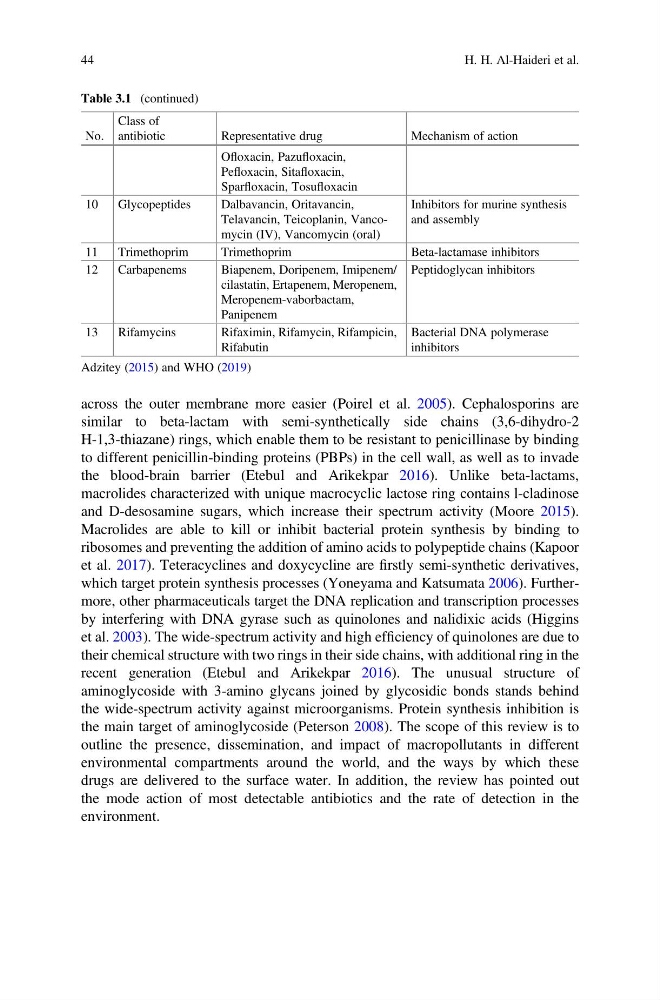
Table 3.1 (continued)
No.
Class of
antibiotic
Representative drug
Mechanism of action
Ofloxacin, Pazufloxacin,
Pefloxacin, Sitafloxacin,
Sparfloxacin, Tosufloxacin
10
Glycopeptides
Dalbavancin, Oritavancin,
Telavancin, Teicoplanin, Vancomycin (IV), Vancomycin (oral)
Inhibitors for murine synthesis
and assembly
11
Trimethoprim
Trimethoprim
Beta-lactamase inhibitors
12
Carbapenems
Biapenem, Doripenem, Imipenem/
cilastatin, Ertapenem, Meropenem,
Meropenem-vaborbactam,
Panipenem
Peptidoglycan inhibitors
13
Rifamycins
Rifaximin, Rifamycin, Rifampicin,
Rifabutin
Bacterial DNA polymerase
inhibitors
Adzitey (2015) and WHO (2019)
44
H. H. Al-Haideri et al.
similar to beta-lactam with semi-synthetically side chains (3,6-dihydro-2
H-1,3-thiazane) rings, which enable them to be resistant to penicillinase by binding
to different penicillin-binding proteins (PBPs) in the cell wall, as well as to invade
the blood-brain barrier (Etebul and Arikekpar 2016). Unlike beta-lactams,
macrolides characterized with unique macrocyclic lactose ring contains l-cladinose
and D-desosamine sugars, which increase their spectrum activity (Moore 2015).
Macrolides are able to kill or inhibit bacterial protein synthesis by binding to
ribosomes and preventing the addition of amino acids to polypeptide chains (Kapoor
et al. 2017). Teteracyclines and doxycycline are firstly semi-synthetic derivatives,
which target protein synthesis processes (Yoneyama and Katsumata 2006). Furthermore, other pharmaceuticals target the DNA replication and transcription processes
by interfering with DNA gyrase such as quinolones and nalidixic acids (Higgins
et al. 2003). The wide-spectrum activity and high efficiency of quinolones are due to
their chemical structure with two rings in their side chains, with additional ring in the
recent generation (Etebul and Arikekpar 2016). The unusual structure of
aminoglycoside with 3-amino glycans joined by glycosidic bonds stands behind
the wide-spectrum activity against microorganisms. Protein synthesis inhibition is
the main target of aminoglycoside (Peterson 2008). The scope of this review is to
outline the presence, dissemination, and impact of macropollutants in different
environmental compartments around the world, and the ways by which these
drugs are delivered to the surface water. In addition, the review has pointed out
the mode action of most detectable antibiotics and the rate of detection in the
environment.
Table 3.1 (continued)
No.
Class of
antibiotic
Representative drug
Mechanism of action
Ofloxacin, Pazufloxacin,
Pefloxacin, Sitafloxacin,
Sparfloxacin, Tosufloxacin
10
Glycopeptides
Dalbavancin, Oritavancin,
Telavancin, Teicoplanin, Vancomycin (IV), Vancomycin (oral)
Inhibitors for murine synthesis
and assembly
11
Trimethoprim
Trimethoprim
Beta-lactamase inhibitors
12
Carbapenems
Biapenem, Doripenem, Imipenem/
cilastatin, Ertapenem, Meropenem,
Meropenem-vaborbactam,
Panipenem
Peptidoglycan inhibitors
13
Rifamycins
Rifaximin, Rifamycin, Rifampicin,
Rifabutin
Bacterial DNA polymerase
inhibitors
Adzitey (2015) and WHO (2019)
44
H. H. Al-Haideri et al.