

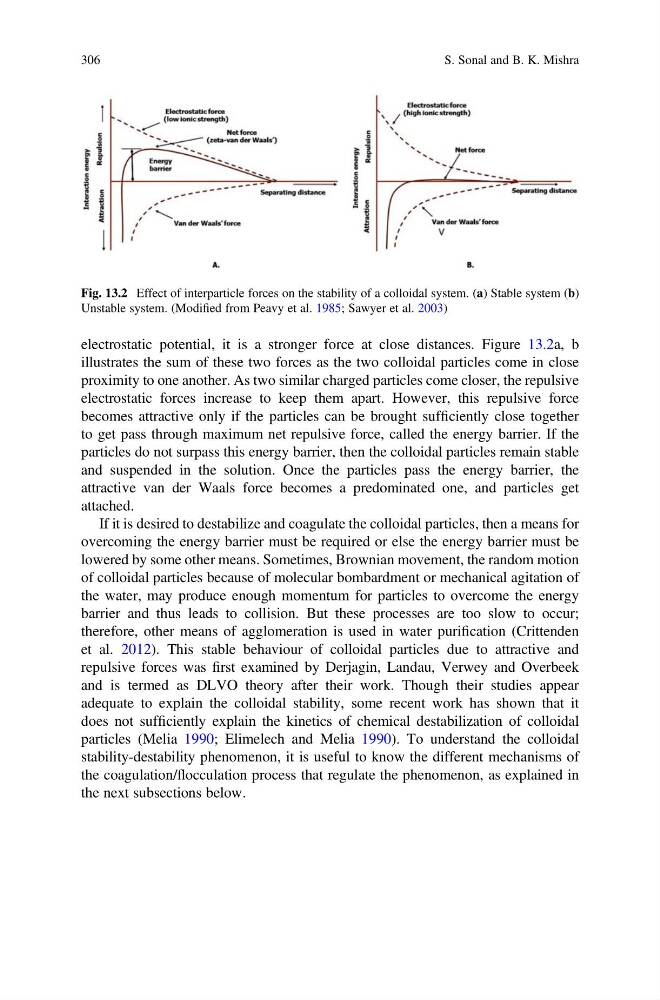
electrostatic potential, it is a stronger force at close distances. Figure 13.2a, b
illustrates the sum of these two forces as the two colloidal particles come in close
proximity to one another. As two similar charged particles come closer, the repulsive
electrostatic forces increase to keep them apart. However, this repulsive force
becomes attractive only if the particles can be brought sufficiently close together
to get pass through maximum net repulsive force, called the energy barrier. If the
particles do not surpass this energy barrier, then the colloidal particles remain stable
and suspended in the solution. Once the particles pass the energy barrier, the
attractive van der Waals force becomes a predominated one, and particles get
attached.
If it is desired to destabilize and coagulate the colloidal particles, then a means for
overcoming the energy barrier must be required or else the energy barrier must be
lowered by some other means. Sometimes, Brownian movement, the random motion
of colloidal particles because of molecular bombardment or mechanical agitation of
the water, may produce enough momentum for particles to overcome the energy
barrier and thus leads to collision. But these processes are too slow to occur;
therefore, other means of agglomeration is used in water purification (Crittenden
et al. 2012). This stable behaviour of colloidal particles due to attractive and
repulsive forces was first examined by Derjagin, Landau, Verwey and Overbeek
and is termed as DLVO theory after their work. Though their studies appear
adequate to explain the colloidal stability, some recent work has shown that it
does not sufficiently explain the kinetics of chemical destabilization of colloidal
particles (Melia 1990; Elimelech and Melia 1990). To understand the colloidal
stability-destability phenomenon, it is useful to know the different mechanisms of
the coagulation/flocculation process that regulate the phenomenon, as explained in
the next subsections below.
Fig. 13.2 Effect of interparticle forces on the stability of a colloidal system. (a) Stable system (b)
Unstable system. (Modified from Peavy et al. 1985; Sawyer et al. 2003)
306
S. Sonal and B. K. Mishra
illustrates the sum of these two forces as the two colloidal particles come in close
proximity to one another. As two similar charged particles come closer, the repulsive
electrostatic forces increase to keep them apart. However, this repulsive force
becomes attractive only if the particles can be brought sufficiently close together
to get pass through maximum net repulsive force, called the energy barrier. If the
particles do not surpass this energy barrier, then the colloidal particles remain stable
and suspended in the solution. Once the particles pass the energy barrier, the
attractive van der Waals force becomes a predominated one, and particles get
attached.
If it is desired to destabilize and coagulate the colloidal particles, then a means for
overcoming the energy barrier must be required or else the energy barrier must be
lowered by some other means. Sometimes, Brownian movement, the random motion
of colloidal particles because of molecular bombardment or mechanical agitation of
the water, may produce enough momentum for particles to overcome the energy
barrier and thus leads to collision. But these processes are too slow to occur;
therefore, other means of agglomeration is used in water purification (Crittenden
et al. 2012). This stable behaviour of colloidal particles due to attractive and
repulsive forces was first examined by Derjagin, Landau, Verwey and Overbeek
and is termed as DLVO theory after their work. Though their studies appear
adequate to explain the colloidal stability, some recent work has shown that it
does not sufficiently explain the kinetics of chemical destabilization of colloidal
particles (Melia 1990; Elimelech and Melia 1990). To understand the colloidal
stability-destability phenomenon, it is useful to know the different mechanisms of
the coagulation/flocculation process that regulate the phenomenon, as explained in
the next subsections below.
Fig. 13.2 Effect of interparticle forces on the stability of a colloidal system. (a) Stable system (b)
Unstable system. (Modified from Peavy et al. 1985; Sawyer et al. 2003)
306
S. Sonal and B. K. Mishra