

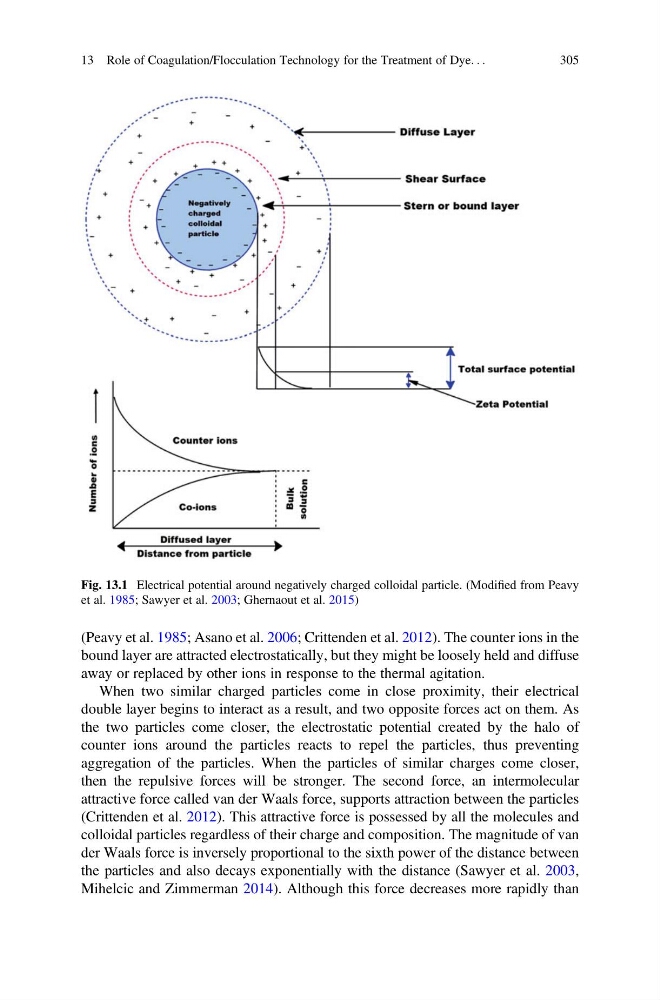
(Peavy et al. 1985; Asano et al. 2006; Crittenden et al. 2012). The counter ions in the
bound layer are attracted electrostatically, but they might be loosely held and diffuse
away or replaced by other ions in response to the thermal agitation.
When two similar charged particles come in close proximity, their electrical
double layer begins to interact as a result, and two opposite forces act on them. As
the two particles come closer, the electrostatic potential created by the halo of
counter ions around the particles reacts to repel the particles, thus preventing
aggregation of the particles. When the particles of similar charges come closer,
then the repulsive forces will be stronger. The second force, an intermolecular
attractive force called van der Waals force, supports attraction between the particles
(Crittenden et al. 2012). This attractive force is possessed by all the molecules and
colloidal particles regardless of their charge and composition. The magnitude of van
der Waals force is inversely proportional to the sixth power of the distance between
the particles and also decays exponentially with the distance (Sawyer et al. 2003,
Mihelcic and Zimmerman 2014). Although this force decreases more rapidly than
Fig. 13.1 Electrical potential around negatively charged colloidal particle. (Modified from Peavy
et al. 1985; Sawyer et al. 2003; Ghernaout et al. 2015)
13 Role of Coagulation/Flocculation Technology for the Treatment of Dye. . .
305
bound layer are attracted electrostatically, but they might be loosely held and diffuse
away or replaced by other ions in response to the thermal agitation.
When two similar charged particles come in close proximity, their electrical
double layer begins to interact as a result, and two opposite forces act on them. As
the two particles come closer, the electrostatic potential created by the halo of
counter ions around the particles reacts to repel the particles, thus preventing
aggregation of the particles. When the particles of similar charges come closer,
then the repulsive forces will be stronger. The second force, an intermolecular
attractive force called van der Waals force, supports attraction between the particles
(Crittenden et al. 2012). This attractive force is possessed by all the molecules and
colloidal particles regardless of their charge and composition. The magnitude of van
der Waals force is inversely proportional to the sixth power of the distance between
the particles and also decays exponentially with the distance (Sawyer et al. 2003,
Mihelcic and Zimmerman 2014). Although this force decreases more rapidly than
Fig. 13.1 Electrical potential around negatively charged colloidal particle. (Modified from Peavy
et al. 1985; Sawyer et al. 2003; Ghernaout et al. 2015)
13 Role of Coagulation/Flocculation Technology for the Treatment of Dye. . .
305