

observed in the exposed infant and children population along with reduced IQ level
due to Pb exposure (Evens et al. 2015; Reuben et al. 2017).
11.4 Remediation of the HMs in Water Systems
Safe water is a global concern for better public health, environment, and healthy
ecosystems as threatened by the several geogenic sources and man-made activities
(Mukherjee and Singh 2018b). Avoiding release of the poorly treated effluent and
sewage sludge into the river bodies or environment can considerably decrease the
HM contamination of the surface and groundwater systems. Similarly, scientific
waste management practices with leachate collection technique can reduce the HM
pollution to the surrounding water environments. Adequate management of the
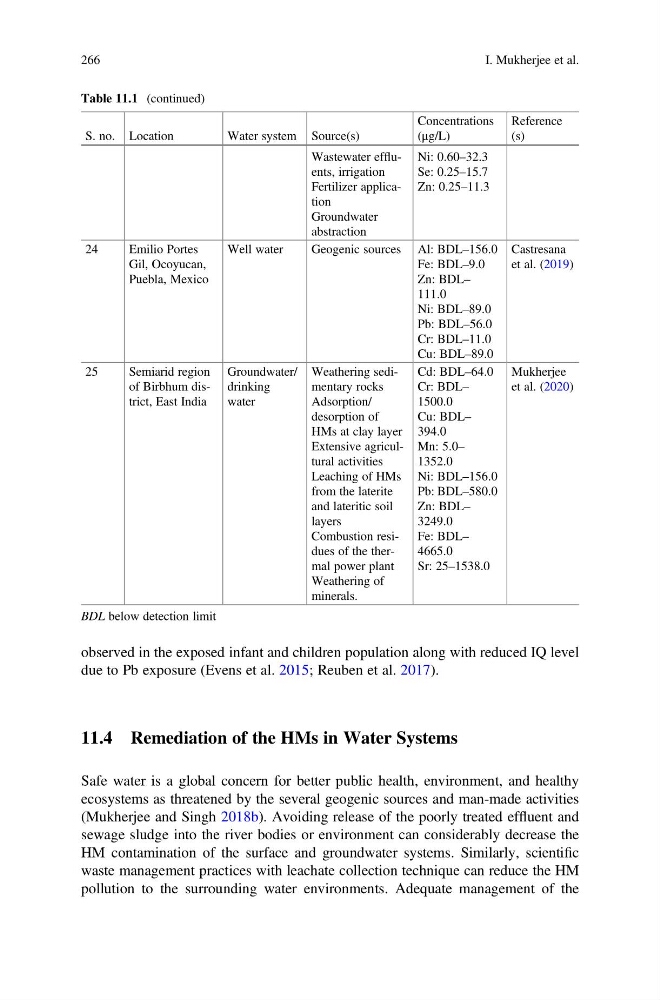
Table 11.1 (continued)
S. no. Location
Water system Source(s)
Concentrations
(μg/L)
Reference
(s)
Wastewater effluents, irrigation
Fertilizer application
Groundwater
abstraction
Ni: 0.60–32.3
Se: 0.25–15.7
Zn: 0.25–11.3
24
Emilio Portes
Gil, Ocoyucan,
Puebla, Mexico
Well water
Geogenic sources Al: BDL–156.0
Fe: BDL–9.0
Zn: BDL–
111.0
Ni: BDL–89.0
Pb: BDL–56.0
Cr: BDL–11.0
Cu: BDL–89.0
Castresana
et al. (2019)
25
Semiarid region
of Birbhum district, East India
Groundwater/
drinking
water
Weathering sedimentary rocks
Adsorption/
desorption of
HMs at clay layer
Extensive agricultural activities
Leaching of HMs
from the laterite
and lateritic soil
layers
Combustion residues of the thermal power plant
Weathering of
minerals.
Cd: BDL–64.0
Cr: BDL–
1500.0
Cu: BDL–
394.0
Mn: 5.0–
1352.0
Ni: BDL–156.0
Pb: BDL–580.0
Zn: BDL–
3249.0
Fe: BDL–
4665.0
Sr: 25–1538.0
Mukherjee
et al. (2020)
BDL below detection limit
266
I. Mukherjee et al.
due to Pb exposure (Evens et al. 2015; Reuben et al. 2017).
11.4 Remediation of the HMs in Water Systems
Safe water is a global concern for better public health, environment, and healthy
ecosystems as threatened by the several geogenic sources and man-made activities
(Mukherjee and Singh 2018b). Avoiding release of the poorly treated effluent and
sewage sludge into the river bodies or environment can considerably decrease the
HM contamination of the surface and groundwater systems. Similarly, scientific
waste management practices with leachate collection technique can reduce the HM
pollution to the surrounding water environments. Adequate management of the
Table 11.1 (continued)
S. no. Location
Water system Source(s)
Concentrations
(μg/L)
Reference
(s)
Wastewater effluents, irrigation
Fertilizer application
Groundwater
abstraction
Ni: 0.60–32.3
Se: 0.25–15.7
Zn: 0.25–11.3
24
Emilio Portes
Gil, Ocoyucan,
Puebla, Mexico
Well water
Geogenic sources Al: BDL–156.0
Fe: BDL–9.0
Zn: BDL–
111.0
Ni: BDL–89.0
Pb: BDL–56.0
Cr: BDL–11.0
Cu: BDL–89.0
Castresana
et al. (2019)
25
Semiarid region
of Birbhum district, East India
Groundwater/
drinking
water
Weathering sedimentary rocks
Adsorption/
desorption of
HMs at clay layer
Extensive agricultural activities
Leaching of HMs
from the laterite
and lateritic soil
layers
Combustion residues of the thermal power plant
Weathering of
minerals.
Cd: BDL–64.0
Cr: BDL–
1500.0
Cu: BDL–
394.0
Mn: 5.0–
1352.0
Ni: BDL–156.0
Pb: BDL–580.0
Zn: BDL–
3249.0
Fe: BDL–
4665.0
Sr: 25–1538.0
Mukherjee
et al. (2020)
BDL below detection limit
266
I. Mukherjee et al.