

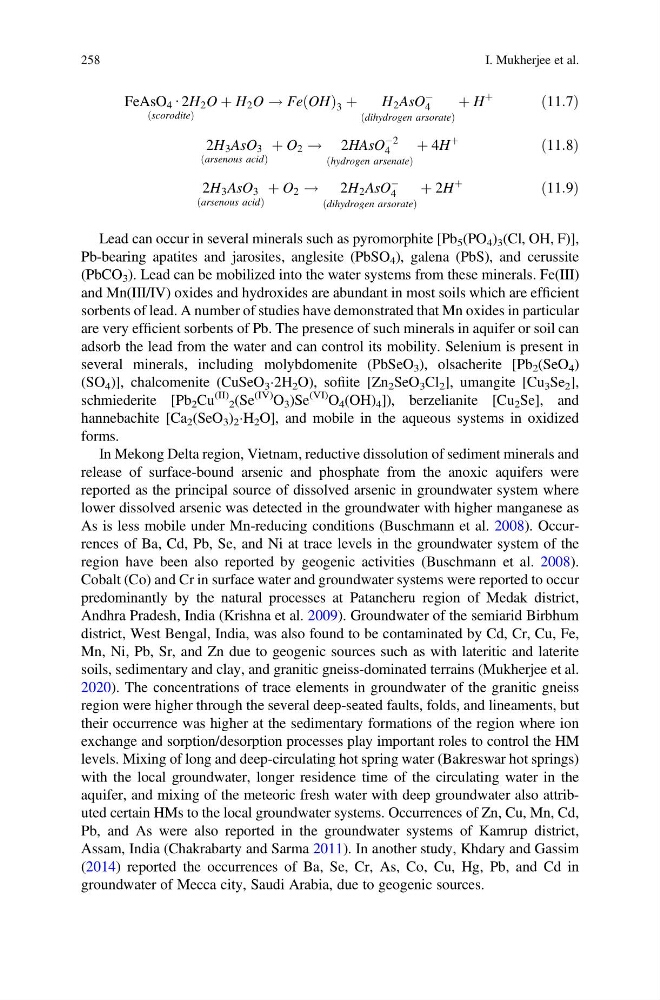
FeAsO 4 ∙ 2H 2 O
scorodite
ð
Þ
þ H 2 O ! Fe OH
ð Þ 3 þ
H 2 AsO
À
4
dihydrogen arsorate
ð
Þ
þ H
þ
ð11:7Þ
2H 3 AsO 3
arsenous acid
ð
Þ
þ O 2 ! 2HAsO
À2
4
hydrogen arsenate
ð
Þ
þ 4H
þ
ð11:8Þ
2H 3 AsO 3
arsenous acid
ð
Þ
þ O 2 ! 2H 2 AsO
À
4
dihydrogen arsorate
ð
Þ
þ 2H
þ
ð11:9Þ
Lead can occur in several minerals such as pyromorphite [Pb 5 (PO 4 ) 3 (Cl, OH, F)],
Pb-bearing apatites and jarosites, anglesite (PbSO 4 ), galena (PbS), and cerussite
(PbCO 3 ). Lead can be mobilized into the water systems from these minerals. Fe(III)
and Mn(III/IV) oxides and hydroxides are abundant in most soils which are efficient
sorbents of lead. A number of studies have demonstrated that Mn oxides in particular
are very efficient sorbents of Pb. The presence of such minerals in aquifer or soil can
adsorb the lead from the water and can control its mobility. Selenium is present in
several minerals, including molybdomenite (PbSeO 3 ), olsacherite [Pb 2 (SeO 4 )
(SO 4 )], chalcomenite (CuSeO 3 Á2H 2 O), sofiite [Zn 2 SeO 3 Cl 2 ], umangite [Cu 3 Se 2 ],
schmiederite [Pb 2 Cu
(II)
2 (Se
(IV) O 3 )Se
(VI) O 4 (OH) 4 ]), berzelianite [Cu 2 Se], and
hannebachite [Ca 2 (SeO 3 ) 2 ÁH 2 O], and mobile in the aqueous systems in oxidized
forms.
In Mekong Delta region, Vietnam, reductive dissolution of sediment minerals and
release of surface-bound arsenic and phosphate from the anoxic aquifers were
reported as the principal source of dissolved arsenic in groundwater system where
lower dissolved arsenic was detected in the groundwater with higher manganese as
As is less mobile under Mn-reducing conditions (Buschmann et al. 2008). Occurrences of Ba, Cd, Pb, Se, and Ni at trace levels in the groundwater system of the
region have been also reported by geogenic activities (Buschmann et al. 2008).
Cobalt (Co) and Cr in surface water and groundwater systems were reported to occur
predominantly by the natural processes at Patancheru region of Medak district,
Andhra Pradesh, India (Krishna et al. 2009). Groundwater of the semiarid Birbhum
district, West Bengal, India, was also found to be contaminated by Cd, Cr, Cu, Fe,
Mn, Ni, Pb, Sr, and Zn due to geogenic sources such as with lateritic and laterite
soils, sedimentary and clay, and granitic gneiss-dominated terrains (Mukherjee et al.
2020). The concentrations of trace elements in groundwater of the granitic gneiss
region were higher through the several deep-seated faults, folds, and lineaments, but
their occurrence was higher at the sedimentary formations of the region where ion
exchange and sorption/desorption processes play important roles to control the HM
levels. Mixing of long and deep-circulating hot spring water (Bakreswar hot springs)
with the local groundwater, longer residence time of the circulating water in the
aquifer, and mixing of the meteoric fresh water with deep groundwater also attributed certain HMs to the local groundwater systems. Occurrences of Zn, Cu, Mn, Cd,
Pb, and As were also reported in the groundwater systems of Kamrup district,
Assam, India (Chakrabarty and Sarma 2011). In another study, Khdary and Gassim
(2014) reported the occurrences of Ba, Se, Cr, As, Co, Cu, Hg, Pb, and Cd in
groundwater of Mecca city, Saudi Arabia, due to geogenic sources.
258
I. Mukherjee et al.
scorodite
ð
Þ
þ H 2 O ! Fe OH
ð Þ 3 þ
H 2 AsO
À
4
dihydrogen arsorate
ð
Þ
þ H
þ
ð11:7Þ
2H 3 AsO 3
arsenous acid
ð
Þ
þ O 2 ! 2HAsO
À2
4
hydrogen arsenate
ð
Þ
þ 4H
þ
ð11:8Þ
2H 3 AsO 3
arsenous acid
ð
Þ
þ O 2 ! 2H 2 AsO
À
4
dihydrogen arsorate
ð
Þ
þ 2H
þ
ð11:9Þ
Lead can occur in several minerals such as pyromorphite [Pb 5 (PO 4 ) 3 (Cl, OH, F)],
Pb-bearing apatites and jarosites, anglesite (PbSO 4 ), galena (PbS), and cerussite
(PbCO 3 ). Lead can be mobilized into the water systems from these minerals. Fe(III)
and Mn(III/IV) oxides and hydroxides are abundant in most soils which are efficient
sorbents of lead. A number of studies have demonstrated that Mn oxides in particular
are very efficient sorbents of Pb. The presence of such minerals in aquifer or soil can
adsorb the lead from the water and can control its mobility. Selenium is present in
several minerals, including molybdomenite (PbSeO 3 ), olsacherite [Pb 2 (SeO 4 )
(SO 4 )], chalcomenite (CuSeO 3 Á2H 2 O), sofiite [Zn 2 SeO 3 Cl 2 ], umangite [Cu 3 Se 2 ],
schmiederite [Pb 2 Cu
(II)
2 (Se
(IV) O 3 )Se
(VI) O 4 (OH) 4 ]), berzelianite [Cu 2 Se], and
hannebachite [Ca 2 (SeO 3 ) 2 ÁH 2 O], and mobile in the aqueous systems in oxidized
forms.
In Mekong Delta region, Vietnam, reductive dissolution of sediment minerals and
release of surface-bound arsenic and phosphate from the anoxic aquifers were
reported as the principal source of dissolved arsenic in groundwater system where
lower dissolved arsenic was detected in the groundwater with higher manganese as
As is less mobile under Mn-reducing conditions (Buschmann et al. 2008). Occurrences of Ba, Cd, Pb, Se, and Ni at trace levels in the groundwater system of the
region have been also reported by geogenic activities (Buschmann et al. 2008).
Cobalt (Co) and Cr in surface water and groundwater systems were reported to occur
predominantly by the natural processes at Patancheru region of Medak district,
Andhra Pradesh, India (Krishna et al. 2009). Groundwater of the semiarid Birbhum
district, West Bengal, India, was also found to be contaminated by Cd, Cr, Cu, Fe,
Mn, Ni, Pb, Sr, and Zn due to geogenic sources such as with lateritic and laterite
soils, sedimentary and clay, and granitic gneiss-dominated terrains (Mukherjee et al.
2020). The concentrations of trace elements in groundwater of the granitic gneiss
region were higher through the several deep-seated faults, folds, and lineaments, but
their occurrence was higher at the sedimentary formations of the region where ion
exchange and sorption/desorption processes play important roles to control the HM
levels. Mixing of long and deep-circulating hot spring water (Bakreswar hot springs)
with the local groundwater, longer residence time of the circulating water in the
aquifer, and mixing of the meteoric fresh water with deep groundwater also attributed certain HMs to the local groundwater systems. Occurrences of Zn, Cu, Mn, Cd,
Pb, and As were also reported in the groundwater systems of Kamrup district,
Assam, India (Chakrabarty and Sarma 2011). In another study, Khdary and Gassim
(2014) reported the occurrences of Ba, Se, Cr, As, Co, Cu, Hg, Pb, and Cd in
groundwater of Mecca city, Saudi Arabia, due to geogenic sources.
258
I. Mukherjee et al.