

HMs by the pounding of ore and gangue materials, which may further distribute into
the other systems of environment though chemical weathering like dissolution,
oxidation, hydrolysis, acidolysis, and alcalinolysis. Oxidation of sulfide minerals
present in the heavy metal(loid) ore deposits increases the acidity of the water
systems which further accelerates the mobility of the HMs in potentially bioavailable
forms (Cravotta 1993; Jambor et al. 2000; Revan et al. 2014; Shengo et al. 2019), as
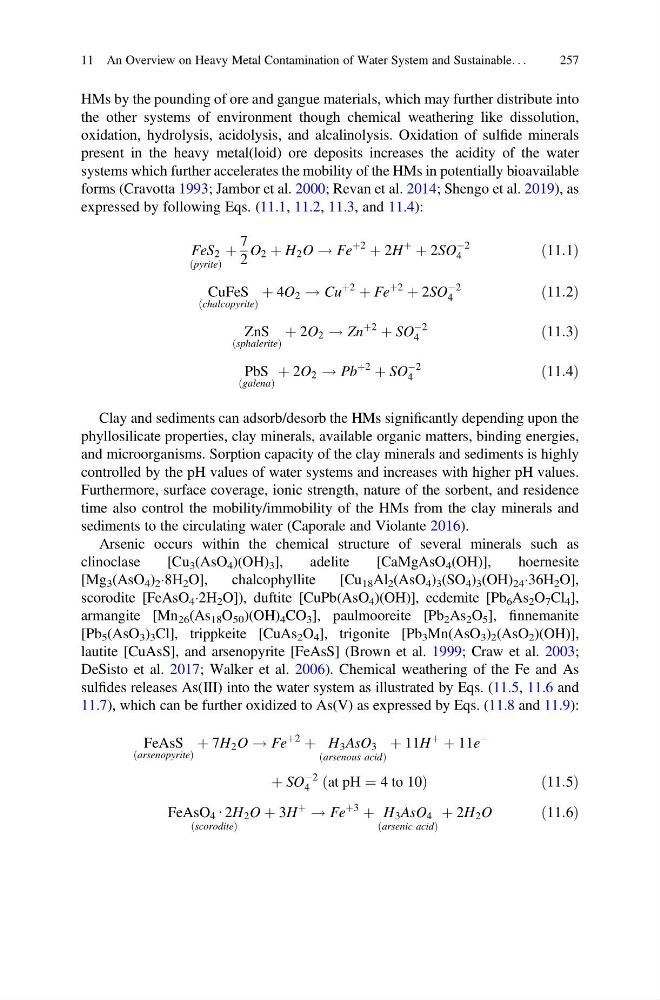
expressed by following Eqs. (11.1, 11.2, 11.3, and 11.4):
FeS 2
pyrite
ð
Þ
þ
7
2
O 2 þ H 2 O ! Fe
þ2
þ 2H
þ
þ 2SO
À2
4
ð11:1Þ
CuFeS
chalcopyrite
ð
Þ
þ 4O 2 ! Cu
þ2
þ Fe
þ2
þ 2SO
À2
4
ð11:2Þ
ZnS
sphalerite
ð
Þ
þ 2O 2 ! Zn
þ2
þ SO
À2
4
ð11:3Þ
PbS
galena
ð
Þ
þ 2O 2 ! Pb
þ2
þ SO
À2
4
ð11:4Þ
Clay and sediments can adsorb/desorb the HMs significantly depending upon the
phyllosilicate properties, clay minerals, available organic matters, binding energies,
and microorganisms. Sorption capacity of the clay minerals and sediments is highly
controlled by the pH values of water systems and increases with higher pH values.
Furthermore, surface coverage, ionic strength, nature of the sorbent, and residence
time also control the mobility/immobility of the HMs from the clay minerals and
sediments to the circulating water (Caporale and Violante 2016).
Arsenic occurs within the chemical structure of several minerals such as
clinoclase
[Cu 3 (AsO 4 )(OH) 3 ],
adelite
[CaMgAsO 4 (OH)],
hoernesite
[Mg 3 (AsO 4 ) 2 Á8H 2 O],
chalcophyllite
[Cu 18 Al 2 (AsO 4 ) 3 (SO 4 ) 3 (OH) 24 Á36H 2 O],
scorodite [FeAsO 4 Á2H 2 O]), duftite [CuPb(AsO 4 )(OH)], ecdemite [Pb 6 As 2 O 7 Cl 4 ],
armangite [Mn 26 (As 18 O 50 )(OH) 4 CO 3 ], paulmooreite [Pb 2 As 2 O 5 ], finnemanite
[Pb 5 (AsO 3 ) 3 Cl], trippkeite [CuAs 2 O 4 ], trigonite [Pb 3 Mn(AsO 3 ) 2 (AsO 2 )(OH)],
lautite [CuAsS], and arsenopyrite [FeAsS] (Brown et al. 1999; Craw et al. 2003;
DeSisto et al. 2017; Walker et al. 2006). Chemical weathering of the Fe and As
sulfides releases As(III) into the water system as illustrated by Eqs. (11.5, 11.6 and
11.7), which can be further oxidized to As(V) as expressed by Eqs. (11.8 and 11.9):
FeAsS
arsenopyrite
ð
Þ
þ 7H 2 O ! Fe
þ2
þ H 3 AsO 3
arsenous acid
ð
Þ
þ 11H
þ
þ 11e
À
þ SO
À2
4
at pH ¼ 4 to 10
ð
Þ
ð 11:5Þ
FeAsO 4 ∙ 2H 2 O
scorodite
ð
Þ
þ 3H
þ
! Fe
þ3
þ H 3 AsO 4
arsenic acid
ð
Þ
þ 2H 2 O
ð11:6Þ
11 An Overview on Heavy Metal Contamination of Water System and Sustainable. . .
257
the other systems of environment though chemical weathering like dissolution,
oxidation, hydrolysis, acidolysis, and alcalinolysis. Oxidation of sulfide minerals
present in the heavy metal(loid) ore deposits increases the acidity of the water
systems which further accelerates the mobility of the HMs in potentially bioavailable
forms (Cravotta 1993; Jambor et al. 2000; Revan et al. 2014; Shengo et al. 2019), as
expressed by following Eqs. (11.1, 11.2, 11.3, and 11.4):
FeS 2
pyrite
ð
Þ
þ
7
2
O 2 þ H 2 O ! Fe
þ2
þ 2H
þ
þ 2SO
À2
4
ð11:1Þ
CuFeS
chalcopyrite
ð
Þ
þ 4O 2 ! Cu
þ2
þ Fe
þ2
þ 2SO
À2
4
ð11:2Þ
ZnS
sphalerite
ð
Þ
þ 2O 2 ! Zn
þ2
þ SO
À2
4
ð11:3Þ
PbS
galena
ð
Þ
þ 2O 2 ! Pb
þ2
þ SO
À2
4
ð11:4Þ
Clay and sediments can adsorb/desorb the HMs significantly depending upon the
phyllosilicate properties, clay minerals, available organic matters, binding energies,
and microorganisms. Sorption capacity of the clay minerals and sediments is highly
controlled by the pH values of water systems and increases with higher pH values.
Furthermore, surface coverage, ionic strength, nature of the sorbent, and residence
time also control the mobility/immobility of the HMs from the clay minerals and
sediments to the circulating water (Caporale and Violante 2016).
Arsenic occurs within the chemical structure of several minerals such as
clinoclase
[Cu 3 (AsO 4 )(OH) 3 ],
adelite
[CaMgAsO 4 (OH)],
hoernesite
[Mg 3 (AsO 4 ) 2 Á8H 2 O],
chalcophyllite
[Cu 18 Al 2 (AsO 4 ) 3 (SO 4 ) 3 (OH) 24 Á36H 2 O],
scorodite [FeAsO 4 Á2H 2 O]), duftite [CuPb(AsO 4 )(OH)], ecdemite [Pb 6 As 2 O 7 Cl 4 ],
armangite [Mn 26 (As 18 O 50 )(OH) 4 CO 3 ], paulmooreite [Pb 2 As 2 O 5 ], finnemanite
[Pb 5 (AsO 3 ) 3 Cl], trippkeite [CuAs 2 O 4 ], trigonite [Pb 3 Mn(AsO 3 ) 2 (AsO 2 )(OH)],
lautite [CuAsS], and arsenopyrite [FeAsS] (Brown et al. 1999; Craw et al. 2003;
DeSisto et al. 2017; Walker et al. 2006). Chemical weathering of the Fe and As
sulfides releases As(III) into the water system as illustrated by Eqs. (11.5, 11.6 and
11.7), which can be further oxidized to As(V) as expressed by Eqs. (11.8 and 11.9):
FeAsS
arsenopyrite
ð
Þ
þ 7H 2 O ! Fe
þ2
þ H 3 AsO 3
arsenous acid
ð
Þ
þ 11H
þ
þ 11e
À
þ SO
À2
4
at pH ¼ 4 to 10
ð
Þ
ð 11:5Þ
FeAsO 4 ∙ 2H 2 O
scorodite
ð
Þ
þ 3H
þ
! Fe
þ3
þ H 3 AsO 4
arsenic acid
ð
Þ
þ 2H 2 O
ð11:6Þ
11 An Overview on Heavy Metal Contamination of Water System and Sustainable. . .
257