

increasing autochthonous carbon and temperature coupled with reduced flow also
contribute to oxygen depletion in riverine ecosystems (Jaiswal and Pandey 2019b;
Pandey et al. 2019). Accordingly, the variations in DO and associated shift in DOD
can be used to get insight into the human-induced alterations in biological and
chemical processes operating in river ecosystems. Studies have shown that the
riverbed sediment consumes a large amount of DO from the overlying water leading
to increased dissolved oxygen deficit at sediment-water interface (DOD sw ) (Jaiswal
and Pandey 2019b). Benthic hypoxia/anoxia has been reported in the Gulf of Mexico
(Rabalais et al. 2001), in the St. Lawrence River (Gilbert et al. 2005), and in the
Arabian Sea and the Bay of Bengal (McCreary et al. 2013). The DOD sw affects
microhabitats (Mackenzie et al. 2000) and biogeochemical processes controlling
nutrient cycling (Diaz and Rosenberg 2008) and causes habitat fragmentation
leading to a shift in the benthic community and trophic cascade (Rabalais et al.
2001). At low DO (<2.0 mg L
À1 ), benthic organisms start showing abnormal
behavior, and mass mortality and a shift in community structure can be observed
if the level below 0.5 mg L
À1 persists for a longer time (Diaz and Rosenberg 2008).
Most of the studies conducted so far on the Ganga River consider only biological
oxygen demand (BOD) and chemical oxygen demand (COD) to describe oxygen
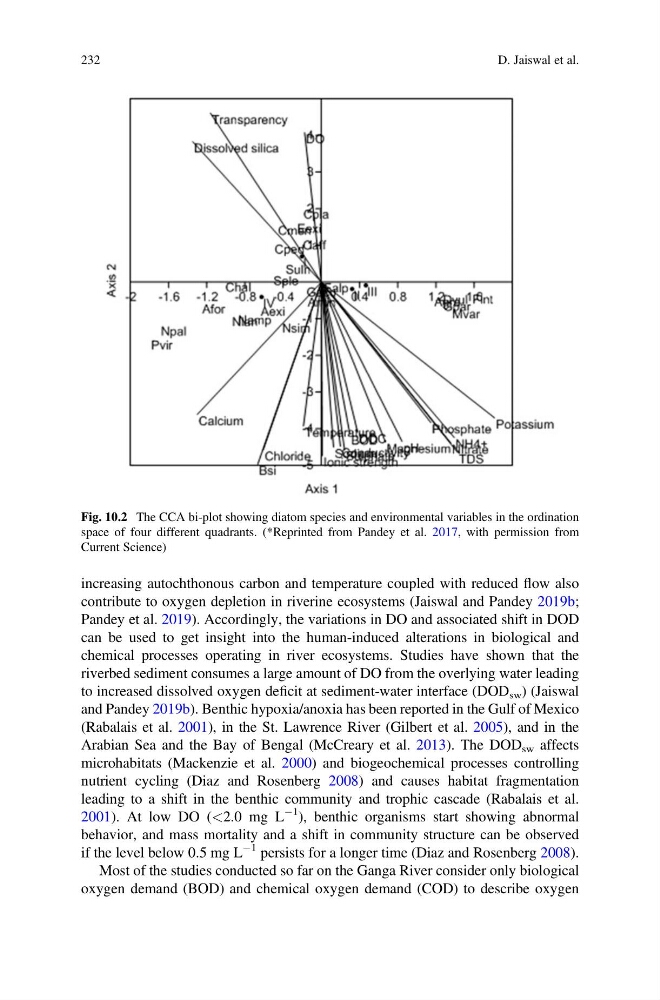
Fig. 10.2 The CCA bi-plot showing diatom species and environmental variables in the ordination
space of four different quadrants. (*Reprinted from Pandey et al. 2017, with permission from
Current Science)
232
D. Jaiswal et al.
contribute to oxygen depletion in riverine ecosystems (Jaiswal and Pandey 2019b;
Pandey et al. 2019). Accordingly, the variations in DO and associated shift in DOD
can be used to get insight into the human-induced alterations in biological and
chemical processes operating in river ecosystems. Studies have shown that the
riverbed sediment consumes a large amount of DO from the overlying water leading
to increased dissolved oxygen deficit at sediment-water interface (DOD sw ) (Jaiswal
and Pandey 2019b). Benthic hypoxia/anoxia has been reported in the Gulf of Mexico
(Rabalais et al. 2001), in the St. Lawrence River (Gilbert et al. 2005), and in the
Arabian Sea and the Bay of Bengal (McCreary et al. 2013). The DOD sw affects
microhabitats (Mackenzie et al. 2000) and biogeochemical processes controlling
nutrient cycling (Diaz and Rosenberg 2008) and causes habitat fragmentation
leading to a shift in the benthic community and trophic cascade (Rabalais et al.
2001). At low DO (<2.0 mg L
À1 ), benthic organisms start showing abnormal
behavior, and mass mortality and a shift in community structure can be observed
if the level below 0.5 mg L
À1 persists for a longer time (Diaz and Rosenberg 2008).
Most of the studies conducted so far on the Ganga River consider only biological
oxygen demand (BOD) and chemical oxygen demand (COD) to describe oxygen
Fig. 10.2 The CCA bi-plot showing diatom species and environmental variables in the ordination
space of four different quadrants. (*Reprinted from Pandey et al. 2017, with permission from
Current Science)
232
D. Jaiswal et al.