

(2007) have reported high growth of Achnanthidium in polluted water including
those affected by acid mine drainage. Similarly, studies have reported high growth of
Surirella, Amphipleura, and Craticula at sites affected with urban discharge and are
known to be tolerant to high concentration of nutrients (Muscio 2002). Studies on
heavy metal-diatom responses are limited. Species such as Nitzschia has been shown
to grow under metal contamination if coupled with nutrient-rich condition (Trobajo
et al. 2013).
10.4 Dissolved Oxygen Deficit and Ecosystem Feedbacks
One of the most general ways of aquatic ecosystems to respond to increasing
anthropogenic perturbations is the reduction in dissolved oxygen (DO) level. Development of hypoxic/anoxic zones in aquatic ecosystems is among the most widespread and deleterious effects of anthropogenic influences on global scale (Diaz and
Rosenberg 2008). High input of oxygen-demanding substances (ODS) increases the
rate of decomposition to an extent greater than the rate of oxygen supply (Rabalais
et al. 2010) leading to dissolved oxygen deficit (DOD) in the system. Besides this,
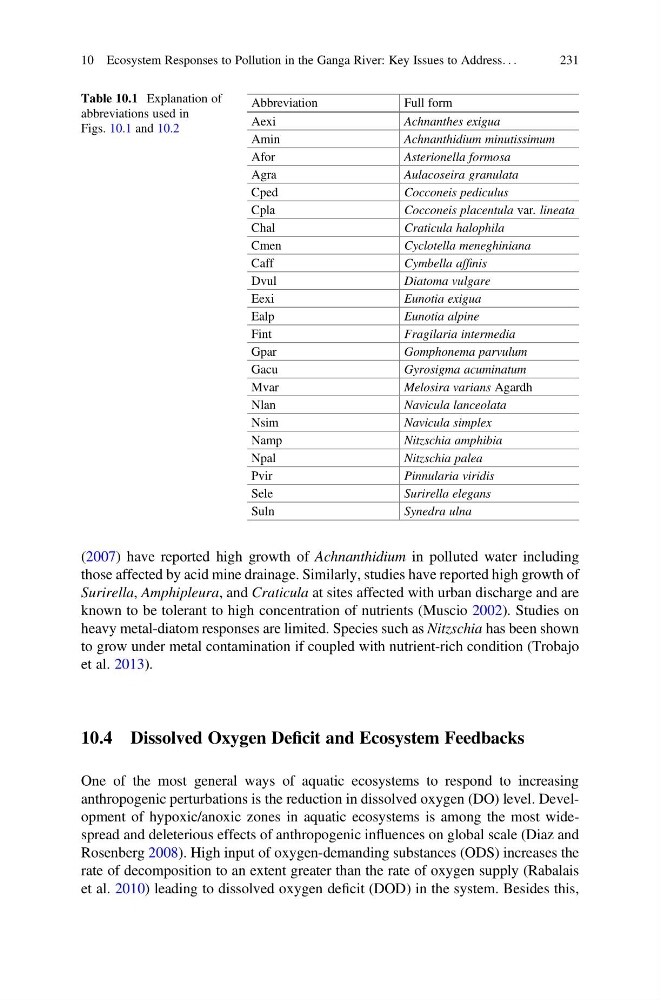
Table 10.1 Explanation of
abbreviations used in
Figs. 10.1 and 10.2
Abbreviation
Full form
Aexi
Achnanthes exigua
Amin
Achnanthidium minutissimum
Afor
Asterionella formosa
Agra
Aulacoseira granulata
Cped
Cocconeis pediculus
Cpla
Cocconeis placentula var. lineata
Chal
Craticula halophila
Cmen
Cyclotella meneghiniana
Caff
Cymbella affinis
Dvul
Diatoma vulgare
Eexi
Eunotia exigua
Ealp
Eunotia alpine
Fint
Fragilaria intermedia
Gpar
Gomphonema parvulum
Gacu
Gyrosigma acuminatum
Mvar
Melosira varians Agardh
Nlan
Navicula lanceolata
Nsim
Navicula simplex
Namp
Nitzschia amphibia
Npal
Nitzschia palea
Pvir
Pinnularia viridis
Sele
Surirella elegans
Suln
Synedra ulna
10 Ecosystem Responses to Pollution in the Ganga River: Key Issues to Address. . .
231
those affected by acid mine drainage. Similarly, studies have reported high growth of
Surirella, Amphipleura, and Craticula at sites affected with urban discharge and are
known to be tolerant to high concentration of nutrients (Muscio 2002). Studies on
heavy metal-diatom responses are limited. Species such as Nitzschia has been shown
to grow under metal contamination if coupled with nutrient-rich condition (Trobajo
et al. 2013).
10.4 Dissolved Oxygen Deficit and Ecosystem Feedbacks
One of the most general ways of aquatic ecosystems to respond to increasing
anthropogenic perturbations is the reduction in dissolved oxygen (DO) level. Development of hypoxic/anoxic zones in aquatic ecosystems is among the most widespread and deleterious effects of anthropogenic influences on global scale (Diaz and
Rosenberg 2008). High input of oxygen-demanding substances (ODS) increases the
rate of decomposition to an extent greater than the rate of oxygen supply (Rabalais
et al. 2010) leading to dissolved oxygen deficit (DOD) in the system. Besides this,
Table 10.1 Explanation of
abbreviations used in
Figs. 10.1 and 10.2
Abbreviation
Full form
Aexi
Achnanthes exigua
Amin
Achnanthidium minutissimum
Afor
Asterionella formosa
Agra
Aulacoseira granulata
Cped
Cocconeis pediculus
Cpla
Cocconeis placentula var. lineata
Chal
Craticula halophila
Cmen
Cyclotella meneghiniana
Caff
Cymbella affinis
Dvul
Diatoma vulgare
Eexi
Eunotia exigua
Ealp
Eunotia alpine
Fint
Fragilaria intermedia
Gpar
Gomphonema parvulum
Gacu
Gyrosigma acuminatum
Mvar
Melosira varians Agardh
Nlan
Navicula lanceolata
Nsim
Navicula simplex
Namp
Nitzschia amphibia
Npal
Nitzschia palea
Pvir
Pinnularia viridis
Sele
Surirella elegans
Suln
Synedra ulna
10 Ecosystem Responses to Pollution in the Ganga River: Key Issues to Address. . .
231