

Many of the agricultural residues include rice husk, peels, wheat waste, and
bagasses and are commonly used to remove heavy metals from soil. Using agricultural residues in metal immobilization and other uses is strongly encouraged in order
to reduce the rate of air pollution and for sustainable agriculture.
Rice husk, sawdust, coconut husk, and other agricultural residues are used for
extracting the metal ion from metal-contaminated system. They have several reasons
to be good adsorption materials for reducing availability of heavy metals such as low
cost, easy to avail, can be reused, easy to separate, and high adsorption capacities
with high removal efficiency (Aydin and Aksoy 2009). In recent years, the use of
agricultural residues to remove toxic heavy metals has increased to a great extent.
8.5.1 Use of Rice Husk
Rice husk is produced in large quantities as a by-product in rice milling industry. It
consists of 35% cellulose, 25% hemicelluloses, 20% lignin, 17% ash (including
silica), and 3% crude protein.
These compounds are associated with many chelating ligands and functional
groups that help in the fixation of metal ions. The ash produced by the burning of
rice husk can also be used as a good adsorptive material and has been reported for the
removal of metal ions (Srivastava et al. 2006). Tawwab et al. (2017) have applied
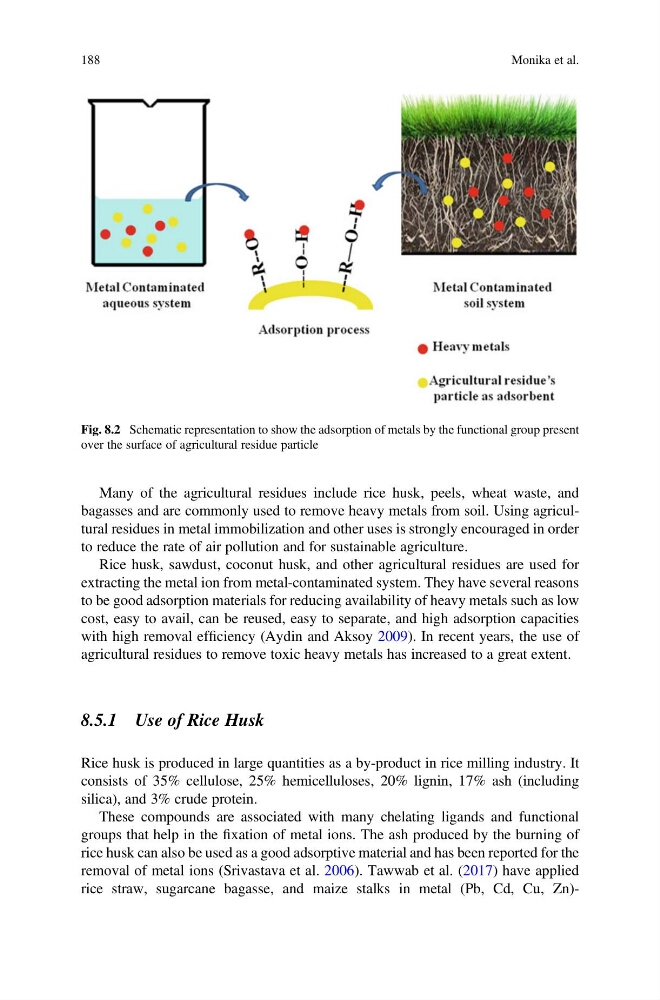
rice straw, sugarcane bagasse, and maize stalks in metal (Pb, Cd, Cu, Zn)Fig. 8.2 Schematic representation to show the adsorption of metals by the functional group present
over the surface of agricultural residue particle
188
Monika et al.
bagasses and are commonly used to remove heavy metals from soil. Using agricultural residues in metal immobilization and other uses is strongly encouraged in order
to reduce the rate of air pollution and for sustainable agriculture.
Rice husk, sawdust, coconut husk, and other agricultural residues are used for
extracting the metal ion from metal-contaminated system. They have several reasons
to be good adsorption materials for reducing availability of heavy metals such as low
cost, easy to avail, can be reused, easy to separate, and high adsorption capacities
with high removal efficiency (Aydin and Aksoy 2009). In recent years, the use of
agricultural residues to remove toxic heavy metals has increased to a great extent.
8.5.1 Use of Rice Husk
Rice husk is produced in large quantities as a by-product in rice milling industry. It
consists of 35% cellulose, 25% hemicelluloses, 20% lignin, 17% ash (including
silica), and 3% crude protein.
These compounds are associated with many chelating ligands and functional
groups that help in the fixation of metal ions. The ash produced by the burning of
rice husk can also be used as a good adsorptive material and has been reported for the
removal of metal ions (Srivastava et al. 2006). Tawwab et al. (2017) have applied
rice straw, sugarcane bagasse, and maize stalks in metal (Pb, Cd, Cu, Zn)Fig. 8.2 Schematic representation to show the adsorption of metals by the functional group present
over the surface of agricultural residue particle
188
Monika et al.