

6.5.2.2 Fungal Biodegradation
The fungal communities play an important role as a biological agent in degradation
of toxicants from wastewater. Fungi can grow at a higher rate, produce much tolerant
spores, enzymes, and have capability to degrade toxicants and they are ecologically
safe in nature (Williams et al. 2003; Uniyal et al. 2019). Most of the fungal species
commonly grow in soil, root, and foliar parts of plants, partially decomposed organic
materials. It has high resistance capacity against potential toxic compounds such as
heavy metals, emerging contaminants, pathogens as well as antibiotics. Different
types of fungi like basidiomycetes and ascomycetes have been used in decolorization of natural and synthetic melanoidins from distillery wastewater and at the same
time also generate fungal protein-enriched biomass for animal feed as a valuable
product (Pant and Adholeya 2007).
Arikan et al. (2019) reported the contaminant removal capacity of two filamentous fungal species namely, Aspergillus carbonarius M333 and Penicillium glabrum
Pg1 immobilized in macroporous polymeric support from textile wastewater. They
studied the removal efficiency of color and chemical oxygen demand (COD) tested
in two set up, i.e., batch experiments and continuously operated upflow packed bed
bioreactor. The optimized pH was found 5.5 (4.5 to 6.0) for its higher removal
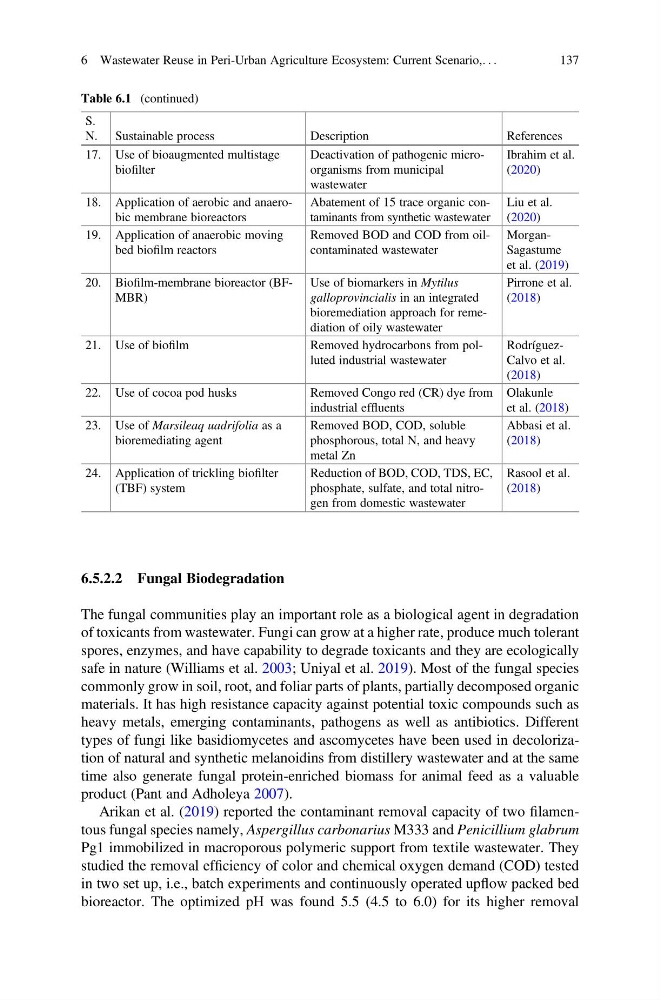
Table 6.1 (continued)
S.
N. Sustainable process
Description
References
17. Use of bioaugmented multistage
biofilter
Deactivation of pathogenic microorganisms from municipal
wastewater
Ibrahim et al.
(2020)
18. Application of aerobic and anaerobic membrane bioreactors
Abatement of 15 trace organic contaminants from synthetic wastewater
Liu et al.
(2020)
19. Application of anaerobic moving
bed biofilm reactors
Removed BOD and COD from oilcontaminated wastewater
MorganSagastume
et al. (2019)
20. Biofilm-membrane bioreactor (BFMBR)
Use of biomarkers in Mytilus
galloprovincialis in an integrated
bioremediation approach for remediation of oily wastewater
Pirrone et al.
(2018)
21. Use of biofilm
Removed hydrocarbons from polluted industrial wastewater
RodríguezCalvo et al.
(2018)
22. Use of cocoa pod husks
Removed Congo red (CR) dye from
industrial effluents
Olakunle
et al. (2018)
23. Use of Marsileaq uadrifolia as a
bioremediating agent
Removed BOD, COD, soluble
phosphorous, total N, and heavy
metal Zn
Abbasi et al.
(2018)
24. Application of trickling biofilter
(TBF) system
Reduction of BOD, COD, TDS, EC,
phosphate, sulfate, and total nitrogen from domestic wastewater
Rasool et al.
(2018)
6 Wastewater Reuse in Peri-Urban Agriculture Ecosystem: Current Scenario,. . .
137
The fungal communities play an important role as a biological agent in degradation
of toxicants from wastewater. Fungi can grow at a higher rate, produce much tolerant
spores, enzymes, and have capability to degrade toxicants and they are ecologically
safe in nature (Williams et al. 2003; Uniyal et al. 2019). Most of the fungal species
commonly grow in soil, root, and foliar parts of plants, partially decomposed organic
materials. It has high resistance capacity against potential toxic compounds such as
heavy metals, emerging contaminants, pathogens as well as antibiotics. Different
types of fungi like basidiomycetes and ascomycetes have been used in decolorization of natural and synthetic melanoidins from distillery wastewater and at the same
time also generate fungal protein-enriched biomass for animal feed as a valuable
product (Pant and Adholeya 2007).
Arikan et al. (2019) reported the contaminant removal capacity of two filamentous fungal species namely, Aspergillus carbonarius M333 and Penicillium glabrum
Pg1 immobilized in macroporous polymeric support from textile wastewater. They
studied the removal efficiency of color and chemical oxygen demand (COD) tested
in two set up, i.e., batch experiments and continuously operated upflow packed bed
bioreactor. The optimized pH was found 5.5 (4.5 to 6.0) for its higher removal
Table 6.1 (continued)
S.
N. Sustainable process
Description
References
17. Use of bioaugmented multistage
biofilter
Deactivation of pathogenic microorganisms from municipal
wastewater
Ibrahim et al.
(2020)
18. Application of aerobic and anaerobic membrane bioreactors
Abatement of 15 trace organic contaminants from synthetic wastewater
Liu et al.
(2020)
19. Application of anaerobic moving
bed biofilm reactors
Removed BOD and COD from oilcontaminated wastewater
MorganSagastume
et al. (2019)
20. Biofilm-membrane bioreactor (BFMBR)
Use of biomarkers in Mytilus
galloprovincialis in an integrated
bioremediation approach for remediation of oily wastewater
Pirrone et al.
(2018)
21. Use of biofilm
Removed hydrocarbons from polluted industrial wastewater
RodríguezCalvo et al.
(2018)
22. Use of cocoa pod husks
Removed Congo red (CR) dye from
industrial effluents
Olakunle
et al. (2018)
23. Use of Marsileaq uadrifolia as a
bioremediating agent
Removed BOD, COD, soluble
phosphorous, total N, and heavy
metal Zn
Abbasi et al.
(2018)
24. Application of trickling biofilter
(TBF) system
Reduction of BOD, COD, TDS, EC,
phosphate, sulfate, and total nitrogen from domestic wastewater
Rasool et al.
(2018)
6 Wastewater Reuse in Peri-Urban Agriculture Ecosystem: Current Scenario,. . .
137