

66
3.4.2 Neurotoxic Effect
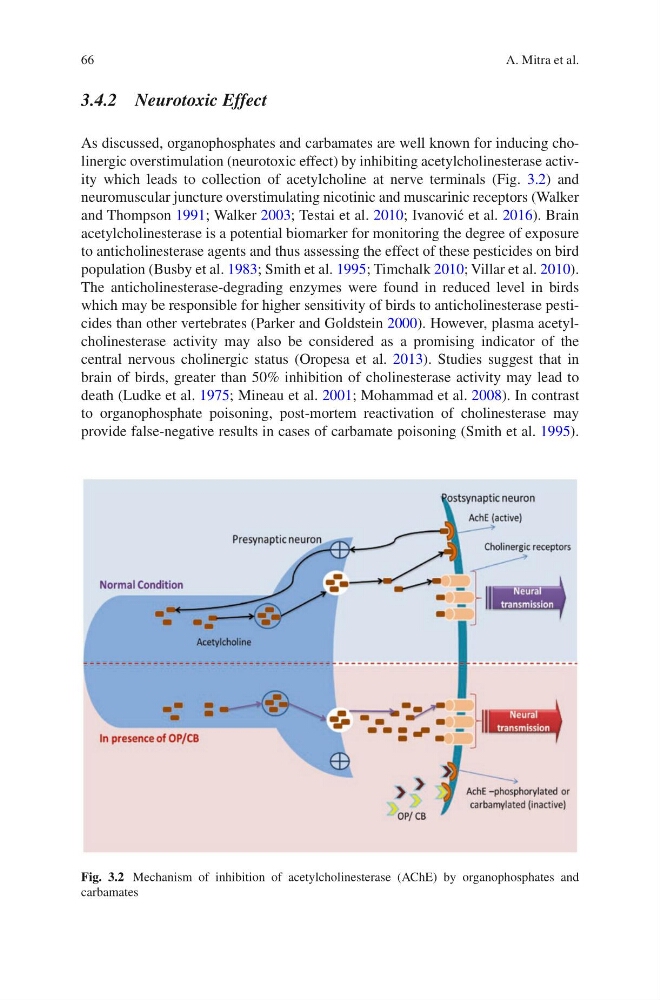
As discussed, organophosphates and carbamates are well known for inducing cholinergic overstimulation (neurotoxic effect) by inhibiting acetylcholinesterase activity which leads to collection of acetylcholine at nerve terminals (Fig. 3.2) and
neuromuscular juncture overstimulating nicotinic and muscarinic receptors (Walker
and Thompson 1991; Walker 2003; Testai et al. 2010; Ivanović et al. 2016). Brain
acetylcholinesterase is a potential biomarker for monitoring the degree of exposure
to anticholinesterase agents and thus assessing the effect of these pesticides on bird
population (Busby et al. 1983; Smith et al. 1995; Timchalk 2010; Villar et al. 2010).
The anticholinesterase-degrading enzymes were found in reduced level in birds
which may be responsible for higher sensitivity of birds to anticholinesterase pesticides than other vertebrates (Parker and Goldstein 2000). However, plasma acetylcholinesterase activity may also be considered as a promising indicator of the
central nervous cholinergic status (Oropesa et al. 2013). Studies suggest that in
brain of birds, greater than 50% inhibition of cholinesterase activity may lead to
death (Ludke et al. 1975; Mineau et al. 2001; Mohammad et al. 2008). In contrast
to organophosphate poisoning, post-mortem reactivation of cholinesterase may
provide false-negative results in cases of carbamate poisoning (Smith et al. 1995).
Fig. 3.2 Mechanism of inhibition of acetylcholinesterase (AChE) by organophosphates and
carbamates
A. Mitra et al.
3.4.2 Neurotoxic Effect
As discussed, organophosphates and carbamates are well known for inducing cholinergic overstimulation (neurotoxic effect) by inhibiting acetylcholinesterase activity which leads to collection of acetylcholine at nerve terminals (Fig. 3.2) and
neuromuscular juncture overstimulating nicotinic and muscarinic receptors (Walker
and Thompson 1991; Walker 2003; Testai et al. 2010; Ivanović et al. 2016). Brain
acetylcholinesterase is a potential biomarker for monitoring the degree of exposure
to anticholinesterase agents and thus assessing the effect of these pesticides on bird
population (Busby et al. 1983; Smith et al. 1995; Timchalk 2010; Villar et al. 2010).
The anticholinesterase-degrading enzymes were found in reduced level in birds
which may be responsible for higher sensitivity of birds to anticholinesterase pesticides than other vertebrates (Parker and Goldstein 2000). However, plasma acetylcholinesterase activity may also be considered as a promising indicator of the
central nervous cholinergic status (Oropesa et al. 2013). Studies suggest that in
brain of birds, greater than 50% inhibition of cholinesterase activity may lead to
death (Ludke et al. 1975; Mineau et al. 2001; Mohammad et al. 2008). In contrast
to organophosphate poisoning, post-mortem reactivation of cholinesterase may
provide false-negative results in cases of carbamate poisoning (Smith et al. 1995).
Fig. 3.2 Mechanism of inhibition of acetylcholinesterase (AChE) by organophosphates and
carbamates
A. Mitra et al.