

21
1.8 Recent Drifts in Microbial Degradation Research
Research on plastic biodegradation is going from half a century, while root information about plastic mineralization and utilization by microorganisms is beyond the
wall. The standard design and knowledge about biochemical routes for whole-cell
biocatalysis can provide a visionary model of new dimensions for engineering
microbes for better bioremediation prospects. Continuous development in research
technology has provided an endless opportunity to endure and uncover veiled facts
(Kawai et al. 2019).
Few concomitant queries for the plastic utilizing ability of microbes, their interaction with the hydrophobic surface of the substrate, to endure and grow in diverse
environmental conditions are still unclear. Technological and conceptual advancement will drive a transitional bottleneck to new insights in the bioremediation field.
Today, the era of genomics and metabolomics techniques is playing a significant
role in resolving many research mysteries in the broad sector of science. It can also
uncover the wider opportunities for the exploitation of microbes that represent an
important asset for maintaining a sustainable environment. Emerging genomic and
high-throughput metabolomic technologies are the way out solution to study the
whole microbial system for their bioremediation potential. The availability of rich
bioinformatics databases and existing computational tools enables new insights to
aid in data mining and pathway prediction (Dvořák et al. 2017; de Lorenzo 2018).
The challenge ahead is to identify the pathways which are expressed in different
environmental conditions (Kujawinski 2011). Genomic evidence provides a schematic overview of all possible metabolic pathways in individual microorganisms or
in complex consortia (Guo et al. 2017). The RNA expression (transcriptomics),
metabolic (metabolomic), and protein (proteomic) profiling, the so-called omic
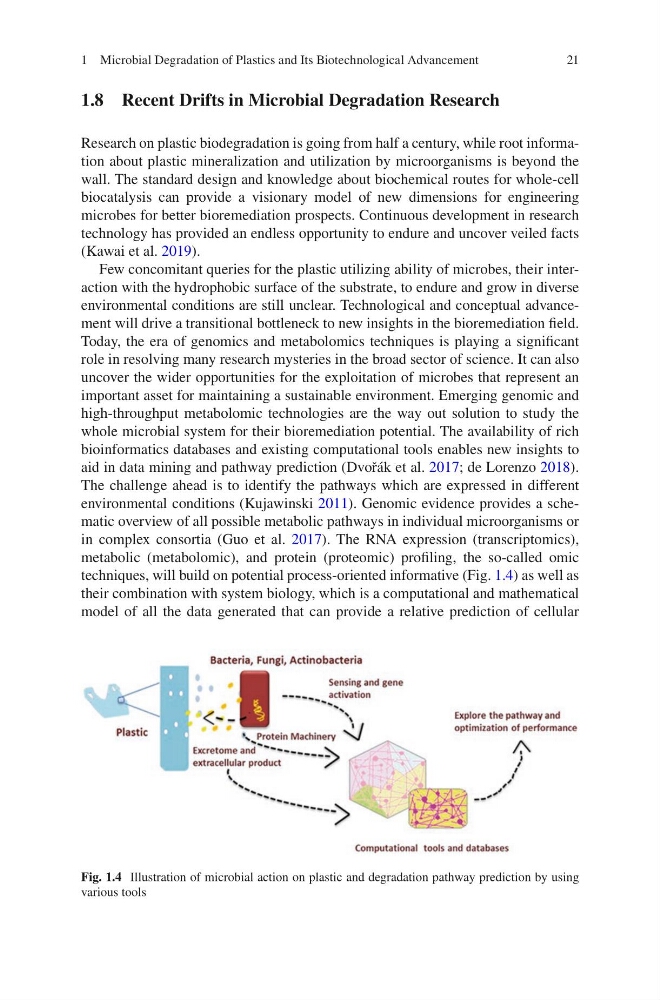
techniques, will build on potential process-oriented informative (Fig. 1.4) as well as
their combination with system biology, which is a computational and mathematical
model of all the data generated that can provide a relative prediction of cellular
Fig. 1.4 Illustration of microbial action on plastic and degradation pathway prediction by using
various tools
1 Microbial Degradation of Plastics and Its Biotechnological Advancement
1.8 Recent Drifts in Microbial Degradation Research
Research on plastic biodegradation is going from half a century, while root information about plastic mineralization and utilization by microorganisms is beyond the
wall. The standard design and knowledge about biochemical routes for whole-cell
biocatalysis can provide a visionary model of new dimensions for engineering
microbes for better bioremediation prospects. Continuous development in research
technology has provided an endless opportunity to endure and uncover veiled facts
(Kawai et al. 2019).
Few concomitant queries for the plastic utilizing ability of microbes, their interaction with the hydrophobic surface of the substrate, to endure and grow in diverse
environmental conditions are still unclear. Technological and conceptual advancement will drive a transitional bottleneck to new insights in the bioremediation field.
Today, the era of genomics and metabolomics techniques is playing a significant
role in resolving many research mysteries in the broad sector of science. It can also
uncover the wider opportunities for the exploitation of microbes that represent an
important asset for maintaining a sustainable environment. Emerging genomic and
high-throughput metabolomic technologies are the way out solution to study the
whole microbial system for their bioremediation potential. The availability of rich
bioinformatics databases and existing computational tools enables new insights to
aid in data mining and pathway prediction (Dvořák et al. 2017; de Lorenzo 2018).
The challenge ahead is to identify the pathways which are expressed in different
environmental conditions (Kujawinski 2011). Genomic evidence provides a schematic overview of all possible metabolic pathways in individual microorganisms or
in complex consortia (Guo et al. 2017). The RNA expression (transcriptomics),
metabolic (metabolomic), and protein (proteomic) profiling, the so-called omic
techniques, will build on potential process-oriented informative (Fig. 1.4) as well as
their combination with system biology, which is a computational and mathematical
model of all the data generated that can provide a relative prediction of cellular
Fig. 1.4 Illustration of microbial action on plastic and degradation pathway prediction by using
various tools
1 Microbial Degradation of Plastics and Its Biotechnological Advancement