

20
(Luckachan and Pillai 2011; Sudesh 2013; Murariu and Dubois 2016). Bio-based
plastics have been more promoted in the preceding years by the public due to environmental sustainability, climate change, and the exhaustion of fossil fuels (Shen
et al. 2010). In general, polymers derived from biological sources are considered to
be capable of breaking down into nontoxic and entering the biogeochemical cycling
of ecosystems after a certain period. Different strategies have been applied for producing bio-based plastics such as the bacterial product polyhydroxyalkanoate, polymeric blends with lipids and polysaccharides, using agricultural feedstock for
producing polyhydroxyalkanoate, and use of biofuel instead of conventional petroleum fraction for polymer synthesis (Ramírez et al. 2017; Kalia et al. 2015).
Polyhydroxyalkanoate is a well-known biodegradable polymer that is produced
from bacteria. Moreover, many research on polyhydroxyalkanoate production is
going on to reduce the production cost through application of genetically modified
bacterial strains or by incorporating polyhydroxyalkanoate producing gene in plants
for more yield and production (Pagliano et al. 2017; Lee et al. 2011). Reddy and
Yang (2011) developed a biodegradable composite of soyprotein-jute biocomposites. Several parameters have been reported to influence the degradation behavior of
biodegradable polymers; the most important factors are moisture sensitivity and
stability, which is also a limitation to broad applications (Farah et al. 2016).
Still the limited application and high production cost of biopolymers are making
unsatisfactory to compete with synthetic plastics and not getting much attention in
the market. Other approaches are also in trial, such as blending of natural materials
like starch, protein, lactic acid, cellulose, or collagen with conventional one which
will provide stability to the material and more application opportunities as well as
enhanced degradation rates (Leja and Lewandowicz 2010; Luckachan and Pillai
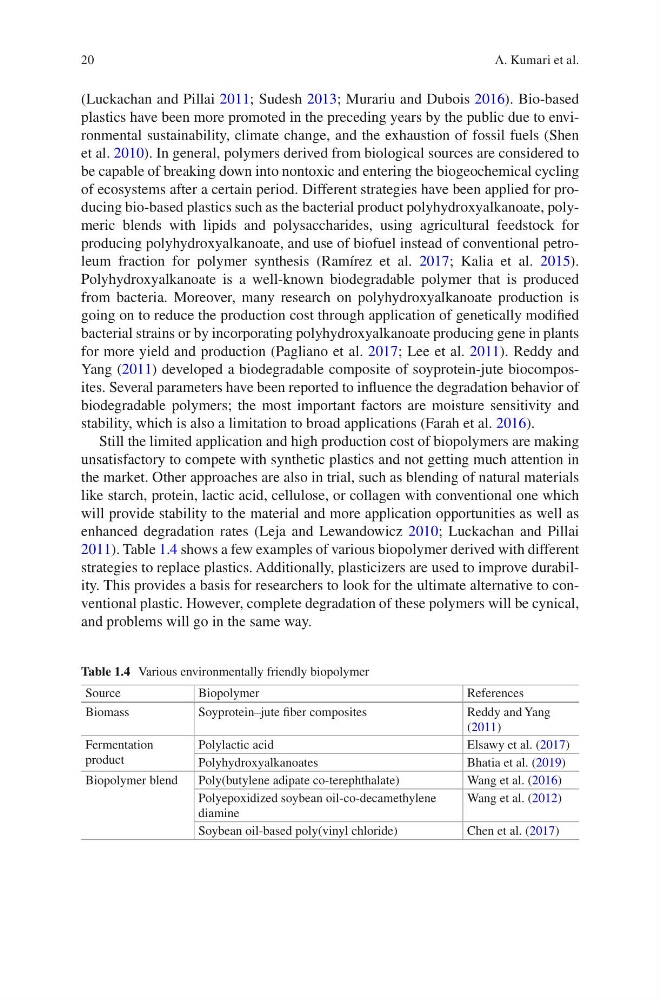
2011). Table 1.4 shows a few examples of various biopolymer derived with different
strategies to replace plastics. Additionally, plasticizers are used to improve durability. This provides a basis for researchers to look for the ultimate alternative to conventional plastic. However, complete degradation of these polymers will be cynical,
and problems will go in the same way.
Table 1.4 Various environmentally friendly biopolymer
Source
Biopolymer
References
Biomass
Soyprotein–jute fiber composites
Reddy and Yang
(2011)
Fermentation
product
Polylactic acid
Elsawy et al. (2017)
Polyhydroxyalkanoates
Bhatia et al. (2019)
Biopolymer blend
Poly(butylene adipate co-terephthalate)
Wang et al. (2016)
Polyepoxidized soybean oil-co-decamethylene
diamine
Wang et al. (2012)
Soybean oil-based poly(vinyl chloride)
Chen et al. (2017)
A. Kumari et al.
(Luckachan and Pillai 2011; Sudesh 2013; Murariu and Dubois 2016). Bio-based
plastics have been more promoted in the preceding years by the public due to environmental sustainability, climate change, and the exhaustion of fossil fuels (Shen
et al. 2010). In general, polymers derived from biological sources are considered to
be capable of breaking down into nontoxic and entering the biogeochemical cycling
of ecosystems after a certain period. Different strategies have been applied for producing bio-based plastics such as the bacterial product polyhydroxyalkanoate, polymeric blends with lipids and polysaccharides, using agricultural feedstock for
producing polyhydroxyalkanoate, and use of biofuel instead of conventional petroleum fraction for polymer synthesis (Ramírez et al. 2017; Kalia et al. 2015).
Polyhydroxyalkanoate is a well-known biodegradable polymer that is produced
from bacteria. Moreover, many research on polyhydroxyalkanoate production is
going on to reduce the production cost through application of genetically modified
bacterial strains or by incorporating polyhydroxyalkanoate producing gene in plants
for more yield and production (Pagliano et al. 2017; Lee et al. 2011). Reddy and
Yang (2011) developed a biodegradable composite of soyprotein-jute biocomposites. Several parameters have been reported to influence the degradation behavior of
biodegradable polymers; the most important factors are moisture sensitivity and
stability, which is also a limitation to broad applications (Farah et al. 2016).
Still the limited application and high production cost of biopolymers are making
unsatisfactory to compete with synthetic plastics and not getting much attention in
the market. Other approaches are also in trial, such as blending of natural materials
like starch, protein, lactic acid, cellulose, or collagen with conventional one which
will provide stability to the material and more application opportunities as well as
enhanced degradation rates (Leja and Lewandowicz 2010; Luckachan and Pillai
2011). Table 1.4 shows a few examples of various biopolymer derived with different
strategies to replace plastics. Additionally, plasticizers are used to improve durability. This provides a basis for researchers to look for the ultimate alternative to conventional plastic. However, complete degradation of these polymers will be cynical,
and problems will go in the same way.
Table 1.4 Various environmentally friendly biopolymer
Source
Biopolymer
References
Biomass
Soyprotein–jute fiber composites
Reddy and Yang
(2011)
Fermentation
product
Polylactic acid
Elsawy et al. (2017)
Polyhydroxyalkanoates
Bhatia et al. (2019)
Biopolymer blend
Poly(butylene adipate co-terephthalate)
Wang et al. (2016)
Polyepoxidized soybean oil-co-decamethylene
diamine
Wang et al. (2012)
Soybean oil-based poly(vinyl chloride)
Chen et al. (2017)
A. Kumari et al.